


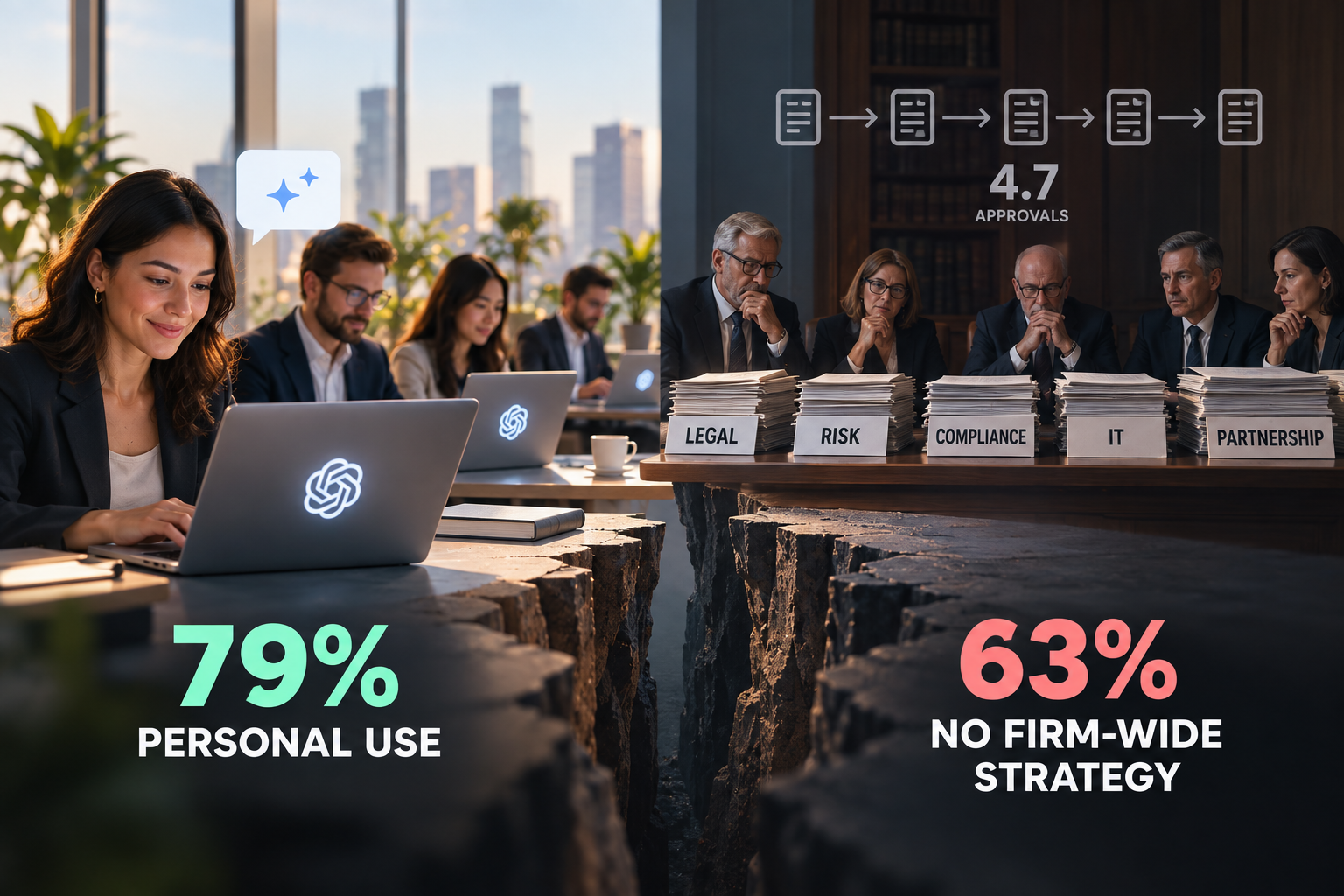
If you asked a managing partner at a law firm whether their organization has "adopted AI," you'd probably get a confident yes. If you actually looked at how that adoption happened, you'd find something messier — and more useful to understand than the headline number suggests.
Here's the split: 79% of legal professionals now personally use AI tools in their work, up sharply from just 19% in 2023. That's a genuinely fast individual shift. But at the same time, 63% of professional services partnerships have no firm-wide AI strategy at all. The average partnership needs 4.7 committee approvals to greenlight a firm-wide AI tool, compared to just 1.2 in corporate legal departments.
Read those two numbers side by side and a very specific pattern emerges: professional services isn't behind on AI adoption. It's behind on AI governance. Those are different problems, and they require different fixes.
Individual adoption is easy. Firm-wide strategy is hard.
This split makes sense once you think about what each number actually measures. An individual lawyer, consultant, or accountant deciding to use an AI tool for drafting, research, or first-pass analysis requires exactly one person's decision. There's no procurement process, no partnership vote, no committee sign-off — they open a tool and start using it, the same way anyone might adopt a new productivity app.
A firm-wide AI strategy is an entirely different kind of decision. It touches client confidentiality obligations, malpractice exposure, billing structures built around human hours, and partnership governance that, in many firms, wasn't designed to move quickly on anything. The 4.7-committee-approval figure isn't dysfunction for its own sake — a lot of it reflects genuine, defensible caution about client data, professional liability, and ethical obligations that don't apply the same way in most industries adopting AI tools.
So you end up with a profession where the individual professional has moved fast and the institution has moved slowly — and both decisions are, in their own context, rational.
Why this gap matters more than the headline number
This is a specific, useful example of a broader pattern in 2026 AI adoption data: research compiled across McKinsey's global survey found 88% of organizations report using AI somewhere in the business, but only 39% can point to a measurable earnings impact. The gap concentrates exactly where individual tool usage has to become organizational workflow change — and professional services shows that gap in an unusually clean, measurable way, because the individual and institutional numbers are being tracked separately.
For a firm's leadership, this split has a direct practical implication: the "are we behind on AI" question is close to meaningless without specifying which layer you're asking about. A firm at high individual adoption but zero firm-wide strategy is not behind its people — its people are already ahead of it. What it's actually missing is the governance layer that turns scattered, ungoverned individual use into something the firm can actually stand behind: consistent standards for what's appropriate to run through an AI tool, clarity on client confidentiality boundaries, and a strategy that doesn't depend on which associate happens to be tech-savvy.
What closing the gap actually requires
Firms that are closing this gap faster than the 4.7-committee average tend to do a few things differently:
They separate "should we use AI at all" from "how do we govern it." The first question is largely already answered — individual professionals have voted with their usage. The real work is the second question: setting standards, not permission.
They build policy around actual use cases already happening, not hypothetical ones. Rather than starting from a blank-slate AI strategy document, effective firms look at what associates and staff are already doing informally and build governance around the real patterns, which moves faster than trying to anticipate every use case from scratch.
They separate low-risk and high-risk use cases explicitly. Using AI to summarize a lengthy discovery document carries different risk than using it to draft client-facing legal advice. Firms that treat every use case with the same level of committee scrutiny end up either over-restricting the low-risk work or under-scrutinizing the high-risk work. Neither is good.
The bigger lesson beyond legal and professional services
This individual-vs-institutional gap isn't unique to law firms — it shows up, in different proportions, across most industries currently reporting AI adoption numbers. The useful benchmark for any organization isn't "what percentage of our industry uses AI." It's a more specific set of questions: does an AI initiative have a named owner with real authority, a metric it's actually supposed to move, and has the surrounding workflow — not just individual habits — genuinely changed as a result?
Globaldev has published a full breakdown of 2026 AI adoption data across industries, including where the professional services numbers above come from and how to benchmark your own organization's progress against a framework that doesn't depend on which survey happened to land in your inbox. Worth reading in full if you're trying to figure out whether your firm's AI story is actually further along than the headline number suggests — or further behind.


Machine Learning is a Form of AI that Enables a System to Learn from Data.
Leverage Big Data & Understand Subtle Changes in Behavior with Oodles AI Machine Learning.
Oodle AI is one of the top AI and machine learnig development company that covers multiple services for variors busiiness verticles like Insurance, Marketing, Healthcare, Banking, etc.Explore our more Artificial intelligence services