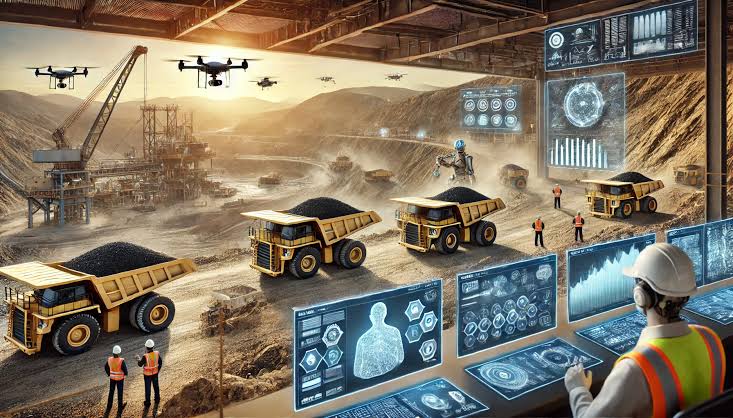
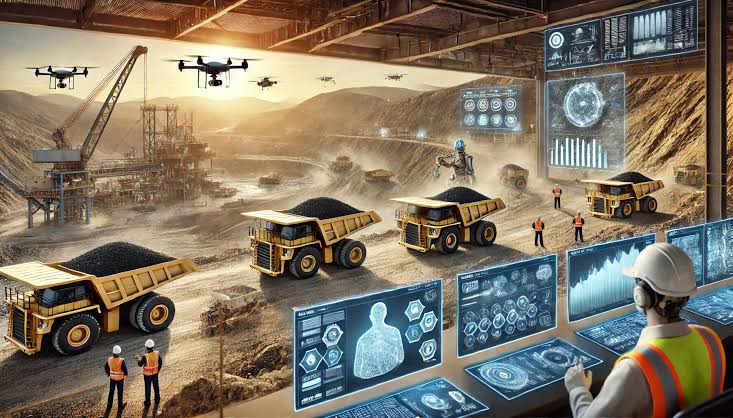
Geological research involves complex datasets, uncertain interpretations, and continuous experimentation. From historical geological maps and drillhole records to geochemical and geophysical data, researchers must evaluate multiple sources before developing reliable exploration hypotheses. Self improving AI could change this process by enabling AI systems to learn from their analytical results and progressively refine how they approach research problems.
1. Moving Beyond Static AI Models
Traditional AI systems are generally trained and evaluated before being deployed for specific tasks. Geological research, however, often produces new evidence that can change an investigation's direction.
Self-improving systems can incorporate feedback from previous analyses and experiments, allowing their approaches to evolve as new information becomes available.
2. Learning From Geological Evidence
A self-improving AI system can analyze geological maps, reports, drillhole information, assays, geophysical surveys, and other datasets to identify potentially relevant relationships.
When additional evidence becomes available, the system can evaluate its earlier conclusions and adjust subsequent analyses. This creates a more iterative approach to geological intelligence.
3. Generating and Testing Exploration Hypotheses
One of the most important opportunities is connecting AI reasoning with experimentation. An AI system could identify a potential geological relationship, formulate a hypothesis, test it against available data, and evaluate the result.
If the evidence does not support the hypothesis, the system can revise its approach and investigate alternative explanations.
4. Improving Geological Data Analysis
Exploration teams often spend considerable time preparing and organizing heterogeneous datasets. AI can assist with extracting information, cleaning data, identifying patterns, and connecting spatial relationships.
A self-improving system can potentially learn which analytical approaches produce useful results and prioritize them in subsequent research cycles.
5. Supporting 3D Subsurface Understanding
Geological exploration frequently requires understanding structures beneath the surface. Drillholes, lithology, geological boundaries, and geophysical observations can contribute to three-dimensional subsurface models.
AI can help analyze these datasets and compare alternative interpretations. Over repeated research cycles, feedback from new observations can help refine the model.
6. The Role of AI Companies for Mineral Exploration
The development of AI Companies for Mineral Exploration reflects growing interest in applying artificial intelligence to exploration workflows. These companies are working across areas such as prospectivity mapping, geophysical interpretation, geological modeling, remote sensing, and exploration data analysis.
Eigenform takes a research-oriented approach by applying AI agents to geological datasets and iterative experimentation. Its Geocluster environment provides tools for data inspection, cleaning, clustering, anomaly analysis, spatial analysis, and visualization.
7. Learning From Successful and Failed Experiments
A major advantage of iterative AI is the ability to learn from outcomes rather than only from successful predictions. Failed analyses can reveal incorrect assumptions, unsuitable methods, or weak relationships.
Capturing this information can help an AI system avoid repeating ineffective approaches and focus future experiments on more promising research directions.
8. Human Expertise Remains Essential
Self-improving AI does not remove the need for geologists. Geological interpretation involves field context, uncertainty, physical evidence, and professional judgment.
AI-generated hypotheses should therefore be evaluated using geological expertise and, where appropriate, field observations, sampling, laboratory analysis, and drilling.
9. The Future of AI-Driven Geological Research
The long-term potential of self improving AI lies in creating systems that can participate in repeated research cycles rather than simply producing one-time predictions.
Such systems could analyze geological evidence, generate hypotheses, conduct computational experiments, evaluate results, and refine their methods over time.
Conclusion
Self-improving AI could introduce a more iterative model of geological research, where data analysis, hypothesis generation, experimentation, and evaluation continuously inform one another. For AI Companies for Mineral Exploration, this approach could open new possibilities for working with complex geological datasets and exploring alternative interpretations.
Eigenform's focus on recursive experimentation and geological AI demonstrates how these concepts can be applied to real research workflows. The future of geological exploration may increasingly combine continuously improving AI systems with the expertise and validation of human scientists and geologists.
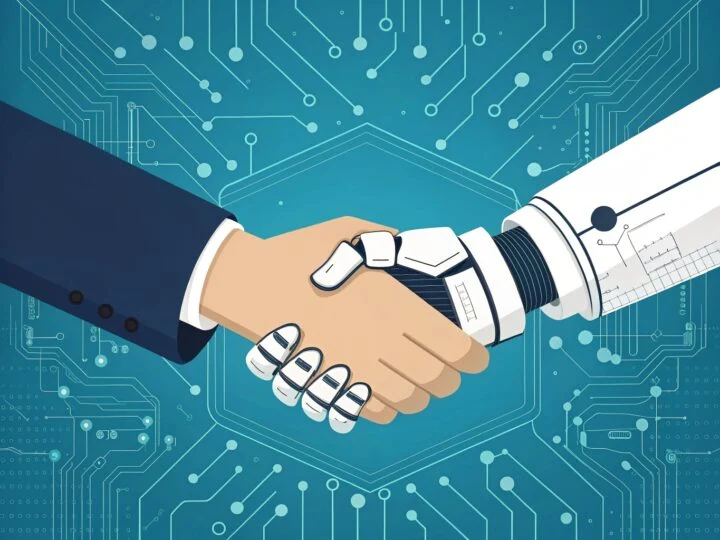

Machine Learning is a Form of AI that Enables a System to Learn from Data.
Leverage Big Data & Understand Subtle Changes in Behavior with Oodles AI Machine Learning.
Oodle AI is one of the top AI and machine learnig development company that covers multiple services for variors busiiness verticles like Insurance, Marketing, Healthcare, Banking, etc.Explore our more Artificial intelligence services