Geological exploration generates enormous amounts of maps, drillhole records, assays, geophysical measurements, satellite imagery, and historical reports. Traditionally, interpreting these datasets requires significant manual effort and specialized expertise. Autonomous AI agents could change this process by combining AI data analysis with iterative reasoning, tool use, and hypothesis testing.
1. Automating Complex Geological Workflows
Autonomous agents can move beyond answering individual questions. They can ingest datasets, inspect their structure, identify relevant information, perform analyses, and organize results into a repeatable workflow.
2. Connecting Multiple Data Sources
Geological intelligence often depends on relationships between different datasets. AI agents can combine geological maps, lithology, geochemistry, geophysics, and drilling information to identify spatial and statistical relationships that may otherwise remain difficult to detect.
3. Identifying Geological Patterns
Machine learning can help detect anomalies, clusters, correlations, and recurring geological features across large datasets. This allows exploration teams to investigate areas that may deserve closer geological attention.
4. Generating Exploration Hypotheses
Instead of simply identifying patterns, autonomous systems can generate competing explanations for those patterns. Each hypothesis can then be compared against available geological evidence, creating a more structured approach to exploration reasoning.
5. Supporting Spatial and Subsurface Analysis
AI agents can assist with geological mapping, spatial analysis, clustering, visualization, and subsurface modeling. Platforms such as Eigenform's Geocluster demonstrate how specialized tools can be incorporated into an agent-driven geological research environment.
6. Learning From Previous Results
A self-improving agent can potentially use the results of previous experiments to refine later analyses. When successful reasoning strategies or useful discoveries are identified, they can become valuable feedback for subsequent research workflows.
7. Keeping Experts in the Loop
Autonomous does not mean unsupervised. Geological interpretations still require expert review, field observations, sampling, drilling, and laboratory validation. AI is most valuable when it expands the amount of evidence geoscientists can evaluate rather than replacing professional judgment.
Conclusion
Autonomous AI agents could transform geological workflows by connecting data analysis, spatial reasoning, hypothesis generation, and iterative experimentation. With approaches centered on AI data analysis and the development of the self-improving agent, systems such as Eigenform can help explore large geological datasets more systematically while keeping scientific validation at the center of the process.
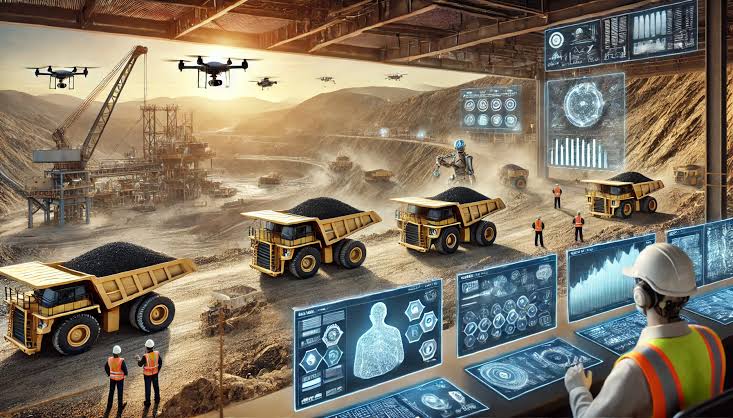
Geological research is becoming increasingly data-intensive. Exploration teams work with historical reports, geological maps, drillhole records, assays, geophysical surveys, and spatial datasets. A