


Many owners leave profits in their corporation and invest them. It is often a sensible thing to do. But once the investment income passes a certain level, it starts to reduce the corporation’s access to the small business deduction, and the effect can be larger than the investment income itself.
The small business deduction in one line
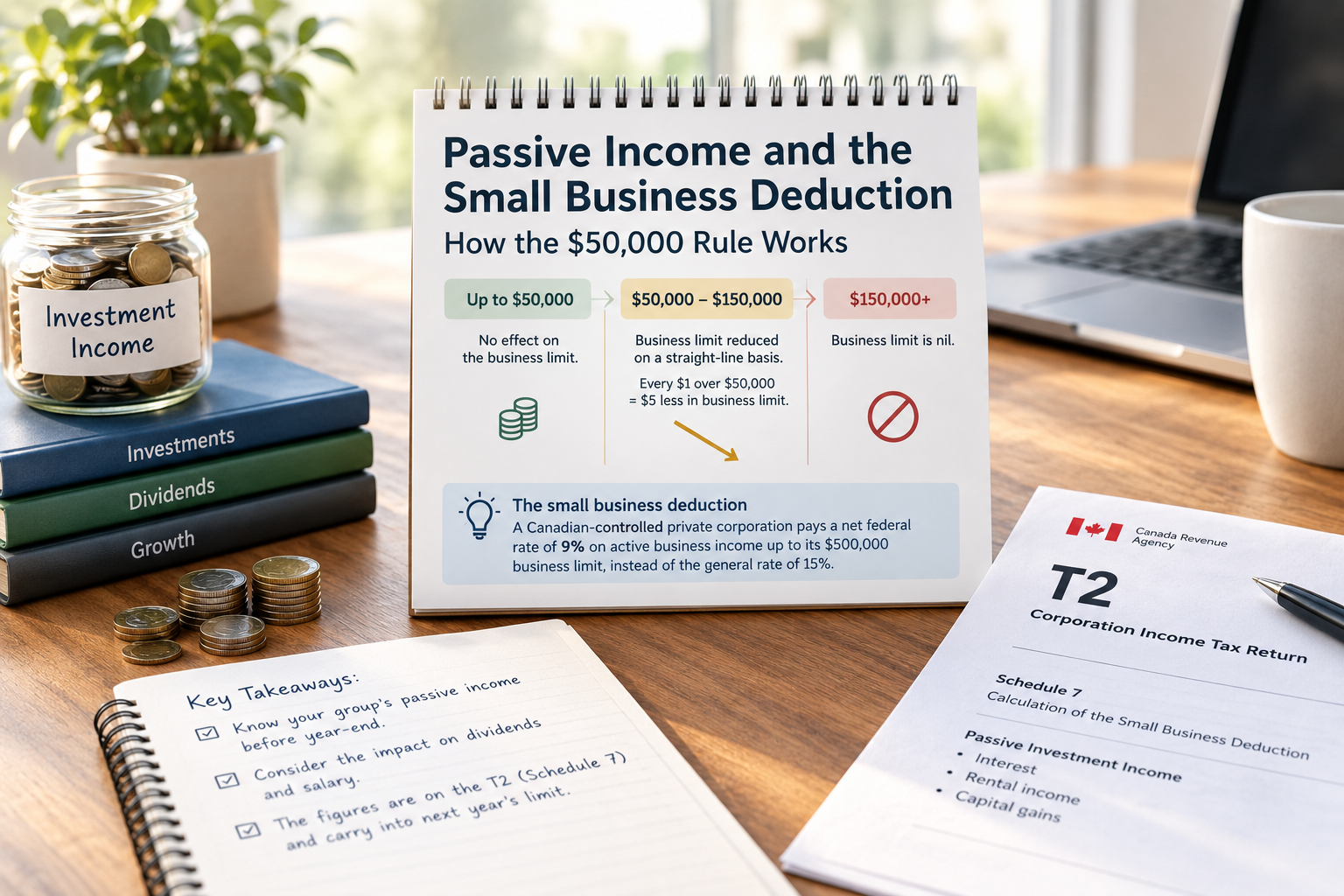
A Canadian-controlled private corporation pays a net federal rate of 9% on active business income up to its $500,000 business limit, instead of the general rate of 15%. That difference is what the small business deduction is worth.
Where passive income comes in
The federal rule looks at the adjusted aggregate investment income of the corporation and every corporation associated with it, from the previous tax year. In plain terms, that is mostly investment income such as interest, rental income from passive investments and taxable capital gains on investments.
- Up to $50,000: no effect on the business limit.
- Between $50,000 and $150,000: the business limit is reduced on a straight-line basis.
- At $150,000 or more: the business limit is nil.
Because the limit falls by $500,000 over a $100,000 range, every $1 of passive income above $50,000 takes $5 off the business limit.
An example
A corporation has $80,000 of passive investment income in a year. That is $30,000 over the threshold, so its business limit for the next year falls by $150,000, from $500,000 to $350,000.
If the corporation then earns $500,000 of active business income, $150,000 of it is no longer eligible for the 9% federal rate. At 15% instead of 9%, that is $9,000 more federal tax, caused by $30,000 of investment income.
Why the associated group matters
The test adds up the passive income of all associated corporations. A holding company that holds the investments can reduce the operating company’s business limit even though the operating company earned no investment income itself.
What owners can do
The answer is not always to stop investing inside the corporation. It is to know where the group stands before year-end, so that decisions about investments, dividends and salary are made with the threshold in mind. The figures are on the T2 itself, worked out on Schedule 7, and they carry into the following year’s limit.
Adian Professional Corporation reviews the passive income test as part of every T2 return for corporations in Mississauga and the GTA, including groups with a holding company.
FAQs
1. How much passive income reduces the small business deduction in Canada?
A Canadian-controlled private corporation (CCPC) can generally earn up to $50,000 in adjusted aggregate investment income without reducing its federal small business limit. When this income exceeds $50,000, the business limit is reduced by $5 for every additional $1 of investment income. At $150,000 or more, the business limit is fully eliminated, subject to the applicable rules.
2. Does passive income in a holding company affect the operating company's small business deduction?
Yes. If a holding company and an operating company are associated corporations, their adjusted aggregate investment income is generally combined when calculating the reduction to the small business limit. As a result, investment income earned by a holding company can reduce the operating company's access to the small business deduction.
3. How can a corporation reduce the impact of passive income on its small business deduction?
Corporation owners can monitor their group's investment income before year-end and review their investment, salary and dividend strategies with a qualified tax professional. Planning ahead can help owners understand how passive income may affect the following year's business limit and federal corporate tax liability. The calculation is reported through Schedule 7 of the T2 corporate income tax return.



Passive Income can assist you in realizing your goals.
While passive income does necessitate some effort or funds upfront, you can take advantage of that investment with little to no effort later on.
We have got some Best Passive Income ideas that you can start in 2021.PPT