





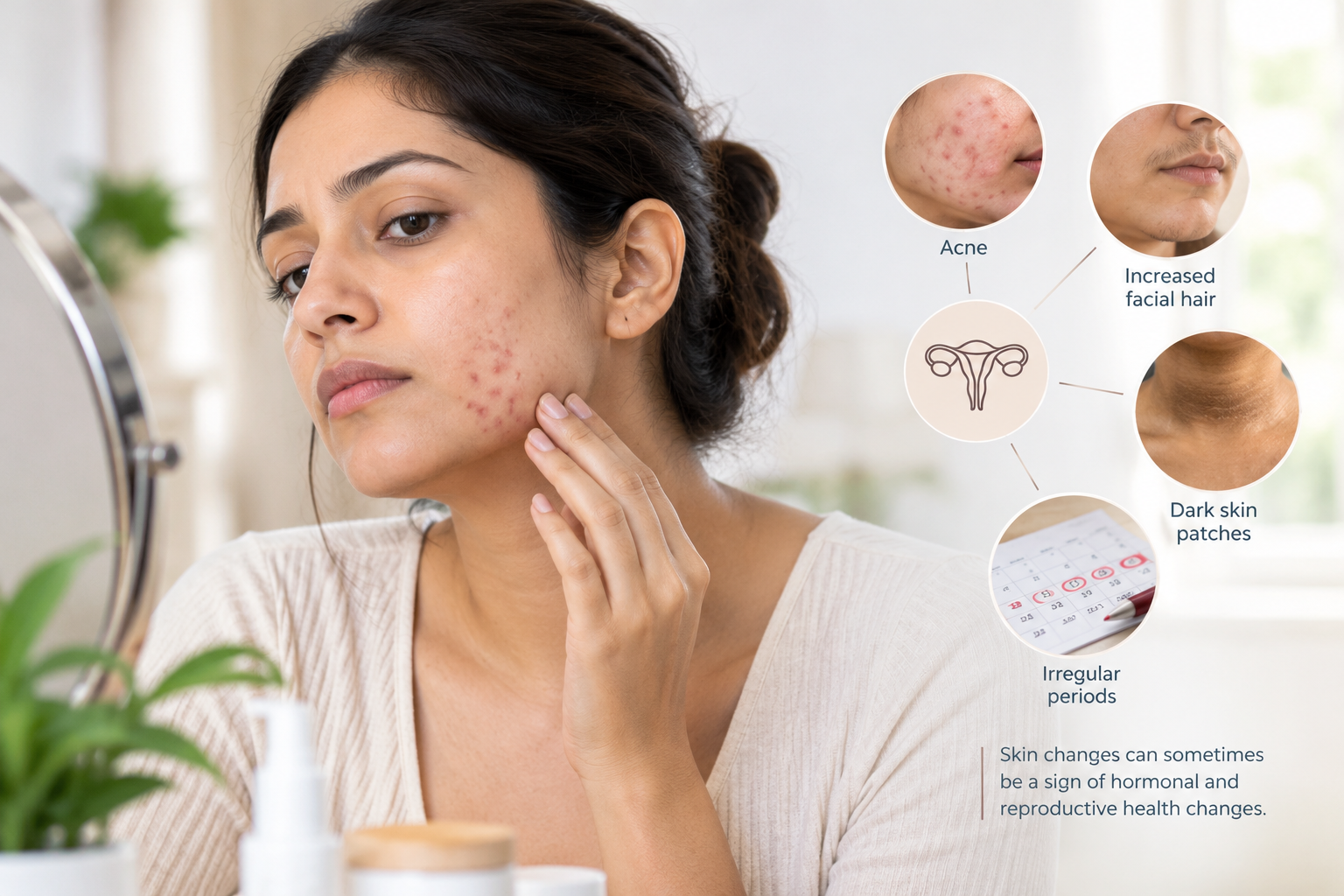
It starts with something that feels completely cosmetic.
A few stubborn pimples around the jawline.
Skin that suddenly becomes oilier.
Dark patches appearing around the neck.
Or facial hair becoming more noticeable than before.
So naturally, you change your skincare.
You try a different cleanser.
You blame stress, pollution, or your diet.
But what if the problem is not beginning on your skin at all?
Sometimes, changes appearing on the outside may provide clues about hormonal and reproductive health on the inside.
When Acne Is More Than a Skin Problem?
Acne can happen at any age for many reasons.
But persistent acne around the chin and jawline, particularly when it appears alongside menstrual changes, may sometimes be associated with hormonal fluctuations.
Androgens—hormones present in both women and men—can influence oil production.
When androgen levels are higher or the body responds differently to them, breakouts may become more frequent.
The important clue is often not acne alone.
It is what happens alongside it.
Your Period Can Complete the Picture.
Imagine acne becoming worse while periods also become irregular.
Or facial hair increasing while cycles begin arriving weeks late.
Individually, these symptoms may seem unrelated.
Together, they can create a pattern worth investigating.
PCOS is one condition that may involve irregular ovulation, acne, increased facial or body hair, scalp hair thinning, and metabolic changes.
For women planning pregnancy, these changes may also raise questions about ovulation and fertility. A fertility specialist can assess the broader reproductive picture rather than looking at the skin symptoms in isolation.
Dark Skin Patches May Tell Another Story.
Dark, thickened, or velvety-looking skin around the neck, underarms, or other body folds can sometimes be associated with insulin resistance.
Insulin resistance may occur for different reasons and can also be present in some women with PCOS.
Because these patches often develop gradually, women may assume they are caused by tanning, pigmentation, or friction.
Treating only the visible change may therefore leave an underlying hormonal or metabolic factor unexplored.
What About Unexpected Facial Hair?
A few facial hairs are not automatically a health concern.
But if coarse hair becomes noticeably more prominent on the chin, upper lip, chest, or abdomen—particularly alongside irregular periods and acne—it may warrant evaluation.
If these hormonal changes are also affecting ovulation, women trying to conceive may eventually seek a top fertility specialist gujarat to understand whether reproductive function is being affected.
The goal is not to assume that every skin change means infertility.
It is to recognise when several symptoms begin forming a pattern.
Why Treating Only the Skin May Not Be Enough?
Skincare can manage acne.
Hair-removal methods can address unwanted facial hair.
Pigmentation treatments may improve dark patches.
But if an underlying hormonal condition is contributing to these changes, cosmetic solutions alone may not address the complete picture.
Reproductive health assessment can help identify whether ovulation, insulin response, or hormone levels need closer attention.
If pregnancy occurs and additional monitoring is medically required later, care may also involve a fetal specialist doctor depending on individual pregnancy needs.
Conclusion
Your skin cannot diagnose a reproductive condition, but it can sometimes reveal clues worth investigating. Persistent acne, unexpected facial hair, darkened skin patches, and irregular periods may occasionally share an underlying hormonal connection. Speaking with a fertility specialist or top fertility specialist gujarat when fertility is also a concern can help determine whether these visible changes are purely cosmetic or part of a broader reproductive health pattern.
FAQs
1. Can skin changes be a sign of hormonal imbalance?
Yes, persistent acne, oily skin, increased facial hair, and darkened skin patches may sometimes be associated with hormonal changes. When these symptoms occur alongside irregular periods, a medical evaluation can help identify possible underlying causes.
2. How is PCOS linked to acne, facial hair, and irregular periods?
Polycystic ovary syndrome (PCOS) can involve higher androgen activity, irregular ovulation, acne, and increased facial or body hair. Some women with PCOS also experience insulin resistance, which may contribute to dark, velvety skin patches.
3. When should I consult a fertility specialist for hormonal symptoms?
Consider consulting a fertility specialist if hormonal symptoms occur alongside irregular periods, difficulty conceiving, or concerns about ovulation. A specialist can assess your reproductive health and recommend appropriate tests or treatment based on your symptoms.


Windows 10 gives various options to sign in to your account but you may face some problems at the initial stage if you have purchased a brand new Windows 10 PC or laptop.
There are multiple ways that you can choose to login to your device with ease.
Face Recognition is also there but it sometimes doesn’t support on various Windows 10 devices.Here is how to get signed into the device without any extra equipment or software:Accessing your Sign-In SettingsFirst and foremost, hit the Window logo located at the lowermost left hand side section of your display.
It helps you to launch the Start menu.Now, press the gear shaped icon to expand the Settings page.Next, tap the “Accounts” section.After that, press the Sign In tab there.Now, you can easily manage all your login settings for your respective device.
Then you have to hit the Next tab.Now, you will be requested to type your Microsoft related passcode and you have to do the same.Type the passcode carefully and then hit the “Sign In” tab.Now, select PIN and then type it in the relevant boxes.
In case you wish to use symbols and letters as per your choice, then you have to hit the box to mark it.

“Here’s your chance to gain the best experience in reproductive medicine”Join the courses Offered by India's leading institution IIRRH (International Institute for Training & Research in Reproductive Health) for education and training in Reproductive Medicine.
We have trained more than thousands of aspirants and now you have the opportunity.
Make the rest of your 2020, the best of your 2020.Scroll through the courses and know more on:www.iirrh.orgCall on: +91 7829 192444 or drop an email at: info.iirrh@gmail.comFollow us on: Facebook, Instagram and Twitter#BasicInfertilityTraining #IVF #Infertility #IVFTraining #Infertility Fellowship #FellowshipinIVF #ReproductiveMedicineCourse #DecemberPedagogy #IIRRH
