


There is a famous Hadeeth concerning the unity of the Muslims, in which the community of the believers is compared to the human body. The Prophet (PBUH) pointed out that any issue affecting a part of the body transforms it as a whole. If one is suffering a fever, his entire body will experience aches, fatigue, and weakness.
This analogy emphasizes how Muslims should always be together in every state. One’s joy is another’s joy, and one’s sorrow is another’s sorrow. It is unbecoming of a Muslim to disregard the state of his fellow Muslims.
Indeed, if a Muslim is oppressed or wronged, one should not turn a blind eye and undermine his predicament. Conversely, one must appreciate another’s success and share his joy, rather than harboring jealousy and resentment. Hence, it is of importance for every member of the Ummah to be unselfish and caring. Unity is a core component of the Muslim nation.
“The similitude of believers in regard to mutual love, affection, fellow-feeling is that of one body; when any limb of it aches, the whole body aches, because of sleeplessness and fever” (Sahih Muslim).
Prophet Muhammad said to his companions, “Does it please you that you will be one-fourth of the people of Paradise?” They answered, “God is Great.” He added, “Does it please you that you will be one-third of the people of Paradise.” They answered, “God is Great!” He said, “I hope that you will be half of the people of Paradise” (Bukhari and Muslim).
The Prophet PBUH was also known to cry “My Ummah, my Ummah” in his duas (Saheeh Muslim). This indicated how strongly he cared about the state of the believers, especially concerning the Afterlife.


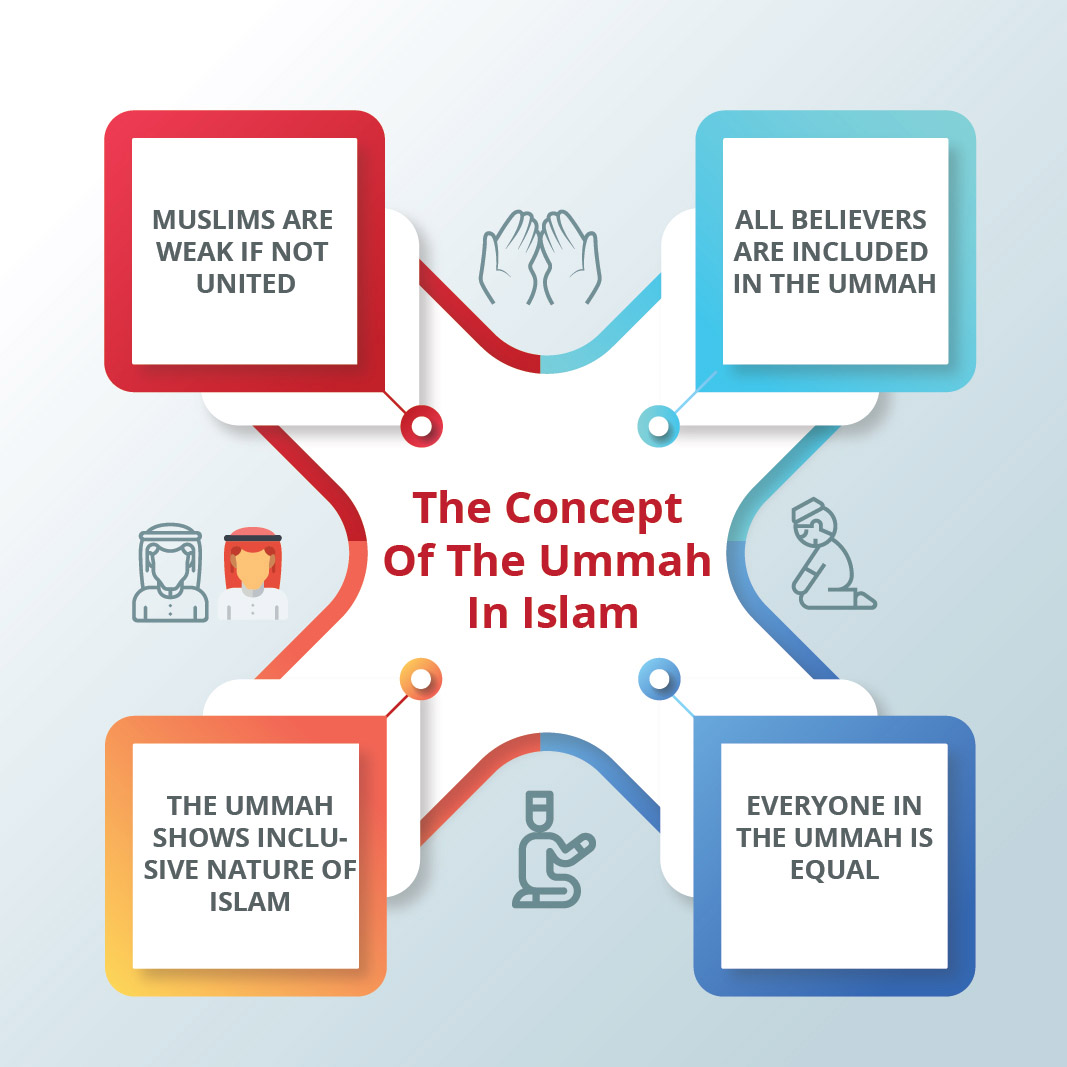
There is a famous Hadeeth concerning the unity of the Muslims, in which the community of the believers (ummah) is compared to the human body.
The Prophet (PBUH) pointed out that any issue affecting a part of the body transforms it as a whole.
It is unbecoming of a Muslim to disregard the state of his fellow Muslims.Indeed, if a Muslim is oppressed or wronged, one should not turn a blind eye and undermine his predicament.
When one part of it experiences pain, so does the rest.
There is a Hadith in Sahih Al-Bukhari and Muslim in which the Prophet (PBUH) hopes his followers will comprise half of the people in Heaven.The Prophet PBUH was also known to cry My Ummah, my Ummah in his duas, as mentioned in Saheeh Muslim.
If the massive community of well over a billion believers is unified, any threats facing Islam can be nullified.If we fail to support fellow Muslims, abandoning our brothers and sisters in Islam, we are severely weakened.
Welcome To Islamicrevolutionary.comISLAMIC REVIVAL - Discussions on Political Islam | Islamic Awakening | Muslim Self Determination Why Islam is politicalThis page discusses about Political Islam, Muslim issues and solutions and framework for Islamic civilization.Islam created empires of justice, values and ethics.
islam gave its adherents an identity and honor based on these unique humanity, justice, morals and spirituality.
Thus Islamic empire is unlike any other people's empire or history.
No nation, race or people can challenge the uniqueness of Islamic identity and Islamic empire.These writings have been put here from their original places to make reading easier for Muslims and general readers.
Is Islam politicalIslam is PoliticalMan, by nature is political and hence he does not like anarchy.
This is due to the fact that man as Khalifa of God on earth needed to be political to represent His authority and dominion against the authority and dominion of the devil Djinns (Quran 2:30).