

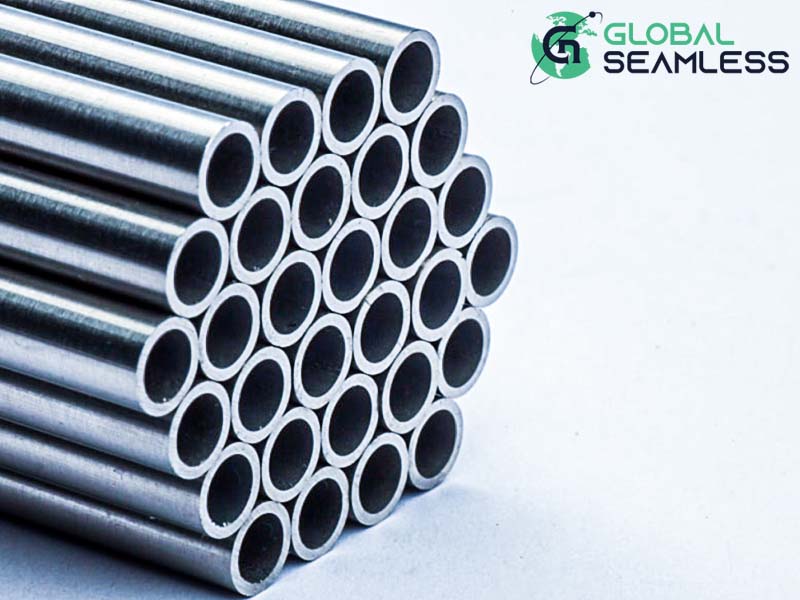
Hollow seamless steel pipes are frequently used as pipelines for the transportation of liquids like oil, natural gas, gas, water, and solid items. When the bending and torsion strengths are equivalent, steel pipe weighs less than solid steel, such as round steel, and it is a more economical form of section steel.
"ERW" stands for Electric Resistance Welding, also known as steel pipes. Transport involves moving gaseous and liquid materials like oil and natural gas. It is able to manage a variety of pressure requirements, both high and low. It currently has a crucial function in the worldwide transportation pipe business as a result.
1. Differences in molding methods
From a single piece of circular steel that has no apparent welds on the surface, a seamless steel pipe has been perforated.
ERW steel pipe is defined as steel pipe that has been bent and curved into a round form by a steel strip or a steel plate and then joined to another steel pipe with surface seams. The welding procedure for ERW steel pipe is high-frequency induction heating, which uses a high-frequency induction current to heat the formed coil's edge and compress rollers for extrusion welding.
2. The cost is different
Seamless steel pipe is more costly than ERW steel pipe, but it is higher quality. Seamless steel pipes are roughly 30% more expensive than welded steel pipes of the same quality, and the price difference is significantly more significant for big diameters. Seamless steel pipes have a considerably greater needed stress, while welded steel pipes have pressure of roughly 10Mpa. Hence, seamless steel pipes are more costly.
3. Various application areas
Seamless steel pipes
General-purpose seamless steel pipes, constructed of ordinary carbon structural steel, low-alloy structural steel, or structural alloy steel, are the most popular kind of seamless steel pipes. Pipelines are most frequently used to transport fluids or to create structural and mechanical components, like oil drills. Steel pipes are also utilised to make ring components, improve material consumption, streamline production processes, and use less resources and processing labour hours. Steel pipes are used to produce rods, bicycle frames, automobile drive shafts, and steel scaffolds for building construction.
ERW Steel Pipes
Applications for ERW longitudinally welded pipe include water supply engineering, petrochemical industry, chemical industry, power industry, agricultural irrigation, and urban building. Transporting liquids requires both water supply and drainage. Options for moving gas include steam, liquefied petroleum gas, and coal gas. pipes for piling pipes and bridges; pipes for ports, roads, and building structures. pipes for docks, roads, and building structures.
Conclusion
In the power sector, ERW straight seam welded pipes are frequently used as wire casings. Specifications of performance: 100% ultrasonic testing of the base material to guarantee the internal quality of the pipe body; There are fewer scratches, a pressure pit in the base material, and no uncoiling-disc shearing process.
After the stress is released, there is essentially no residual stress in the finished pipe. There is a little chance of flaws since the weld seam is short. It may, nevertheless, under some circumstances transport wet, sour natural gas since the steel pipe's geometrical dimension increases with increasing diameter. After the forming is complete, welding is done in a horizontal position in a straight line. Therefore, the welding quality is excellent and staggered edges, slits, pipe diameter, and circumference are all well controlled.