

Bio-control agents are used by cheese manufacturers to ensure that the product is safe for human consumption. However, dairy processing equipment are required in cheese-making to make sure that there is no contamination. The cheese-making facilities that do not have these equipment have to maintain strict hygiene standards to prevent cross-contamination. In this article, we will learn about the equipment that helps in keeping the end product safe for consumption.
Pasteurizing Cheese Vat
Milk that is used in cheese production should be free from pathogens. Vat pasteurization is used primarily in the dairy industry to prepare milk for the purpose of processing cheese and yogurt, among others. They have a smooth, non-absorbent surface and are easily cleanable. They have a proper slope to ensure self-drainage. A pasteurizing cheese vat will have the following components.
Inlet Line – The inlet line is used to fill the vat with milk.
Covers – They are meant to ensure that no contaminant enters during pasteurization
Jacket – A double-wall covering is used to circulate steam to heat up the milk
Agitators – They constantly run during the pasteurization cycle to ensure a uniform product and temperature throughout the vat.
Indicating thermometers – Thermometers are allowed to reach into the product zone.
Valves – The valves should be designed in such a way that it prevents leakage of milk. They are curved or placed at an angle to allow draining.

Stainless steel wash tank
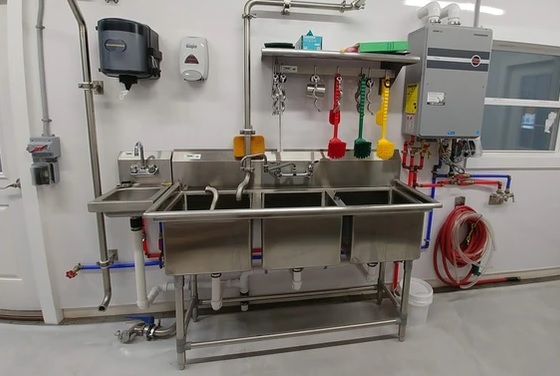
All the components in a pasteurizing cheese vat must be clean also. Like any other dairy processing equipment, the valves, covers and agitators need to be thoroughly cleaned after every batch of cheese is produced. To ensure this, a CIP system can be installed. A COP parts washer can also help in the efficient cleaning of the parts. However, a small manufacturer who does not produce large quantities of cheese can opt for stainless steel wash tank. It is a very cost-effective way to clean the parts. There are state-of-the-art CIP and COP systems having a stainless steel wash tank that will efficiently use an aqueous solution to thoroughly clean the equipment before another batch of cheese is produced. A COP parts washer also has jet manifolds that helps in cleaning pipes and hoses with a longitudinal jet flow. These tanks also have a motor that will circulate the cleaning fluid.
Summary
Controlling contamination in cheese production units is essential to ensure that the end product meets the quality standards. There are equipment that will help the units keep contaminants out of the way.

The latest Report released on Cheese Processing Equipment Market Size, Share, Growth, Industry Trends, covers different industry elements and growth inclinations that help in predicting market forecast.
Also, the statistical survey elaborates detailed commentary on changing market dynamics that includes market growth drivers, roadblocks and challenges, future opportunities, and influencing trends to better understand Cheese Processing Equipment market outlook.
Request to Sample PDF Brochure: https://www.databridgemarketresearch.com/request-a-sample/?dbmr=global-cheese-processing-equipment-market Brief Overview on Cheese Processing Equipment:Cheese processing equipment market is expected to grow at a rate of 5.50% in the forecast period 2020 to 2027.
Increasing consumption as well as production of cheese, growing automation provided by technology providers, rising abolition of milk quota in European Union are some of the factors which will likely to enhance the growth of the cheese processing equipment market in the forecast period of 2020-2027.
On the other hand, prevalence of after sale services to increase operational efficiency along with surging level of funds by the government for startups and SMEs which will further bring various opportunities for the growth of the cheese processing equipment.
Important years considered in the study are:Historical year – 2010-2019; Base year – 2020; Forecast period– 2021 to 2027 List of Key Players Profiled in the study includes market overview, Market Share, business strategies, Development activities, and SWOT analysis:GEA Group Aktiengesellschaft, SPX FLOW, Inc., Krones AG, Tetra Pak International S.A., ALFA LAVAL, JBT., I.M.A.