Summary
The post will discuss the different types of hazards faced in modern workplaces. With guidance from professional ISO 45001 consultants, it aims to help organisations comprehend workplace hazards and find suitable ways to control them.
According to the estimates of the UN Global Compact, 374 million employees annually suffer from non-fatal occupational accidents.
The only way to bring down these numbers is to have an effective hazard identification process. However, before implementing hazard management controls, you need to understand what hazards are and what form of hazard your company faces.
Therefore, the best ISO 45001 consultants bring you an in-depth overview of workplace hazards through today’s post.

The post highlights the different types of hazards, the hierarchy of controls and the categories of threats.
So, keep reading!
What Is Hazard And Risk?
A hazard can be anything that damages or harms people, including with the environment and property. It comes in many forms, including physical, biological, chemical and psychological. Hazards can exist in natural and man-made environments.
Risk, on the other hand, refers to the likelihood of a hazard causing damage or harm. It’s noteworthy that not all hazards cause accidents. The risk depends on the severity of the situation and the possibility of the incident occurring.
Types Of Hazards with Examples
The most well-known hazard types are physical, chemical, psychological, and biological.
Physical hazards: The danger posed by the objects and physical properties in your workplace is physical hazards. Common examples of physical hazards are trips or falls, exposure to harmful substances, and electricity. According to ISO 45001 consultants, natural disasters, like floods, earthquakes and hurricanes, can result in physical hazards.
Chemical hazards: Asbestos, lead, acids, bases, corrosive and toxic gases, radioactive materials, and flammable liquids are among the most common chemical hazards in workplaces.
Biological hazards: Bacteria, fungi, viruses, parasites, protozoa, parasites, dirty water- all come under the umbrella of biological hazards.
Psychological hazards: Although often overlooked, psychological hazards can be as harmful to your employees as any other hazard. Examples of psychological dangers include bullying, pressure, brutality and harassment in the workplace.
Hierarchy Of Control Measures
Once you have identified existing and potential hazards at your workplace, the ISO 45001 consultants recommend implementing control measures accordingly.
Depending on the detected hazards, your control measures may include:
Engineering controls: These controls focus on eliminating or minimising hazards by modifying the work environment. Local exhaust ventilation, guardrails, and machine guards are examples of engineering controls.
Administrative controls: These controls minimise hazards by altering how you operate. Examples of administrative controls include job rotation, training programs, and workplace policies.
Personal protective equipment: PPE kits are the clothing, devices or equipment organisations that offer methods for employees to keep themselves safe when performing risky tasks, such as hard hats, protective clothing and safety glasses.
Different Hazard Categories
Businesses typically put hazards into five categories.
Material hazard refers to liquid and solid chemicals, raw materials and gases that can lead to critical hazards if not regulated.
Equipment hazard refers to tools and machinery used by your company to produce goods or deliver services.
Environmental hazard emerges from the workplace your employees operate in and the risks it poses.
People-related hazards result from unsafe employee behaviours.
System hazards are typically related to unsafe management systems or tools.
Final Take
Hopefully, this post from expert ISO 45001 consultants has helped you get a better understanding of workplace hazards. Once you get an idea of the existing and potential hazards and risks of your work environment, you can use this guide to classify them and implement effective control. Hazard classification can also help you find risky patterns in your company and spot improvement opportunities. So, start preparing for your company’s hazard analysis today!
Author Bio
Damon Anderson is renowned for his result-driven and client-centred ISO 45001 consulting services. In addition to that, he is well-known for his informative blogs on workplace and employee safety.

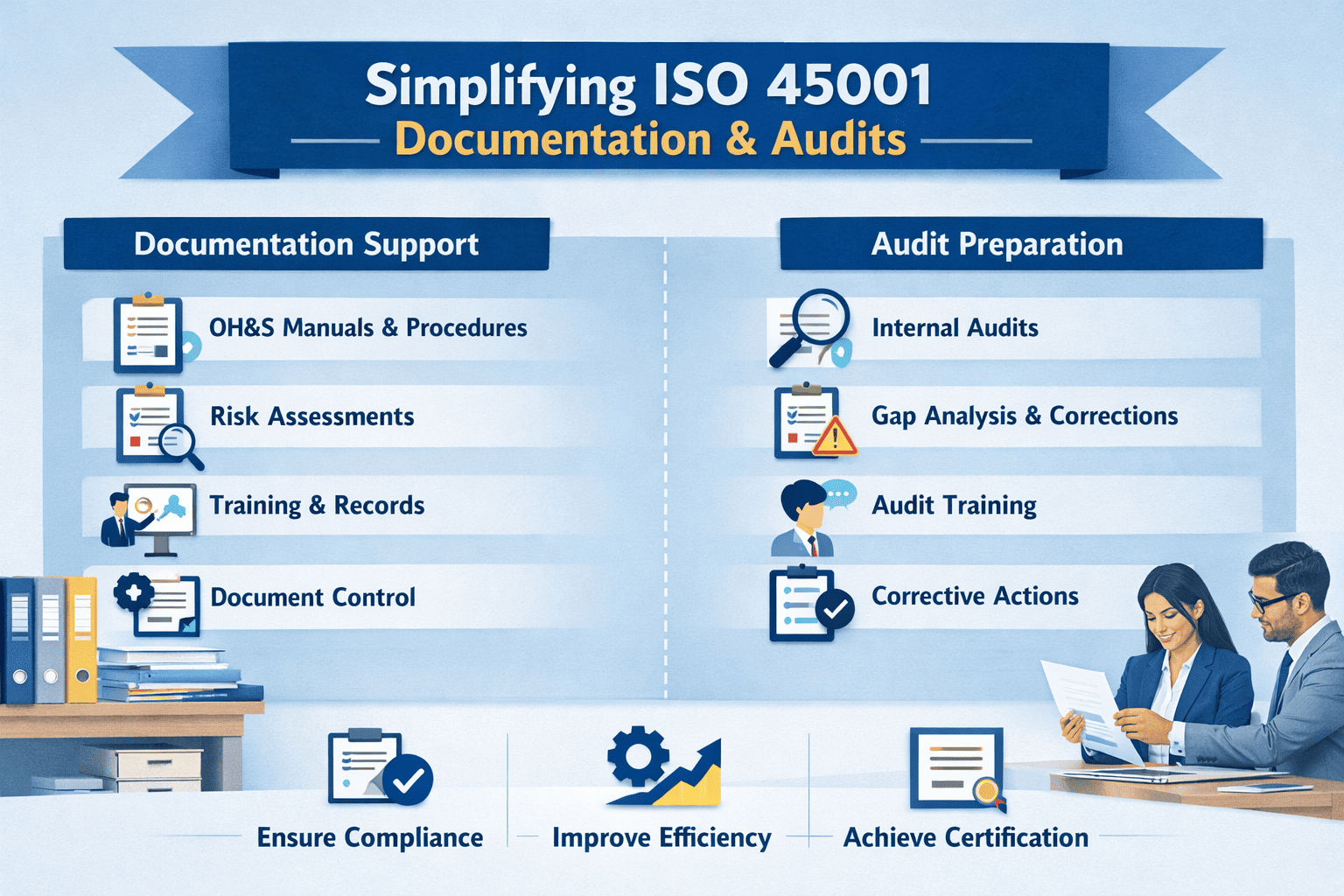
ISO 45001 certification requires organizations to establish a well-structured occupational health and safety (OH&S) management system supported by proper documentation and audit readiness. Howe