


You know how necessary it is to have a strong mobile app marketing strategy. With people worldwide spending an average of 7 hours a day online, and marketers utilizing a variety of channels, it can be challenging to determine the best way to reach your audience.
Mobile devices now make up about half of all web traffic worldwide. In the last quarter of 2023, they accounted for 58.67% of global website traffic (excluding tablets). Since early 2017, mobile and smartphone usage has hovered around the 50% mark, finally surpassing it in 2020. You can look at the graph below.

Global Mobile Website Traffic 2015-2023 (Source: Statista)
Device ownership data from the latest report shows that 97.6% of internet users aged 16-24 own a smartphone. What's more, while 90% of internet users are accessing the internet via a laptop/desktop/tablet, 98.1% are accessing the internet on their phones.
The latest survey from Datareporatl Global Overview simply tells that around 97.6% of internet users use a smartphone and then come with other device users.

So, how do you create an effective mobile app marketing strategy plan for your app?
For businesses looking to navigate the complexities of app development, mobile app consulting offers expert guidance and strategic insights. Our mobile app consulting services ensure that your project is aligned with industry best practices and market demands, driving successful outcomes.
Here, we outline the best mobile app marketing strategies and how you can use them together to achieve your goals.
Key Takeaways
- Taking the knowledge about the mobile app market and developing the best mobile app marketing strategies for your business. They should be aligned with your business needs, that is the most important point.
- Taking in the best mobile app marketing strategies from the mentioned best practices will give the idea of it. How you can get your mobile app in the market with the best possible practices.
- Then you should know how you can incorporate all the best practices in a proper process. Where you can make a whole step-by-step process of which best practices should be done.
- Integrating the mobile app marketing strategies will give your business new heights and awareness in the market.
Best Mobile App Marketing Strategies

Build an App Landing Page
Your app’s landing page is often the first thing users see about your business, acting as a “showroom” for your app. It should be clean, attractive, and user-friendly. A great example is Robinhood’s landing page, which features a clear headline, concise body text, and an obvious call to action. It encourages users to explore the app’s features and download it.

Utilize the Viral Loop
Create something in your app worth sharing, like high scores or unique experiences, and make it easy for users to spread the word. Viral loops can turn your users into marketers for your app. Companies like Dropbox offered extra storage space for referrals. CanduCrush, which allowed score sharing, has successfully used viral loops to grow its user base.

Optimize for App Store
Just like optimizing a website for search engines, your app's listing should be optimized. To rank high in app store search results. The higher your app ranks, the more exposure it gets, leading to more downloads.
Captivate Your Audience with Video
Video is a powerful marketing tool. Create short, engaging videos that can be shared on platforms like YouTube, Instagram, and Facebook. Venmo’s video content, for instance, is short, descriptive, and understandable even without sound. Use videos to explain your app, share tutorials, and promote your brand.

Run App Store Ads
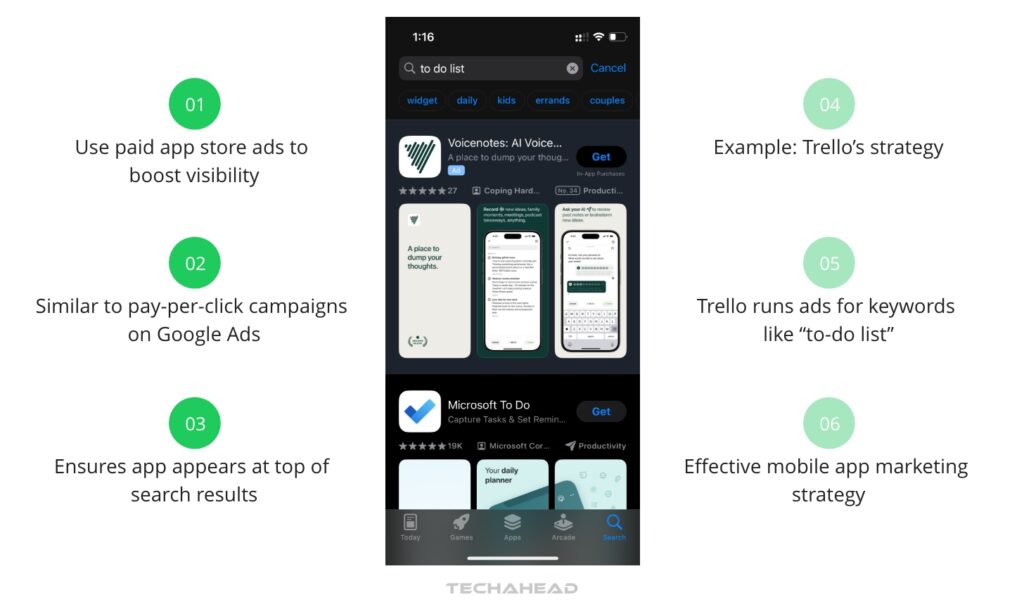
Boost your app’s visibility with paid app store ads, similar to pay-per-click campaigns on Google Ads. This mobile app marketing strategy ensures your app appears at the top of search results for relevant keywords. Let’s take an example, Trello runs app store ads for keywords like “to-do list.”
Publish Press Releases
Regularly publish press releases to inform the public about new features and updates. A well-crafted press release can attract potential users by showcasing what your app does and the problems it solves.
Have a Social Media Presence
Be active on social media to boost your app’s visibility and gain valuable insights about your followers. Engage with users and share user-generated content. Airbnb often shares user photos and interacts with followers, showing how others use their app.

Create an Affiliate Program
Set up an affiliate program to encourage others to promote your app in exchange for cash incentives. Shopify’s affiliate program is successful because it offers high commissions, great content for affiliates to share, and robust support.
Drive Downloads with App Install Ads
Use app install ads on search engines and social media to drive traffic and increase downloads. Target relevant keywords and segmented audiences to get your app in front of the right people. Companies like Postmates effectively use app install ads on platforms like Pinterest and Snapchat.

Read more: Progressive Web Apps
Offer Free Trials
Attract users by offering free trials, promo codes, or giveaways. Spotify, YouTube, and Netflix all offer free trials to hook users before they subscribe.
This strategy is to gain the trust of the users and make them stick to it. With this, they can utilize all the features of your mobile app and then decide to still stick to it.

Partner to Cross-Promote
Partner with another app for cross-promotion. This can help you reach a new audience. For example, McDonald's and Uber Eats partnered to promote each other's services. This will help both businesses to create buzz about their business on each other platforms.
By implementing these mobile app marketing strategies, you can effectively market your app and acquire more users.
Now, let’s see how you can take these mobile app marketing strategies and combine them in a proper process.

How You Can Simplify Mobile App Marketing Strategies?
Mobile app marketing is a journey with four key stages, each playing a crucial role in your app’s success.
 Pre-launch Phase: Foundation of the Project
In this initial stage, you prepare for a successful launch. This is when you study your competition and understand your target audience. You’ll build a strong brand identity, create a user-friendly experience, and establish a solid organic presence. Essentially, you are laying the groundwork for your app’s grand launch.

Study the Market
All the industries are quite competitive. You need to research similar apps to identify gaps, trends, and opportunities. Analyze their strength and weaknesses to see how your app can stand out. This information will become the foundation of your mobile app marketing strategy.
Find Ideal Users
Who is your app for? Define your target audience by creating user personas that highlight their characteristics, performances, and pain points. Consider factors like demographics, behavior, and lifestyle to build a detailed profile of your ideal users. This will help you tailor your mobile app marketing strategies to effectively reach and engage them.
Build a Strong Brand
Branding is more than just a logo and color scheme. It is about your app’s identity. A consistent and compelling brand helps your app stand out. Your brand should resonate with your target audience and clearly convey your app’s unique value. Make sure this identity is reflected in all aspects of your app, from visuals to messaging.
App Store Optimization (ASO)
Visibility is key in the digital world. App Store Optimization (ASO) improves your app’s discoverability in app stores. Choose relevant keywords that match your app’s features. Create a compelling title, write an engaging description, and design eye-catching screenshots. A well-optimized app store listing increases your app’s chances of being found by potential users.
Develop a Conversion Optimized Website
Your app’s website is the gateway to your app. Use it to showcase your app’s features and benefits through tailored landing pages and keyword-optimized blogs. Include screenshots and videos to give users a preview of what to expect. Add clear calls-to-action (CTAs) to encourage visitors to sign up for notifications or learn more about the app. Collect email addresses from interested users to build a mailing list for launch updates.
Launching a Demo Campaign
Build excitement and curiosity around your app with a teaser campaign. Share teaser videos and sneak peeks to offer glimpses of your app’s unique features. Use social media platforms to spread teaser content and create countdowns to generate urgency and anticipation.
Thorough testing
Ensure your app is polished before launch. Start with alpha testing by releasing the app to a small group of internal users to identify any major issues. Then, move to beta testing with a larger group of external users. Their feedback will help you uncover bugs, usability issues, and areas for improvement. This feedback is invaluable for finalizing your app before the official launch.
The pre-launch phase is like laying the foundation for a grand masterpiece. Thorough market research, detailed user profiling, strong branding, seamless UX, thoughtful ASO, and a well-executed teaser campaign set the stage for a successful launch.
Launch Phase: Creating the Buzz
Your app officially debuts, starting with a soft launch to gather feedback and make improvements before the big launch. Burning this phase, your mobile app marketing strategies efforts should focus on boosting visibility and getting the word out about your app.
However, there are phases in the launching phase that make a strong impact.

Soft Launch: The Warm-Up Launch
Before releasing your app to everyone, a soft launch allows you to fine-tune it. When your app’s key features are functional, it looks polished, and you have a plan for user support and debugging. It’s ready for this limited release. Think of it as a dress rehearsal.
A soft launch involves releasing your app to a select group of users to see how it performs in the real world without risking major issues. You might ask:
Often, a soft launch is limited to a specific region. For example, you might release it in the UK before expanding to other markets. This approach helps you gather feedback, fix issues, and improve your app before the official launch.
Hard Launch: Reveal of Your Project
The hard launch is your app’s official debut. After addressing any issues from the soft launch. It is the time to introduce your mobile app to people. This involves a well-coordinated marketing campaign to quickly and effectively attract users. The goal is not just to release your app but to do so in a way that captures attention and makes a lasting impression.
Key factors for a thriving hard launch:
The hard launch is an important moment, and its success depends on a strategic approach that balances marketing skills, user focus, and adaptability.
Build Launch Strategy
A well-rounded strategy is essential for a successful launch. Here are some key components:
By combining these elements, your app’s launch can capture attention and set the stage for long-term success.
Post-Launch Phase: The Growth Phase
After launch, the focus shifts to acquiring users and keeping them engaged. Regular updates and enhancements based on user feedback help keep your app relevant and valuable. Content marketing and building a community around your app foster a sense of belonging among users.

Mastering User Acquisition (UA)
User acquisition is important for your app growth. Whether you use paid advertising, organic methods, or a mix of both, your mobile app marketing strategies should be well-planned and effective.
The Content Connection
Content marketing is a powerful strategy to boost your app’s visibility. It helps add value for users, build an online community, and improve search engine rankings.
Diversify Your Channels
AI-driven technologies can deliver highly personalized ads based on viewers’ preferences and habits. For example, a grocery app ad could appear while a user watches a cooking show. AI also allows for interactive and shoppable ads, enhancing viewer engagement.
Engage and Retain Users
Keeping users engaged is important to prevent them from leaving your app.
Gamification
Incorporate gamification elements to make your app more engaging and fun.
Read more: Fantasy App Development Like CBS Sports
Loyalty Program
Loyalty programs reward users for their ongoing engagement.
By focusing on these mobile app marketing strategies, you can ensure your app not only attracts users but keeps them engaged and loyal. This drives too long-term success of your mobile app.
Maintenance and Sustainability Phase
In this stage, data-driven optimization becomes crucial. Clear analytics help you refine your strategies based on real-time insights, ensuring the long-term growth and success of your mobile app marketing strategies.

Collaboration
Collaboration with other apps or brands can expand your audience and add value for your users. Look for partners whose audience matches your target demographic. This can involve co-developing features or cross-promotion of each other’s apps.
Cross-Promotion
Cross-promotion involves promoting each other’s apps to your user bases. For example, a fitness app partnering with a nutrition app. This can drive organic downloads and increase user retention. Developers with multiple apps can also cross-promotion within their portfolio.
Co-Marketing Campaign
Co-marketing campaigns involve jointly running marketing efforts like social media campaigns, email marketing, or events. By pooling resources and expertise, you can create more impactful and cost-effective marketing initiatives.
Pinpointing the “It” Factor with Testing
A/B testing helps determine what impacts user behavior and marketing effectiveness. Test different versions of app store listings, ad creatives, or messaging strategies to see what works best. If one version performs better, use it and learn from the results.
Read More about the Best practices and tools for mobile app testing
Immersion and innovation with AI, AR and VR
Stay ahead by adopting new technologies like artificial intelligence (AI), augmented reality (AR), and virtual reality (VR). These technologies can enhance user experiences and keep your app innovative and competitive.
By using these mobile app marketing strategies, you can ensure your app's long-term success, keep users engaged, and build a loyal community. It's not just about launching an app; it's about creating lasting relationships with your users.
Final Thoughts
A robust mobile app marketing strategy is essential for the success of your business in the online business. With mobile devices accounting for a significant portion of web traffic and the majority of internet users accessing the web via smartphones, the importance of effectively reaching your audience cannot be overstated.
To create a successful mobile app marketing plan, you must understand your market, and continuously refine your strategies based on data-driven insights. Whether it's building a captivating app landing page, utilizing viral loops, optimizing for app stores, or leveraging social media, each strategy plays a crucial role in attracting and retaining users.
Remember, the key is to integrate these strategies into a cohesive process, from pre-launch preparations to post-launch optimizations, ensuring your app not only captures attention but also fosters long-term engagement and loyalty.
Partnering with the right mobile app development company can make all the difference. Techahead stands out as a leader in this field, offering unparalleled expertise and support to bring your app to life. Let’s work together to turn your vision into a reality and reach new heights in the competitive app market.

It has transformed our ways of interaction and communication with each other forever, and it will be very difficult to let go of it.Because social media is a trend, the technologies backing it up have been plenty, and more of them have been collaborating over the years.
Joining this bandwagon is the Augmented Reality technology, or AR as we call it.Thanks to AR VR app development, Augmented Reality has been one of the upcoming technologies to have a big impact on the whole social media app scenario.
Such has been its force that innovators are calling it the next big thing in the world of technology as a whole.If you compare AR with the other existing technologies, it exists somewhere between the real and virtual worlds.
While both the technologies are closely related, there are subtle differences to separate them from each other.While Virtual Reality focuses on creating an entirely new world from the beginning, Augmented Reality works the other way round, taking real-world situations and projects on the virtual route through computer-generated augmentations, enhancing the final customer experiences.How AR has Transformed Social MediaGiven the popularity, AR VR services have increased too, where companies have a dedicated workforce of scientists to unearth the potential that AR holds.
The very first instance you might have noticed with AR in front would have been those Snapchat filters.
Despite every bit of effort, Google Glass could never find takers in the real market.Thanks to smartphones though, AR VR app development became a reality.


https://www.juegostudio.com/augmented-reality-company - Augmented Reality App Development company providing full service development for AR apps with experiences AR app developers.