






Challenges and competition define today’s dynamic business landscape. To thrive in such a complex environment, organizations need to embrace efficiency, innovation, and data-driven decision-making. Automation has become a key enabler for streamlining repetitive tasks—but in complex, fast-evolving scenarios, intelligent automation becomes essential.
Intelligent Automation (IA) merges Robotic Process Automation (RPA) with Artificial Intelligence (AI) to create smarter workflows. As a transformative force, IA blends RPA’s structured efficiency with AI’s adaptive intelligence—going far beyond traditional automation methods.
In this blog post, we’ll explore the core components of RPA and AI, how their integration drives intelligent automation, and what businesses should consider when implementing IA solutions.
Key Components of RPA and AI
Robotic Process Automation (RPA) uses software bots to automate repetitive, rule-based tasks such as report generation, invoice processing, and data entry. These bots operate based on predefined rules and structured inputs, making RPA highly effective for speeding up routine processes.
Artificial Intelligence (AI), on the other hand, enables machines to mimic human intelligence through techniques such as Machine Learning (ML), Natural Language Processing (NLP), and Computer Vision. These capabilities allow machines to interpret language, recognize patterns, and even understand images—bringing human-like insight to automation.
By combining AI with RPA, Intelligent Automation (IA) breaks the limitations of rule-based automation, allowing organizations to manage unstructured data and make contextual decisions.
How Intelligent Automation Transforms Business Processes
The fusion of AI and RPA enables Intelligent Process Automation (IPA)—a solution that delivers more than just task automation. It fosters adaptive, data-driven workflows across industries.
In short, IA empowers businesses with smarter, faster, and more accurate operations across departments.
Top Business Benefits of Intelligent Automation
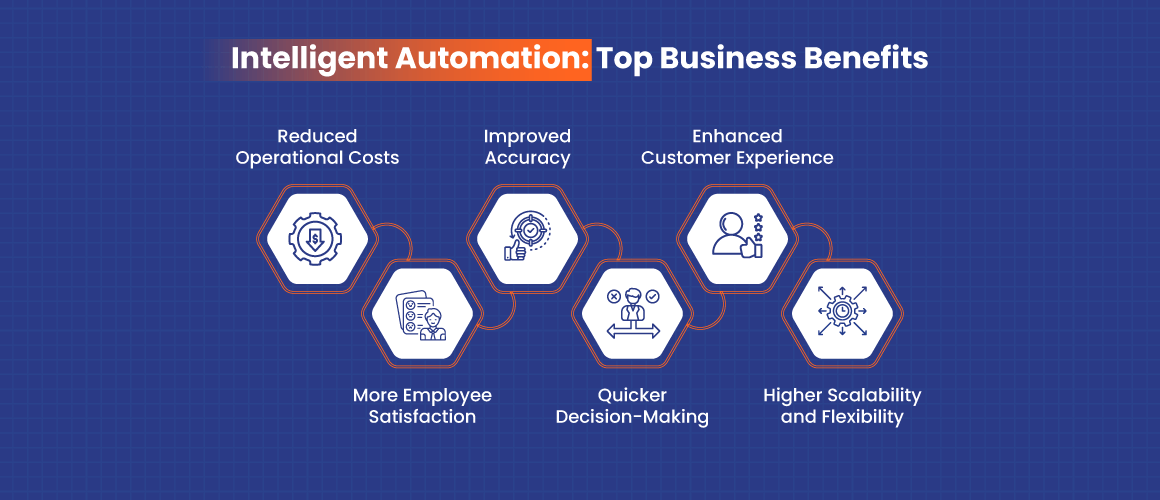
Implementing intelligent automation unlocks several strategic and operational advantages:
Whether it’s a startup or an enterprise, intelligent automation elevates business performance and competitiveness.
Key Challenges and Considerations in IA Implementation
Despite its benefits, deploying IA requires overcoming certain challenges:
Implementation Challenges
Strategic Considerations
Conclusion
Intelligent automation offers businesses a way to reduce costs, improve accuracy, and enhance both customer and employee satisfaction. More than just automating tasks, IA transforms how businesses operate by unlocking the full potential of AI and RPA.
To fully harness these advantages, partnering with a reliable automation expert is essential.
At Silver Touch Technologies, we help businesses embrace intelligent automation with powerful RPA and AI solutions tailored to their needs. Our end-to-end services empower companies to streamline operations, improve agility, and maintain a competitive edge.
Get in touch with us today to discover how AI-powered RPA can transform your business.
Source - https://www.silvertouchinc.com/blog/intelligent-automation-in-business-the-role-of-ai-and-rpa/





RPA, virtual agents BPM are the key pillars of intelligent automation and are driving businesses towards success.
These technologies help organizations in enhancing productivity and competence in many ways.
Robots these days are replacing humans from the production department and manual tasks.
All the operations in the Business are automated and can be done by robots to reduce human involvement.
All the errors and orders will be checked and corrected by robots within less time.
RPA also helps employees to develop creative tasks for these competitive market trends, thus increases the operational excellence of any organization.