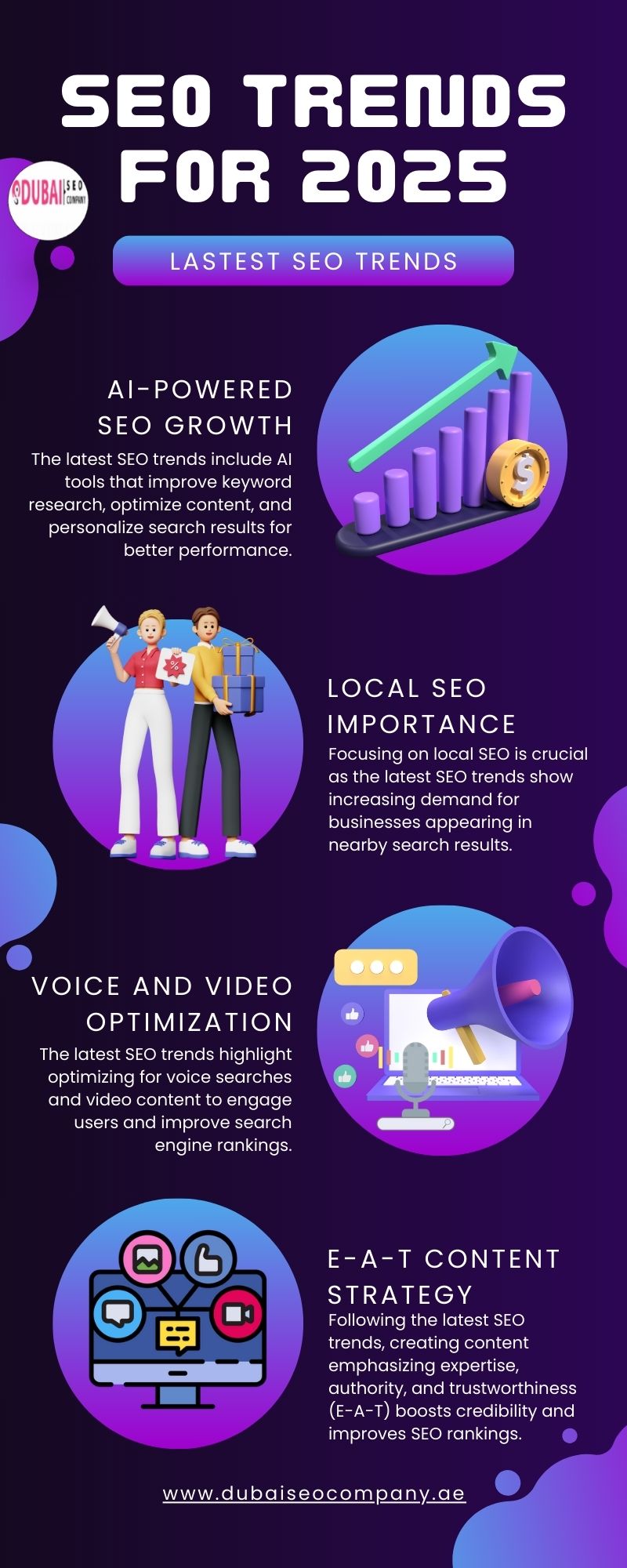


As search engines continue to evolve, staying on top of SEO trends is no longer optional—it’s essential. In 2025, businesses that want to maintain visibility and authority online must adapt to a rapidly changing digital landscape shaped by AI, user behavior, and increasingly sophisticated search algorithms. To help you prepare, we asked 16 SEO thought leaders and digital marketing experts to share the most important trends they believe businesses should focus on in the coming year. From AI-driven search to hyperlocal targeting, their insights reveal where the future of SEO is heading—and how to stay ahead of the curve.
Focus on AI-Driven Search and EEAT
In 2025, businesses need to focus on AI-driven search, EEAT (Experience, Expertise, Authoritativeness, Trustworthiness), and zero-click searches. Google's algorithm is getting smarter, prioritizing first-hand experience and high-quality content over keyword stuffing. AI-generated content won't cut it alone--you need human insights and originality to stand out.
Also, voice and visual search are on the rise, so optimizing for conversational queries and structured data is a must. Lastly, page speed, Core Web Vitals, and mobile-first indexing remain critical for rankings and user experience. Bottom line? Focus on real value, technical SEO, and staying ahead of AI advancements.
Tyson Downs, Owner & Business Growth Consultant, Titan Web Agency: A Dental Marketing Agency
Hyperlocal SEO Key for 2025 Success
In 2025, businesses should consider focusing on hyperlocal SEO as a major trend. While many businesses already target local markets, there's a shift toward an even more granular focus. Hyperlocal SEO involves tailoring content and keywords to specific neighborhoods or even street names, providing a laser focus on the immediate area surrounding a business. This is crucial for small businesses and service-based industries that thrive on proximity, as search engines are increasingly prioritizing neighborhood-level results.
To put this into action, I ensure that the content targets not just the city but specific local landmarks, streets, or neighborhoods. If a client operates in a specific part of town, I might mention the local schools, parks, or businesses near them. For instance, I could write a blog post titled "Best Family Homes Near [Local Park Name] in [City]," directly targeting those looking for properties in that exact vicinity. This helps capture more precise search traffic, bringing in clients who are ready to act in their immediate area.
Mark Sanchez, Founder & Senior Real Estate Manager, Tropic Residential
High-Quality Content and Technical SEO Crucial
SEO in 2025 is all about providing content that answers what people are looking for. Search engines are getting smarter at understanding intent, so businesses like ours need to move away from outdated tactics like keyword stuffing and focus on creating high-quality, informative, and engaging content. AI-driven search is becoming more common, meaning search engines pull answers directly from websites. To stay visible, businesses should provide well-structured, trustworthy content that reflects real expertise instead of just rewording what is already online.
Technical SEO is just as important. Websites need to be fast, mobile-friendly, and easy to navigate because search engines prioritize user experience. If a site is slow or difficult to use, rankings will drop. SEO is no longer about quick fixes but long-term strategy. Businesses that consistently offer value, keep their websites optimized, and stay adaptable will have a much better chance of staying ahead in 2025.
Emil Calangi, Chief Executive Officer, Topnatch Freight
Answer Specific Questions for Better Rankings
Search is getting smarter. Google isn't just looking at keywords anymore, it's trying to figure out what people mean when they search. So if your website is packed with generic content or you're still chasing short phrases like "best plumber," you're going to hit a wall. What's working now is answering specific questions clearly. If someone types in "how long does it take to become an electrician in Ohio," you want a page that walks them through that step-by-step in plain language. That kind of stuff is showing up higher in search results and keeps people on your site longer, which Google notices.
Doug Crawford, President and Founder, Best Trade Schools
Prioritize Semantic Search Optimization in 2025
In 2025, businesses should prioritize semantic search optimization. As search engines become more advanced, they focus less on individual keywords and more on understanding the intent and context behind a user's query.
This means businesses must create content that answers specific questions comprehensively and aligns with the overall meaning of what users are searching for, not just relying on exact-match keywords. By focusing on semantic search, businesses can ensure their content is more likely to meet user needs and rank higher in search results.
Jonathan Ayala, Licensed Real Estate Salesperson | Founder, Hudson Condos
User Behavior Becomes Critical Ranking Signal
What businesses should pay more attention to in 2025 is how user behavior is being treated as a ranking signal. Search engines are giving more weight to what people actually do once they land on a page. Metrics like dwell time, bounce rate, scroll depth, and return visits are becoming stronger indicators of whether your content deserves to stay on page one. If people are bouncing in a few seconds, that sends a different signal than if they stick around, scroll, and click through.
The search algorithm is getting better at identifying content that holds attention and delivers what was promised. That means surface-level answers or keyword-stuffed copy won't hold up as well. Businesses should start thinking less about just getting the click and more about what happens after. Does the page load quickly? Is the headline matched by the body content? Are people finding what they came for or heading back to search?
Robbin Schuchmann, Co-founder / SEO Specialist, EOR Overview
AI-Powered Search and Local SEO Vital
In 2025, businesses should definitely pay attention to the rise of AI-powered search. Understanding search intent has become more sophisticated. The goal is to create content that answers real user needs.
Local SEO will continue to be huge, especially for service-based businesses like mine. Optimizing Google My Business, encouraging local reviews, and using location-based keywords can really make a difference. When we revamped our GMB profile and targeted specific neighborhoods in Sydney, we noticed an uptick in local inquiries. Staying updated on these trends is key for staying competitive.
Adam Bushell, Director, AB Electrical & Communications
Core Web Vitals and AI Content Are Key
In 2025, SEO trends will be shaped largely by how businesses respond to evolving search algorithms, especially in terms of user experience. One of the most important trends I see is the increasing importance of Core Web Vitals, which directly affect site rankings based on user interaction. At SonderCare, we saw a 25% boost in organic search traffic after improving our page load speed and ensuring mobile optimization. Another significant change is the rise of AI-driven content, where search engines like Google now prioritize content that answers specific user queries, not just keywords. We're already using tools like GPT-based content generation for more precise, user-centered material, which has increased our content engagement by 15%. It's clear that SEO success in 2025 will hinge on delivering high-quality, fast, and relevant content that's aligned with real user intent.
Kyle Sobko, Chief Executive Officer, SonderCare
Real-Time Feedback Enhances SEO Effectiveness
Not feedback from search engines. Feedback within the content loop. We've seen businesses push for user intent matching, but what they're missing is the layer of real-time micro-feedback within the content experience itself. Think interactive responses: "Was this helpful?" buttons, embedded sentiment polls, hover-time tracking on specific paragraph clusters.
Instead of guessing if the content answered the query, we measure content satisfaction rate based on how the user interacts inside the session. Then we re-optimize based on what they didn't click, what they skimmed past, or which tool tip they hovered over for 4 seconds but didn't expand.
This also feeds into SERP rebound analysis. Sites will need to build internal UX patterns that reduce bounce-back to Google results. Not just rank-and-leave, it's about containment, keeping the user long enough to signal satisfaction before the algorithm re-ranks.
Another critical shift? Intent-Emotion Syncing. With AI models helping Google read tone and emotional intent, "search intent" is no longer just transactional or informational. It's agitated, tired, overwhelmed, curious. Brands that can match emotion in language tone (not just keywords) will win rankings that feel invisible to competitors.
2025 SEO isn't about adding more backlinks or keywords.
It's about becoming the last click before conversion.
Muhammad Imran Khan, CEO, Brand Ignite
Social Search Integral to SEO Strategy
If businesses want to stay visible in 2025, they should start treating social search like a core part of their SEO strategy. Search is no longer limited to Google. More people, especially under 30, begin their research on TikTok and Instagram. They aren't just browsing either. They're typing in full queries, looking for answers, comparisons, reviews, and recommendations inside those platforms. That shift changes how discoverability works.
We tested this with short-form videos targeting people looking for dental care abroad. We added keywords directly into captions, comments, and even voiceovers. In just two months, traffic from Instagram and TikTok grew by 38%, and we saw a noticeable uptick in branded search on Google as well. People were using our name after seeing us pop up in their feeds. The social content wasn't just attracting attention. It was feeding into wider search behaviour across platforms.
Odellé Joubert, Chief Operating Officer, Dentaly Go
Domain-Specific Expertise Boosts SEO Rankings
Domain-specific expertise optimization rapidly replaces broad keyword strategies as search engines shift toward evaluating a brand's authority within specialized knowledge fields like residential relocation.
After directing moving services across multiple locations nationwide, I've seen how creating comprehensive resource sections addressing specific moving scenarios (like interstate moves, corporate relocations, and specialty item transport) consistently outperforms basic service pages in search rankings.
This evolution demands a strategic shift for moving companies. Rather than simply optimizing existing pages for terms like 'affordable movers' or 'best moving company,' we've found success by identifying specific customer concerns through search intent analysis.
Developing detailed content on topics like 'moving temperature-sensitive items' or 'relocating during housing market fluctuations' demonstrates specialized expertise that search engines increasingly reward with higher rankings.
The most promising approach combines data-driven content development with practical moving industry insights. Our team analyzes thousands of customer moving experiences to identify common challenges, then creates resources addressing these specific pain points.
This customer-focused method has increased our organic traffic by 46% while dramatically reducing acquisition costs compared to paid advertising, proving that authentic expertise in solving moving challenges now trumps traditional keyword optimization.
Vidyadhar Garapati, Chief Executive Officer (CEO), Movers.com
Mobile-First Indexing and Speed Are Crucial
At Tutorbase, we've seen incredible results by focusing on mobile-first indexing and improving our page load speeds - it's not just about being mobile-friendly anymore, it's about being mobile-optimized first. Just last month, after we reduced our loading time from 4 seconds to under 2 seconds, our mobile traffic jumped by 35%, showing how critical speed will be for SEO success in 2025.
Sandro Kratz, Founder, Tutorbase
Optimize for Voice Search to Stay Competitive
In 2025, one of the most crucial aspects businesses should focus on is optimizing for voice search. With the rise of smart devices, voice search is becoming the go-to for many users, and it is changing the way people search for information. From my own experience running Game Host Bros, I have seen that users are relying more on voice assistants to find services, including game server hosting. To capture this audience, businesses need to adjust their content to match conversational, long-tail keywords. For instance, rather than ranking for a generic term like "game servers," a focus on more specific phrases like "best game server hosting for large communities" will deliver better results. Websites that are optimized for voice search not only have a better chance of ranking higher but also show that they're keeping up with modern search trends. In my case, shifting to voice search optimization has significantly increased the traffic from voice queries and improved user experience.
Hone John Tito, Co-Founder, Game Host Bros
Video Content Gains Prominence in Search
Businesses should start leaning into video content in 2025 because it is now showing up directly in search results with more frequency and better placement than most text-based formats. Google has been pushing video results further up the page, especially for searches that imply someone wants to learn something quickly or compare products visually. This shift makes video not just a content play, but a search visibility play too. That's where most brands miss the mark. They build for YouTube and forget that Google pulls from those videos across its own ecosystem.
Spencer Romenco, Chief Growth Strategist, Growth Spurt
Human-Written Content Will Outperform AI
Focus on creating original content written by human beings that isn't over optimized. There has been a surge in AI written content that is over optimized and not delivering the right expectations to users. Google will focus more on devaluing this content going forward. SEOs need to prioritize content that delivers value to the user and is written by humans.
Joe Hall, SEO Consultant, Hall Analysis
AI Search, EEAT, and Content Clusters Essential
SEO involves moving quickly, and staying ahead means adapting to key trends. Here are three I expect will shape this landscape:
1. AI-Powered Search & SGE Optimization - Something we should probably all be doing optimization for - Google's Search Generative Experience! In order to authenticate their content, marketers must create content that solves the question of a user.
2. EEAT & Brand Authority - Google is still leaning hard into Experience, Expertise, Authority, and Trustworthiness (EEAT). For ranking, the building of real brand presence through PR, authoritative backlinks, and expert-driven content olacaktir.
3. Content Velocity & Topical Authority - It's not just about getting one blog post to rank anymore; it's about dominating entire topics. Content clusters: Businesses that can create deep and wide content clusters that are closely interlinked will outperform their competitors.
Oun Art, Founder & Chief Link Strategist, LinkEmpire
Conclusion:
The SEO landscape in 2025 is all about adaptation, intent, and authenticity. As AI transforms search behavior and platforms like Google prioritize user experience and trustworthy content, businesses must go beyond traditional tactics. Whether it's focusing on EEAT, optimizing for voice and social search, or delivering hyper-relevant content, these expert insights provide a roadmap for SEO success. By staying proactive and aligning strategies with user expectations and evolving technologies, businesses can not only maintain search visibility—but also create meaningful digital experiences that convert.


A visually appealing design will definitely grab the users and they choose to stay more on the apps.
It does not alienate them but makes them feel connected.
It is the power of good design that makes this possible.
Read More at : https://www.appsinvo.com/blog/why-you-should-concentrate-on-good-app-design/