




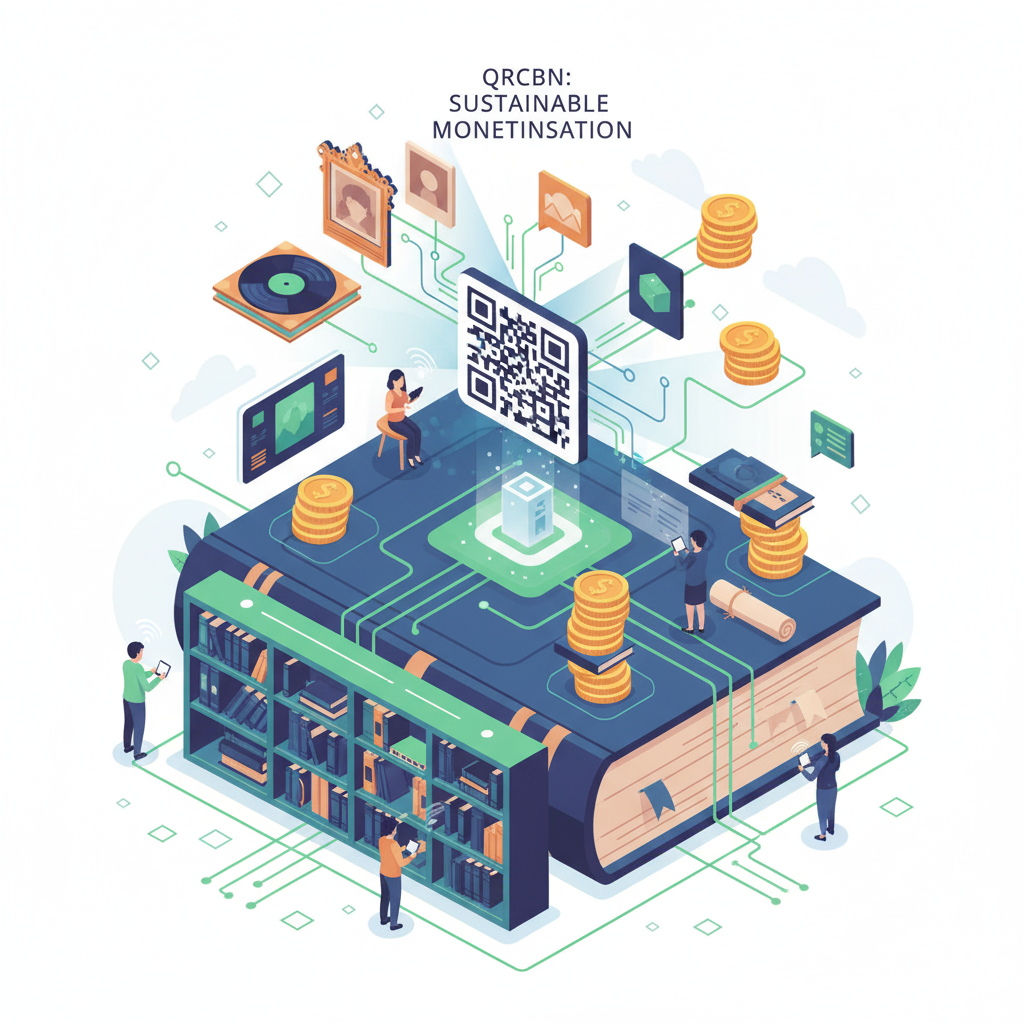
Learn how publishers can transform old book catalogues from passive assets into active, sustainable revenue sources through smart monetisation strategies using QRCBN.
Key Takeaways:
• QRCBN fundamentally transforms old books from passive, costly inventory into active digital assets ready for monetisation.
• Every older book equipped with a QR Code becomes a permanent, always-on sales gateway—especially profitable for digital editions.
• Enables cost-effective digital “repackaging”—such as updating covers and descriptions on landing pages—to boost sales appeal without costly reprints.
• Facilitates effective cross-selling and up-selling by linking backlist titles to new releases or relevant market trends.
• Sustainable monetisation is achieved by ensuring every book remains available via digital editions or print-on-demand (POD), eliminating “out of stock” problems.
• This strategy reduces financial risks tied to warehousing and managing slow-moving physical stock.
Introduction: The Paradox of Dormant Intellectual Assets
For publishing houses, a catalogue of published works represents the core of their intellectual assets. Each title reflects an investment of time, creativity, and financial resources. Yet, over time, many of these valuable assets enter a “dormant” phase. Older titles—no longer the focus of active promotion—gradually shift from being sources of revenue to becoming burdens of inventory. They occupy warehouse space, incur storage costs, and their monetisation potential diminishes as they fall out of market circulation.
The paradox is that the intrinsic value of these works often remains intact. A classic novel is still a classic; a foundational non-fiction book remains relevant. The issue is not with content quality but with mechanisms to reactivate them in today’s market. How can publishers awaken these “sleeping giants” without costly re-marketing campaigns? QRCBN enters here not merely as a tool, but as a strategy—designed to “reactivate” older assets and provide a low-cost mechanism for unlocking sustainable monetisation potential.
Activating Assets Through Permanent Sales Gateways
The most basic monetisation strategy is ensuring there is always a transaction path. For older books, that path is often broken. Bookshops may no longer stock them, and old online sales links may be inactive. Every physical copy that still exists—in libraries, on personal shelves, or in second-hand shops—is an isolated asset with no way to generate fresh revenue.
QRCBN embeds a monetisation engine into every copy. A QR Code printed inside the book serves as a permanent, unbreakable sales gateway. Picture this scenario: a reader discovers a 15-year-old novel at a relative’s house. Enthralled by the story, they reach the final page and find a QR Code. When scanned, it doesn’t lead to an outdated website but to a modern landing page offering:
1. Digital Edition (E-book): With a single click, they can purchase and download a clean, accessible e-book version.
2. Fresh Print Copies: Links to print-on-demand services allow them to order a brand-new physical copy made just for them.
This process instantly converts a rediscovery moment into a commercial transaction. It is the foundation of sustainable monetisation: the ability to capture interest—anytime, anywhere—and convert it into revenue.

Digital “Repackaging” to Boost Sales Appeal
Monetisation is not only about providing a purchase link—it is about making the product attractive again. An older book may suffer from an outdated cover design or a synopsis that no longer resonates with modern readers. Commissioning reprints just for cosmetic updates is prohibitively expensive.
QRCBN enables smart, cost-efficient digital “repackaging.” While the physical copy in a reader’s hand may look old, its landing page can present a refreshed version 2.0. On this platform, publishers can:
• Showcase Updated Covers: Create a contemporary new design and display it prominently on the landing page, signalling freshness and relevance.
• Optimise Sales Descriptions: Rewrite synopses using persuasive, modern copywriting techniques, perhaps highlighting trending themes in today’s cultural conversation.
• Add Fresh Social Proof: Include testimonials from recent readers or reference awards won by the author for newer works, enhancing credibility.
This approach revitalises an older asset’s sales potential at near-zero cost—directly improving its market performance.
Connected Monetisation Strategies: Cross-Selling and Contextual Relevance
Backlist assets are most powerful when linked to current ones. The QRCBN landing page becomes the perfect hub for creating these revenue-driving connections.
• Cross-Selling Strategy: When a popular author releases a new book, it’s the perfect opportunity to monetise their backlist. Publishers can quickly update landing pages for all older titles by adding a banner such as: “Enjoyed this adventure? Don’t miss the author’s latest masterpiece, [New Title]!” Every campaign for a new release simultaneously boosts the entire catalogue.
• Contextual Monetisation: The world constantly creates opportunities. When a film adaptation of a similar book becomes popular, or current events make a non-fiction title suddenly relevant again, publishers can instantly refresh related landing pages to highlight this new relevance. QR Codes can be re-promoted, driving unexpected revenue spikes from assets once considered inactive.
Ensuring Total Availability for Maximum Revenue
The biggest obstacle to monetising older assets is availability. The phrase “out of stock” ends revenue potential. QRCBN ensures those words need never apply again. Complete availability is guaranteed through digital-first channels.
• Prioritising Digital Editions: Digital formats are the most profitable for older titles. With no printing, storage, or shipping costs, almost every sale becomes pure profit. QRCBN landing pages naturally foreground this option, making it the easiest choice for global readers.
• Print-on-Demand (POD) as Risk-Free Solution: For readers who still prefer print, POD solves the problem. Publishers no longer need to gamble on reprint quantities. A new copy is produced only when ordered and prepaid. This risk-free model ensures every catalogue title remains “in print” indefinitely.
Conclusion: Your Catalogue as a Revenue Engine, Not a Museum
QRCBN empowers publishers to make a fundamental mindset shift. A backlist is no longer a static museum of past glories sustained at a cost—it becomes a dynamic revenue engine, with every title a cog that can be reactivated. By giving each older asset a living, marketable, monetisable digital identity, publishers unlock the full financial potential of their intellectual property.
This strategy ensures that good books never truly stop delivering value—cultural value for readers, and financial value for those who publish them.




Looking for children’s book publisher?
If yes, we are for you!
We are La Sirena Books and we offer a range of classic books that are written by top authors and storytellers.
Great services at the best deals.