





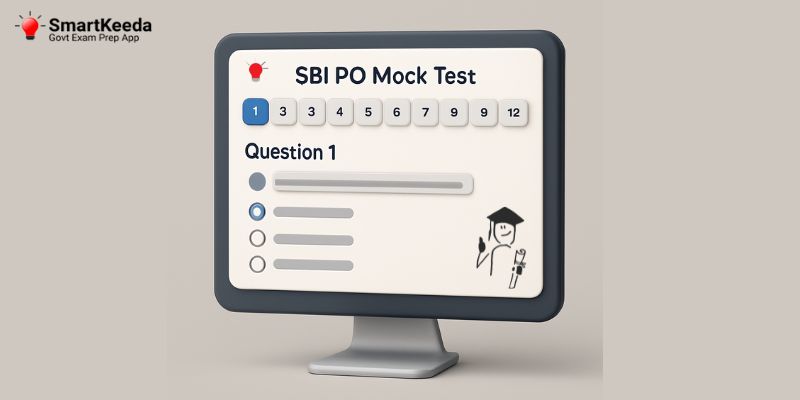
Preparing for the SBI PO exam requires a balance between strategy, knowledge, and practice. Among all preparation tools available, mock tests are the most effective in bridging the gap between learning and actual performance. However, simply attempting mock tests is not enough. The real magic lies in analyzing your performance and using it for smart revision. By doing so, you can identify your weak areas, strengthen your strong areas, and fine-tune your exam-taking approach. Let us understand step by step how to leverage mock test performance for smarter preparation.
Why Mock Tests are Essential for Banking Exams
Mock tests mimic the exact exam environment, helping aspirants experience time pressure, question distribution, and shifting levels of difficulty. They highlight the contrast between what you think you know and what you can actually apply during the test. More importantly, they act as a mirror, reflecting your accuracy, preparation gaps, and scope for improvement.
When used strategically, a good revision plan based on mock test results can significantly improve your overall score. The objective should not just be to attempt multiple mock tests, but to extract valuable lessons from each performance and refine your preparation accordingly.
Using SBI PO Mock Test Performance for Targeted Revision
The process of exam preparation is incomplete without assessment, and mock tests are the most reliable tool for this. By reviewing your strengths, weaknesses, speed, and accuracy, you can form a practical revision strategy rather than a random one. The usefulness of SBI PO Mock Test Performance for Targeted Revision lies in its ability to pinpoint exactly where you lose marks—whether due to conceptual gaps, lack of practice, or poor time management. With this insight, you can allocate focused revision sessions to weaker areas while maintaining regular practice in stronger ones, making your preparation smarter and more effective.
Key Areas to Focus During Mock Test Review
Accuracy vs Attempts – Many aspirants mistakenly focus on attempting more questions while ignoring accuracy. Review which sections reduce your overall percentage due to guesswork. Smart revision means knowing where accuracy weighs more than speed.
Time Distribution – Spend time analyzing how much time you are allotting to Quantitative Aptitude, Reasoning, and English. Are you overspending time in one section and panicking in another? Adjust revision by practicing sets in a timed manner.
Strong vs Weak Subjects – Instead of revising the entire syllabus repeatedly, identify whether your weak spot is arithmetic in Quant, puzzles in Reasoning, or comprehension in English. Target these areas more during revision.
Repeated Errors – If a specific concept keeps pulling down your score, such as ratio-proportion or seating arrangement, it signals a lack of conceptual grip. Smart revision requires re-learning basics here before practicing advanced levels.
Smart Strategies to Revise With Mock Test Insights
Create a Mistake Logbook: After every mock test, note down the type of mistakes—careless, conceptual, or time-based. Use this log for end-stage revision to avoid repeating the same errors.
Re-attempt Wrong Questions: Do not just view answer keys. Instead, re-solve the questions you got wrong without looking at the solution. This strengthens recall and problem-solving ability.
Revise in Cycles: Organize your revision in small cycles focusing on a weak topic, practicing additional sets, and taking a short test on that specific area before moving on.
Simulate Exam Pressure: Sometimes errors occur not due to lack of knowledge but due to pressure. During revision, attempt mini sectional tests with strict timing to build real exam endurance.
How SBI PO Mock Test Review Improves Final Preparation
The SBI PO Mock Test analysis becomes a roadmap for your last phase of preparation. With consistent review, you eliminate weak areas, learn to manage time effectively, and gain confidence before the actual exam. Instead of revising blindly, you follow a data-driven approach where every hour of study adds direct value to your potential performance in the exam.
By combining revision with mock test insights, aspirants learn discipline, accuracy, and exam temperament—all of which are critical for success in SBI PO examinations. Ultimately, the strategy is not about how many hours you study but about how you direct those hours smartly.
In conclusion, mock tests should never be limited to being just practice papers. The real benefit lies in their analysis and their role in shaping smart revision. Each attempt brings you closer to understanding not just the exam pattern but also your own strengths and weaknesses. If you use mock test results correctly, your revision will be sharper, more focused, and much more impactful.
At Examsacademy, we provide Best Online Coaching for the preparation of the SBI PO 2020 exam and all banking exams by providing test papers, free online mock tests, quality study materials with detailed course coverage and competing with exam aspirants.
We provide video lectures by excellent and experienced faculties.We keep students updated with the latest current affairs and GK which are vital for all the competitive exams.For a detailed and thorough preparation, we provide various mock tests which include practice tests, GK tests, sectional tests, daily tests, etc which helps our students to analyze their performance.

Welcome To Brain-nourish.com SBI PO sample paper download in India Download the SBI PO exam question paper sample in India.
BrainNourish provides you a platform to success in various competitive exams.
Get 9 SBI PO Prelim exam question paper at just 49 Rs.
Contact us now - +918766866627 SBI PO Selection ProcedureThe selection process of SBI PO consists of 3 phases (preliminary, mains and interview).
The candidates must qualify each of them to go on to the next phase.The important steps of the SBI PO Recruitment Procedure are as follows:Online Preliminary Examination:Sufficient number of candidates in each category is shortlisted by SBI depending upon the requirements for Online Main ExaminationOnline Mains Examination:Candidates need to qualify each section as well as the overall cut-off in the main exam to be eligible for an interview but in the year 2017, there is no Sectional cut off in SBI PO mains exam.
There is negative marking in SBI PO pre exam as 0.25 marks are deducted for every wrong answer.