

In today’s fast-paced business environment, executives face a common challenge: making critical decisions with incomplete or fragmented data.
Surprisingly, over 60% of business leaders admit to making strategic choices without a complete view of operations.
This is where Customer Relationship Management (CRM) steps in, not just as a sales tool, but as a strategic decision-making engine that empowers boards to forecast revenue, allocate resources efficiently, and align the organization toward growth.
CRM is Actually More Than a Sales Tool
Many organizations still perceive CRM as a system to track leads or customer interactions. In reality, a modern CRM captures every touchpoint across sales, marketing, and support, consolidating data into actionable intelligence.
For executives, this means:
- Identifying high-value clients and emerging opportunities
- Tracking team performance and bottlenecks in real-time
- Making resource allocation decisions based on facts rather than estimates
For example, a mid-sized manufacturing company previously relied on monthly sales reports to make production decisions.
They often overproduced or understocked due to delayed and anecdotal information. By implementing CRM, their board gained real-time visibility into orders and customer preferences, resulting in 15–20% more accurate forecasts and better inventory management.
Driving Accurate Forecasting Through Data
Forecasting is the backbone of strategic planning. CRM systems allow executives to analyze historical trends, pipeline velocity, and customer engagement to predict revenue accurately. The insights derived from CRM data help organizations:
- Anticipate seasonal and regional fluctuations
- Identify potential gaps in the sales funnel
- Mitigate risks before they impact revenue
Advanced CRM solutions now incorporate AI-driven predictive analytics, offering insights into likely deal closures, potential customer churn, and optimal marketing spend. This empowers boards to plan confidently and make decisions based on predictive intelligence, rather than assumptions.
Strategic Planning and Scenario Modeling
Beyond forecasting, CRM enables scenario modeling. Executives can simulate “what-if” situations, such as:
- What if we expand our sales team in a particular region?
- What is the impact of reducing churn by 5%?
- How would reallocating marketing budgets affect revenue and ROI?
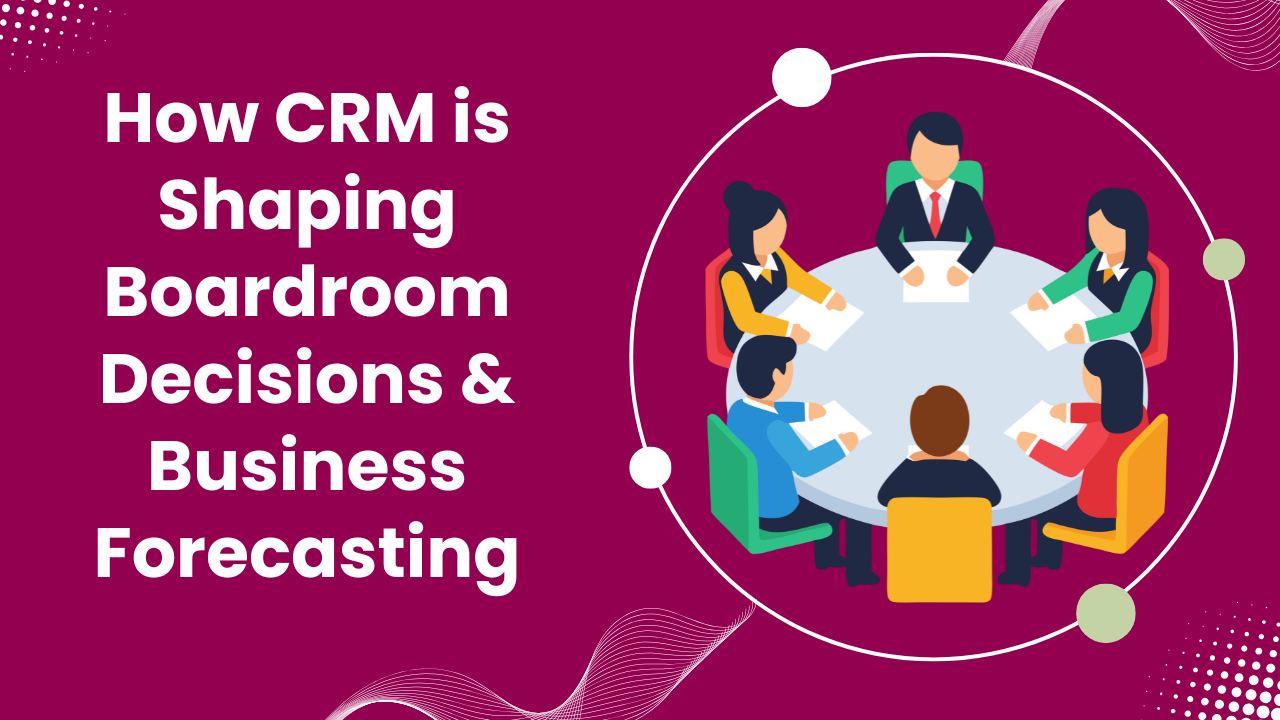
These simulations turn CRM into a virtual boardroom assistant, guiding leaders to make informed, strategic choices that maximize growth.
Breaking Down Organizational Silos
One of the biggest obstacles to effective decision-making is fragmented data across departments. Sales, marketing, finance, and operations often maintain separate systems, resulting in inconsistent reporting. A unified CRM consolidates all this information, providing:
- A single source of truth for board-level insights
- Consistent reporting across departments
- Improved collaboration and alignment for strategic initiatives
With centralized data, executives no longer rely on conflicting departmental reports and can make faster, more confident decisions.
Odoo ERP: Integrating CRM for Strategic Advantage
While CRM provides the data foundation, modern organizations need an integrated solution to connect every function across the business. Platforms like Odoo ERP offer:
- Real-time visibility into sales, finance, inventory, and operations
- Automated reporting and forecasting for boardroom-ready insights
- A unified platform that works quietly in the background, enabling executives to focus on strategic decision-making
The key is that Odoo CRM + ERP empowers leaders without adding complexity, making insights actionable across the organization.
Key Takeaways for Executives
- CRM is no longer just a sales tool; it’s a strategic enabler for the boardroom.
- Real-time data improves revenue forecasting and scenario modeling.
- Unified platforms break down silos, ensuring consistent insights across departments.
- Integrated systems like Odoo ERP turn raw data into actionable intelligence, supporting confident, data-driven decisions.
Executives should ask themselves: “Is my CRM giving me actionable insights, or just reports?” The difference can dramatically impact business outcomes.
Investing in CRM and integrated ERP systems is not about technology alone, it’s about empowering leaders with clarity, accuracy, and agility.
When executed well, CRM transforms how executives understand their business, forecast revenue, and make strategic decisions, turning raw customer data into a competitive advantage.
To know more drop us a line at sales@apagen.com or call us on +91 9971800665.