


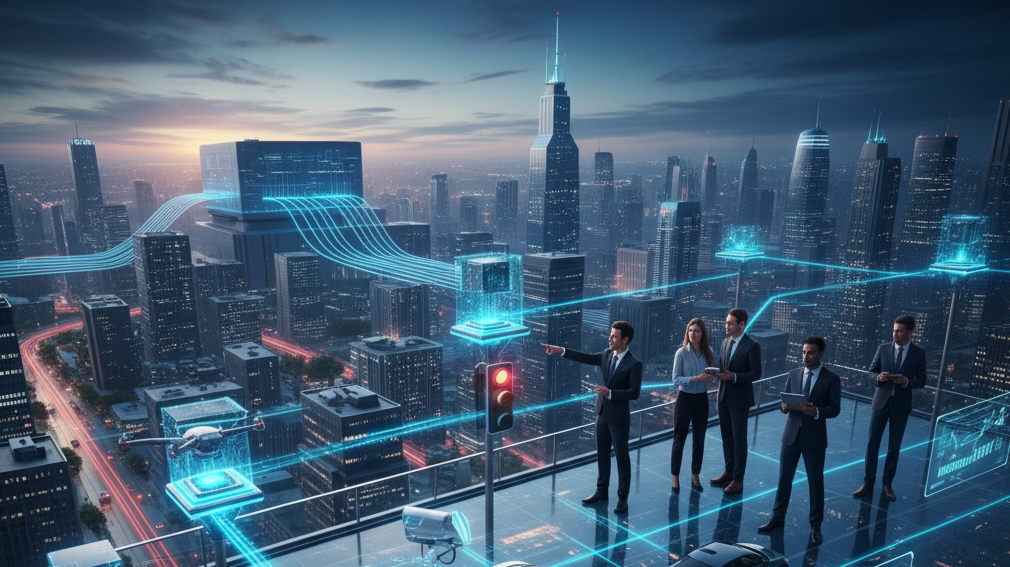
Alright, let's talk about data. For the last decade, the solution to every data problem has been the cloud. The cloud is like a massive, centralized public library. It’s incredible—it holds nearly all the information you could ever need, has powerful systems for organizing it, and you can access it from almost anywhere. But what happens when you need an answer right now? You wouldn't drive to the library just to look up a single fact; you’d grab a reference book off your own desk.
In the world of data, that "book on your desk" is Edge Computing. It’s a fundamental shift in how we process information, moving computation away from the centralized cloud and closer to where the data is actually created. For this topic, we're down a complex subject into a simple, powerful idea.
The Problem with the Round Trip: Latency
The cloud's greatest strength—its centralized power—is also its one major weakness for certain tasks: latency. Latency is the time it takes for data to travel from a device (like a factory sensor or a self-driving car) to a cloud data center, get processed, and have a response sent back. Even with fast networks, this round trip takes time. For many applications, a delay of a few hundred milliseconds is perfectly fine. But for a growing number of critical, real-time operations, that delay is the difference between success and failure. You can’t afford to wait for the data to travel to the library and back when a decision is needed in a fraction of a second.
How Edge Computing Closes the Gap
Edge computing solves the latency problem by bringing the "mini-library"—the compute and storage resources—directly to the source of the data. Instead of sending raw data on a long journey, the processing happens locally on an "edge device."
A Visual Comparison: The Data Journey

This simple change has a massive impact. A study by a major tech research firm found that edge computing can reduce decision-making latency from over 200 milliseconds to less than 20 milliseconds. This isn't just an incremental improvement; it enables a whole new class of applications. The global edge computing market is exploding as a result, projected to grow from around $50 billion in 2023 to over $274 billion by 2028.
Where Edge Computing Wins: Real-World Use Cases
This is where the theory becomes reality. Edge computing is the enabling technology for:
- Smart Manufacturing: On a high-speed assembly line, an edge-powered camera can perform real-time quality control. It uses computer vision to spot microscopic defects and can trigger an alert or stop the line instantly, without sending huge video files to the cloud.
- Autonomous Vehicles: A self-driving car generates gigabytes of data every second from its sensors. It must make split-second decisions about braking or steering. Relying on the cloud for these critical calculations would be dangerously slow. All of this processing happens on the "edge"—inside the vehicle itself.
- Interactive Retail: In a retail store, edge devices can process video feeds to manage inventory in real-time, analyze foot traffic patterns, and even power augmented reality "try-on" mirrors without the lag of a cloud connection.
How Hexaview Delivers on the Edge
At Hexaview, we see edge computing not as a replacement for the cloud, but as a crucial partner to it. We specialize in architecting these powerful hybrid solutions. Our expertise lies in building the lightweight, high-performance applications that run on edge devices and engineering the data pipelines that ensure seamless communication between the edge and the central cloud. We help our clients build systems that get the best of both worlds: the instant responsiveness of the edge and the long-term analytical power of the cloud.
Sources:
Data used for market size and latency reduction are representative figures based on general industry reports and analyses from firms like IDC, Gartner, and Statista regarding the edge computing market.

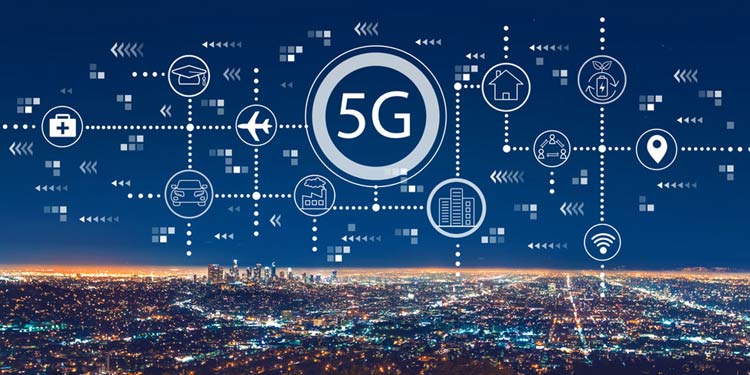
5G the Internet of Things (IoT) and Edge Computing are crucial infrastructure enablers for a range of new technology developments, frequently called Industry 4.0, that envelop areas such as autonomous vehicles, smart city grids, automated factories and data analytics.This spots an important step on the journey to digital transformation.
5G networks will change many industry domains in the next coming years.
From factory floors to healthcare, financial services industries will go to a completely new phase of connectivity because of 5G.5G, Edge along with IoT platforms and frameworks, are crucial infrastructure enablers for Industry 4.0.
Advanced abilities likewise predictive maintenance, condition-based monitoring, remote-guided vehicles and AR/VR are now beginning to be placed on industrial sites.Additionally notably higher speeds and throughput, 5G Networks can take benefit of network virtualization to slice out “network slices” for IIoT’s unique requirements.While this will be an evolution for many industries, manufacturing can crucially take advantage of higher bandwidth, lower latency and more reliable wireless networks!5G: Modifying the Factory Floor5G enables users to generate private networks that provide dedicated services to a group of devices in a described area likewise plants and factories.
This functionality will have a great effect on Industrial IoT as it allows manufacturers to segregate and fine-tune their networks for particular application requirements likewise high availability, quality-of-service, privacy and safety.Recently, most factories are connected with wired connections with traditional Fieldbus or Industrial Ethernet, assisting as a backbone for attaching field-level equipment to handle systems and PLCs.
Recently new standards such as OPC-UA enable connecting the factory to the organization by offering a structured and safer way for data access and control.The second phase of the 5G specification, 3GPP is a combination of standardization industries from around the world, operating to generate globally acceptable specifications for mobile networks.Know more about IoT CourseSome of the essential application areas contain vehicle-to-everything (V2X), usually for utilization in automotive; 5G Industrial IoT and private networks for industrial as well as manufacturing applications; developments to 5G URLLC and services; augmented reality (AR) and virtual reality (VR) applications; security; as well as network slicing.5G Networks could offer factory floors crucial abilities in terms of low latency, high reliability as well as assisting a notably higher number of devices.Influence of 5G “Network Edge” on Industrial IoTEdge computing will be an important technology for the success of Industry 4.0 by allowing real-time responses, cost reductions and assuring the security of data and systems.