


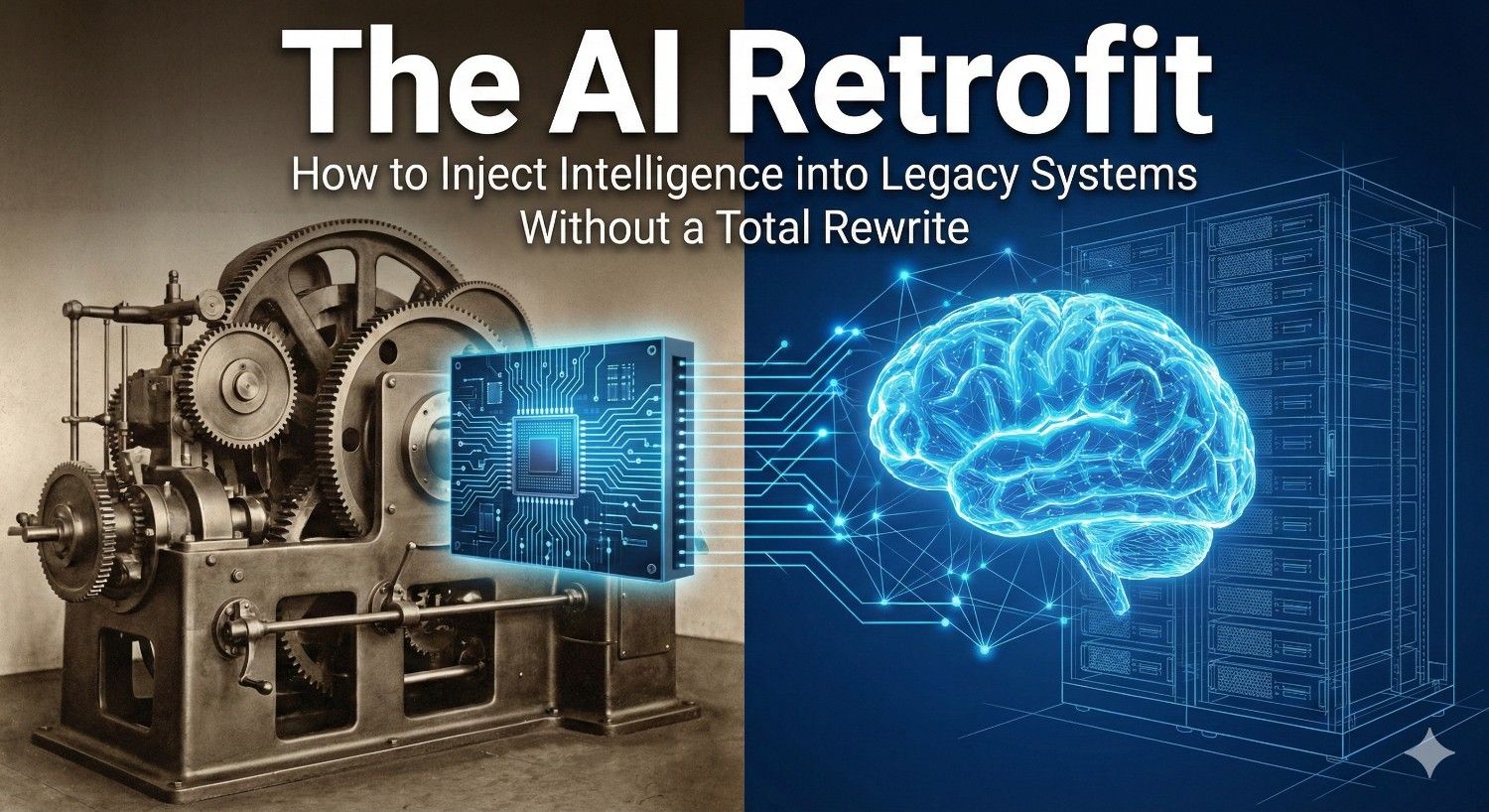
In the boardroom of almost every established enterprise, there is a tension between "The Old" and "The New." The Old is the massive, monolithic legacy system—the ERP from 2005, the Mainframe core, or the custom SQL application that runs the business. The New is the demand for AI, predictive analytics, and conversational interfaces.
The traditional IT instinct is to say: "To get AI, we need to rebuild everything. We need a 3-year cloud migration project to replace the monolith."
This is a trap. Total rewrites are notoriously risky, expensive, and slow. By the time the new system is ready, the market has moved on. The smarter, faster approach—and the one driving the modern AI Engineering discipline—is the AI Retrofit.
Just as you don’t demolish a house to install a smart thermostat, you don’t need to delete your legacy code to get intelligent features. By treating your existing systems as stable "Systems of Record" and building a modern "System of Intelligence" on top of them, you can unlock 80% of the value of AI with 20% of the risk. This is the art of engineering AI around the monolith, not instead of it.
The Philosophy: Treat Legacy as a Data Source, Not a Destination
The core shift in thinking is to stop viewing your legacy application as the user interface and start viewing it merely as a database with rules.
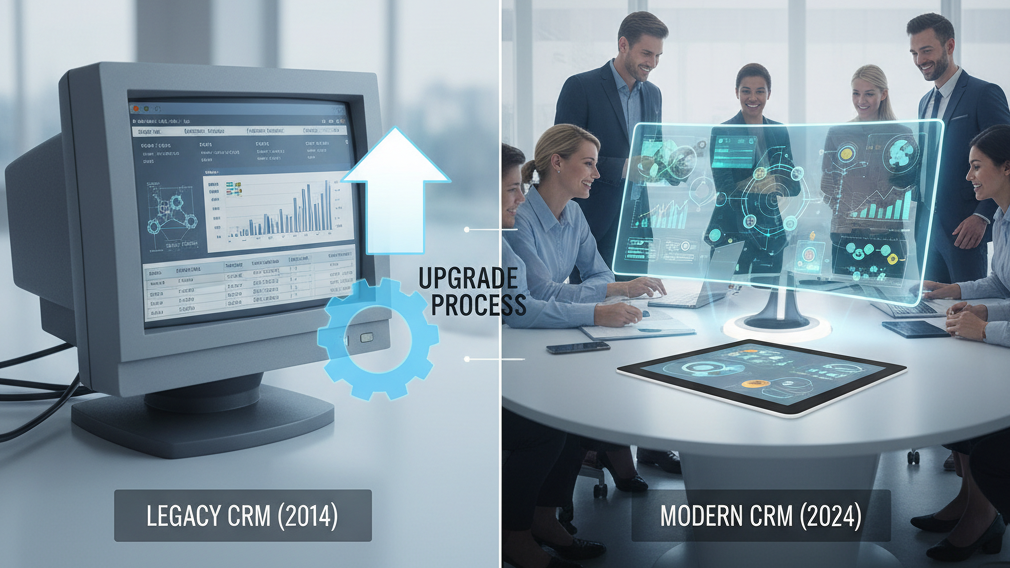
Your 15-year-old CRM might have a terrible user interface (UI), but it has valuable data. It knows every customer, every transaction, and every pricing rule. The goal of AI Engineering in this context is to build a new, intelligent "shim" or layer that sits between the user and that old system.
This layer handles the reasoning, the natural language understanding, and the prediction. It then "talks" to the legacy system using whatever crude methods are available (SQL, SOAP APIs, or even file drops) to execute the final transaction. The user feels like they are using a cutting-edge AI tool; the backend is still the sturdy, paid-for legacy server.
Strategy 1: The "Sidecar" Database (RAG on Legacy)
The most common complaint about legacy systems is, "The data is in there, but I can't find it." Search is slow, and reporting is rigid.
The AI Solution: Instead of migrating the data, we sync it.
- The Engineering: We build a pipeline that replicates key text fields from the legacy database (notes, logs, descriptions) into a modern Vector Database.
- The Experience: We build a "Chat with your Data" interface. When a user asks, "Show me all claims involving water damage from 2020," the AI queries the Vector DB (fast/smart), finds the IDs, and then fetches the specific details from the Legacy DB (slow/reliable).
- The Result: Instant semantic search without changing a single line of legacy code.
Strategy 2: The API Wrapper (The Universal Translator)
Legacy systems often require users to memorize complex codes or navigate 10 screens to do one thing (e.g., "Update Address").
The AI Solution: An AI agent that acts as a translator.
- The Engineering: We expose the legacy system's functions via an API wrapper (or an RPA bot if no API exists). We then connect an LLM to this wrapper using "Function Calling."
- The Experience: The user types: "Update the shipping address for Order #123 to 5th Avenue." The AI parses the intent (Update_Address), extracts the entities (#123, 5th Avenue), converts them into the rigid format the legacy system demands (JSON or XML), and fires the request.
- The Result: A conversational interface for a command-line era backend.
Strategy 3: The Intelligent Observer (Predictive Overlay)
Legacy systems are reactive. They wait for input. AI can make them proactive.
The AI Solution: A monitoring layer that watches the legacy database.
- The Engineering: We set up a "Change Data Capture" (CDC) stream. Every time a new record is inserted into the legacy DB (e.g., a new loan application), a copy is sent to an AI model hosted in the cloud.
- The Experience: The model analyzes the application in real-time for fraud risk or creditworthiness. It then writes a "Risk Score" back into a custom field in the legacy database.
- The Result: The old system now displays "AI Insights" that it didn't generate itself.
Visualizing the Architecture: The Intelligence Layer
The goal is to decouple the "Intelligence" from the "Record Keeping."

The Business Case for Retrofitting
This approach aligns perfectly with modern budget constraints.
- Speed: An AI overlay can be built in 3-6 months. A system rewrite takes 3-5 years.
- Cost: You leverage the sunk cost of your existing infrastructure.
- User Satisfaction: Employees get a modern tool immediately, improving retention and productivity, while the "backend modernization" can happen quietly in the background over the next decade.
How Hexaview Engineers the Retrofit
At Hexaview, we specialize in "Brownfield" AI Engineering. We love the challenge of messy, older systems because that is where the most valuable data lives.
Our approach to improving existing systems includes:
- Non-Invasive Integration: We build read-replicas and API gateways that allow us to extract data without slowing down your core transaction processing.
- Hybrid Architecture: We deploy the AI components in a modern cloud (AWS/Azure) while securely tunneling to your on-premise legacy servers, giving you the best of both worlds.
- UI Modernization: We build the lightweight web or mobile apps that serve as the new "face" of your old system, powered by the AI backend.
We help you skip the rewrite and go straight to the intelligence.


CartUp AI is a cutting-edge AI solution for e-commerce.
It is a SaaS solution that delivers immediate e-commerce sales growth through powerful AI.
By deploying CartUp AI within their e-commerce platform, e-commerce merchants will improve e-commerce conversion and upsell through recommendations and Ecommerce Personalized search.