Who this is for
You’re an SEO professional who’s already experimented with large language models (LLMs). You want concrete, battle-tested systems for planning, producing, and measuring work in an AI-shaped search landscape. This guide is conversational, practical, and designed so you can ship changes this week.
TLDR
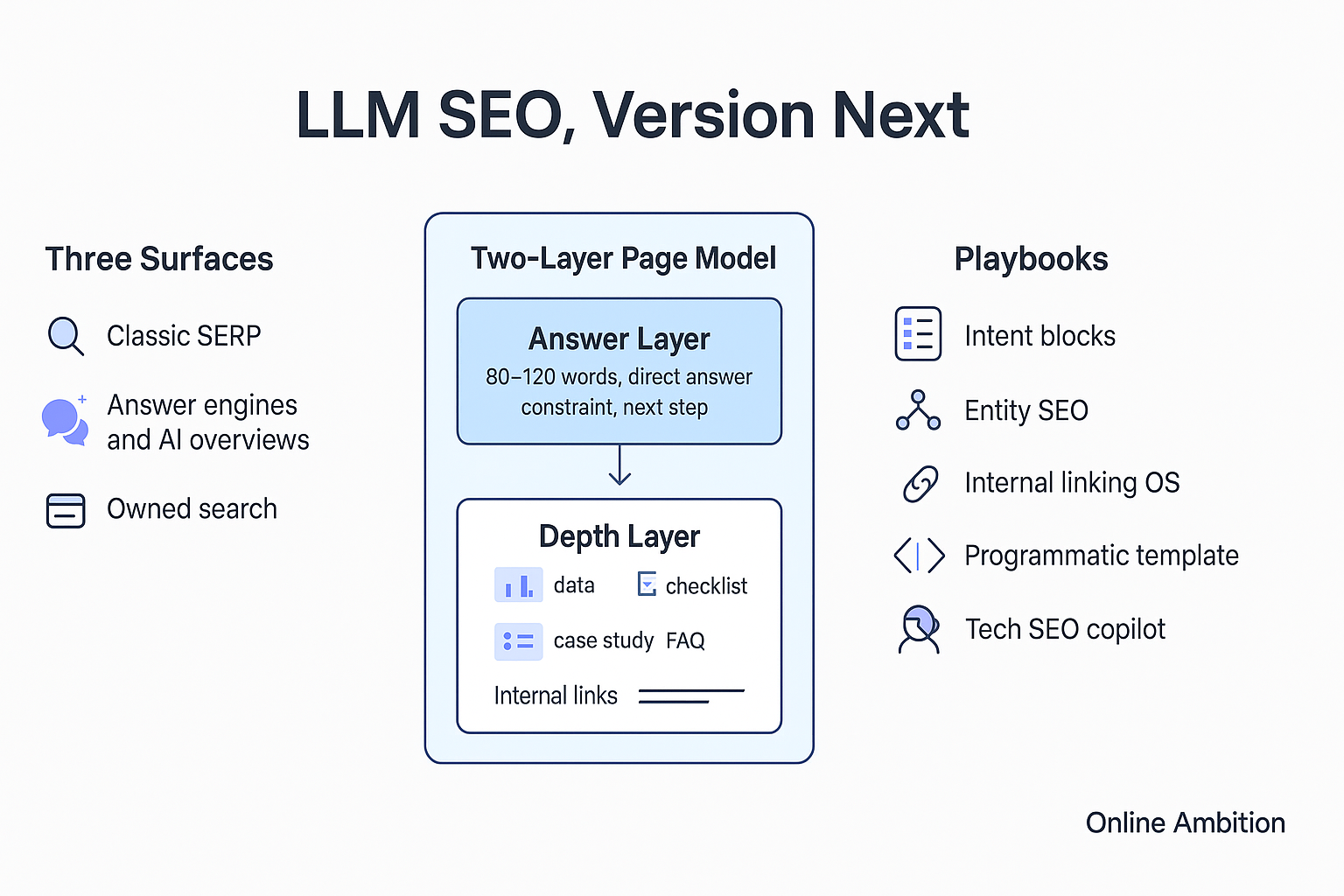
Treat every page as two layers: an extractable Answer Layer for AI and skimmers, and a Depth Layer with evidence, steps, and examples for humans.
Build content around intent clusters and answer shapes (definition, diagnostic, comparison, step-by-step, calculator, policy, case).
Use LLMs for the heavy lifting (ideation, drafts, internal link suggestions, schema scaffolds), then add information gain: data, screenshots, mini-cases, first-party insights.
Measure four lanes, not just rankings: usefulness, visibility, commercial impact, and operations.
Scale programmatic SEO with strict guardrails so you never ship zombie pages.
Visual: The Two-Layer Page Model (simple text diagram)
[User query] → [Answer Layer: 80–120 words, direct answer, extractable] → [Depth Layer: proof, steps, examples, FAQs, internal routes] → [Next best action]
The Answer Layer earns snippets, PAAs, and AI citations. The Depth Layer wins trust, dwell time, links, and conversions.
1) Keyword research reimagined: from terms to tasks
Classic tools give you term lists. LLMs help you model jobs-to-be-done and the obstacles that trigger search.
Workflow you can run today
Interview the AI about your audience’s job, risks, constraints, and success criteria.
Convert those into topic opportunities grouped by job and stage (discover, diagnose, decide, implement, optimize).
Map each opportunity to an answer shape and page type.
Validate with quick SERP spot-checks; prune anything that doesn’t align with observed intent.
Prompt you can paste
You are a senior SEO. For audience [X] trying to achieve [Y], list 10 jobs-to-be-done, 10 risks/constraints, and 10 success criteria. Turn these into a topical map with clusters. For each cluster, propose: primary queries, answer shape, page type, funnel stage, and one metric the reader cares about.
Deliverables
A topical map that mirrors real tasks, not just keywords.
A backlog with answer shapes and evidence requirements per page.
2) Answer Layer engineering: win snippets and AI mentions
Your first 120 words should deliver a self-contained answer the model (and human) can lift without edits.
Checklist
One question, one answer.
Plain language, one idea per sentence.
Include one verifiable detail or constraint.
End with a micro-route: “If [X], go to [Y].”
Micro-components to standardize
TLDR summary
Three outcome bullets
One risk or trade-off note
One “what to do next” sentence
Prompt you can paste
Write an Answer Layer (≤120 words) for [topic] that directly answers [core question]. Include one concrete constraint and a next-step route. Avoid fluff, hedging, and clichés.
3) Depth Layer: information gain over word count
LLMs write fluent text; they don’t produce your proprietary proof. Flip the order: collect evidence first, then draft.
Evidence menu
First-party numbers (anonymized screenshots work)
Mini-cases (three-sentence before/after)
Process artifacts (checklists, templates, decision trees)
Comparative observations from your audits
Clear failures and what you changed
Editor rubric
Every claim traces to a source (internal or external).
At least one detail a competitor can’t easily copy.
Follow-ups answered in FAQs using short, excerptable paragraphs.
4) Playbooks you can steal
A) Entity-first content that disambiguates
Introduce primary entity (who/what/for whom).
Mention related entities naturally (industries, platforms, locations).
Use Organization/LocalBusiness/Product schema and sameAs to authoritative profiles.
Add a 60–90 word “In brief” block near the top to reduce ambiguity for parsers.
Quick prompt
Review this draft for entity clarity. List missing entities and propose an “In brief” summary that disambiguates the topic in 80–90 words.
B) Internal linking as an operating system
Define a hub per cluster.
Each new page must link to its hub, two siblings, and one deep explainer.
Anchors: 4–8 natural words, paragraph-embedded, varied by context.
Track coverage in a simple sheet: page, inlinks, outlinks, last QA date.
Quick prompt
Given these 12 URLs and excerpts, propose internal link insertions. For each new page: 1 hub link, 2 sibling links, 1 deep-dive link. Return suggested anchors and the exact sentence where the link should live.
C) Programmatic SEO without thinness
Template sections
TLDR (two sentences)
Who this is for and not for
Selector or diagnostic checklist
Localized proof or segmented examples
Short FAQ (5–7 items)
Guardrails
Minimum two unique proofs per page.
Similarity scan across pages before publish.
Redactor notes where inputs are missing; never invent facts.
90-day refresh cadence with a “what changed” note.
Quick prompt
Generate page copy for this template and CSV inputs. Where data is missing, insert a redactor note. Return a checklist of additional evidence needed before publish.
D) Technical SEO with AI co-pilots
Good candidates
Drafting hreflang maps from locale lists
JSON-LD scaffolds (Organization, FAQPage, HowTo, Product)
Redirect rules from crawl exports
Explaining audit findings to non-technical stakeholders
Prioritization by impact/effort with test plans
Non-negotiables
Validate schema with testing tools.
Stage redirects, measure before/after, keep a rollback plan.
Log changes with owner and timestamp.
Quick prompt
You are a technical SEO lead. Convert this redirect spreadsheet to .htaccess rules and a QA plan with test cases, expected status codes, and rollback steps.
5) On-page micro-optimizations that actually move the needle
Titles and H1s
Patterns that win clicks
Outcome first, qualifier second
Audience call-out in ≤5 words
Avoid generic superlatives
Checklist
Title ≤60 chars, no truncation of the value.
H1 promises exactly what the page delivers.
Distinct phrasing across the cluster.
Quick prompt
Produce three CTR-first title options (≤60 chars) and one H1 for each of these URLs and intents. Avoid words like ultimate, complete, comprehensive.
Meta descriptions
Treat them as a promise you can keep: outcome + method/proof + next step.
Quick prompt
Write one meta description (≤155 chars) per URL. Include the primary outcome and one proof element (method, data point, or case).
Images and accessibility
Alt text: describe function, not just appearance.
Captions: add one new fact or constraint.
Provide transcripts for any embedded video or audio.
6) Measuring success in an AI-shaped landscape
Move beyond rank-only dashboards. Track four lanes.
A) Usefulness (behavioral)
Time to first meaningful section
Scroll depth to first proof element
FAQ interactions or copy events
Bounce with quick return vs bounce after answers found
B) Visibility (SERP and AI)
Classic: impressions, clicks, CTR, rankings
Snippet/PAA win rate per cluster
Emerging: AI overview mentions and answer citations where tools permit tracking
C) Commercial impact
Assisted conversions from informational pages
Lead quality by cluster and answer shape
Sales velocity influenced by comparison content
D) Operations
Brief-to-publish cycle time
Editor time per AI-assisted draft vs human-only
Refresh cadence adherence and uplift after refresh
Visual: Simple KPI ladder (text chart)
Inputs → Activities → Outputs → Outcomes
Evidence gathered → Briefs and drafts shipped → Snippets/PAAs won → Assisted conversions and revenue
Keep one metric per rung visible on your dashboard.
7) Governance: speed with safety
Hallucinations and accuracy
Never ask the model to invent numbers; supply datasets.
Require source notes for non-obvious claims.
For YMYL or high-stakes content, enforce SME review and a change log.
Brand voice and tone
Maintain a one-page style card with examples to emulate and phrases to avoid.
Include the style card in every prompt until consistent.
Run a “fluff pass” to remove repetition and filler.
Privacy and security
Strip PII and secrets from prompts.
Prefer enterprise AI environments for sensitive workflows.
Keep audit trails of AI-assisted changes.
8) A 90-day rollout plan
Days 1–30: Prove value fast
Select one high-value cluster and build a new hub with the two-layer model.
Standardize micro-components: Answer Layer, TLDR, FAQ, proof blocks.
Ship 5–8 pages; instrument behavioral KPIs.
Stand up link recipes; measure inbound/outbound coverage.
Days 31–60: Scale with control
Add one programmatic template with strict guardrails.
Generate schema scaffolds and internal link suggestions at scale with review.
Launch the four-lane dashboard (usefulness, visibility, commercial, ops).
Run a refresh sprint on underperformers using answer-shape adjustments.
Days 61–90: Harden and optimize
Document SOPs for briefs, QA, updates, and redirects.
Add similarity scans and evidence checks to CI or pre-publish.
Train writers and editors on evidence-first drafting and style card usage.
Set quarterly targets for snippet/PAA coverage and time-to-value.
9) Prompts you’ll actually reuse
Gap-finder brief
Analyze the top three competitor pages for [topic]. List five information gaps we can fill, the answer shapes we should use, and the specific evidence we need. Output an H2/H3 outline, FAQs, and proof assignments.
Answer-shape router
Classify these 40 queries by answer shape. Provide a two-sentence TLDR answer and the recommended page or component for each.
Refresh surgeon
For this underperforming URL, propose a surgical plan: sections to remove, sections to expand, proofs to add, internal links to adjust, and two new FAQ items.
Internal linker
For this cluster, write 20 natural anchor variants (4–8 words) per concept. Group by concept and suggest paragraph placements.
Stakeholder translator
Explain these technical SEO issues in executive-friendly language: why it matters, expected impact, timeline, and how we’ll measure success.
10) Where this is heading and how to prepare
Multimodal answers become standard: pair text with concise charts, annotated screenshots, and short clips; always provide transcripts and descriptive alt text.
Entity clarity is table stakes: every important page states who/what/for whom/where in plain language and schema.
Conversation memory matters: anticipate follow-ups within the page to earn more AI citations and keep readers engaged.
New visibility metrics mature: expect better reporting on AI mentions and assisted discovery; build your dashboard with placeholders now.
Your next three actions
Rebuild one key hub with the two-layer model and answer-shape sections.
Launch link recipes and track coverage per new page.
Stand up the four-lane dashboard and set baselines now.
If you want a partner already operating this way across content, technical, and measurement, talk to Online Ambition
for AI-forward SEO growth.