


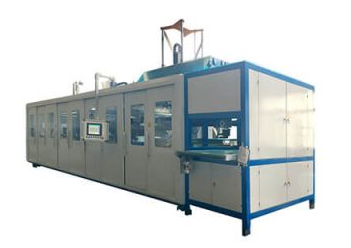
Efficiency is the heartbeat of modern industry. Across sectors—from automotive to packaging, aerospace to medical technology—manufacturers are under growing pressure to produce faster, with higher precision, and at lower cost. Amid this persistent challenge, one piece of equipment has emerged as a true transformation catalyst: the Twin Sheet Thermoforming Machine.

As global production evolves toward leaner, greener, and smarter operations, thermoforming technologies continue to redefine how plastic components are designed and fabricated. Traditional single-sheet forming methods still hold value, but when projects demand complex hollow structures with high rigidity and appealing surface finishes, the Twin Sheet Thermoforming Machine reigns supreme.
At Shanghai Zhanshi Mechanical Equipment Co., Ltd., we have positioned ourselves at the forefront of this innovation. With decades of mechanical design expertise and a deep understanding of material behavior, we engineer twin sheet thermoforming machine that maximize throughput, precision, and versatility.
What Is a Twin Sheet Thermoforming Machine?
In its simplest form, thermoforming involves heating a plastic sheet until it becomes pliable, then molding it over a pattern or into a mold using vacuum or pressure. The twin sheet variant takes this principle twice over—forming two separate sheets simultaneously and fusing them together at specific points to create a hollow and highly durable component.
The process unfold as follows:
- Sheet Loading and Heating: Two sheets of thermoplastic material are positioned on opposite platens within the machine. Each sheet is heated to its forming temperature using precisely controlled infrared heaters.
- Mold Closing and Shaping: As soon as both sheets reach the required softness, they are brought together between two opposing molds—one for each sheet. Vacuum and pressure shape both halves simultaneously to the mold cavities.
- Bonding and Cooling: The molds close further, allowing the hot perimeters of the two sheets to bond under pressure, forming a unified hollow structure. The newly formed part cools under controlled air flow.
- Trimming and Finishing: After cooling, the formed component is removed for edge trimming, finishing, and quality inspection.
This process produces rigid, lightweight, and dimensionally stable plastic assemblies that rival blow-molded or rotationally molded parts but with far greater efficiency and design flexibility.
The Engineering Behind the Technology
What makes the Twin Sheet Thermoforming Machine truly impressive is its balance of mechanical precision, thermal consistency, and material versatility.
1. Temperature Management
Each sheet must be uniformly heated—a challenging task considering varying sheet thicknesses and material responses. Advanced temperature zones and infrared elements ensure even heat distribution, preventing warpage or incomplete fusion.
2. Mold Design Precision
Molds must align perfectly to achieve bonding accuracy down to fractions of a millimeter. Modern CNC machining allows intricate mold geometries, integrated venting channels, and texture replication, empowering manufacturers to replicate fine aesthetic details.
3. Automated Control Systems
State-of-the-art PLC (Programmable Logic Controller) systems monitor temperatures, pressure levels, forming time, and cooling cycles. This automation not only enhances repeatability but also minimizes human error, yielding consistent quality from batch to batch.
4. Rapid Changeover Features
Because industries increasingly require adaptability, Shanghai Zhanshi’s Twin Sheet Thermoforming Machines include modular tooling and quick mold-change systems. Operators can switch production between component types or materials with minimal downtime.
Key Advantages of Twin Sheet Thermoforming
Let’s explore why this technology has earned global recognition across competitive manufacturing sectors.
1. Lightweight Strength
One of the most remarkable advantages is its ability to achieve structural strength without unnecessary weight. By producing hollow sections, manufacturers save material and reduce component weight while maintaining rigidity—ideal for industries like automotive and aerospace.
2. Design Freedom
Twin sheet thermoforming enables engineers to design parts that combine aesthetic surface appeal on both sides with functional internal cavities. Incorporating features such as reinforcement ribs, air ducts, or foam inserts becomes straightforward.
3. Cost Efficiency
Compared to injection molding or blow molding, the tooling for a Twin Sheet Thermoforming Machine is relatively inexpensive and quick to produce. Moreover, cycle times are shorter, and energy consumption is reduced thanks to efficient heat distribution.
4. Multi-Material and Color Options
Manufacturers can thermoform two different sheets simultaneously—for example, combining one layer for strength and another for appearance, or co-molding colored and textured materials to eliminate painting steps.
5. Recyclability and Sustainability
Modern thermoplastics such as HDPE, ABS, and polypropylene are recyclable. Twin sheet forming minimizes off-cut waste, aligning perfectly with sustainability goals and environmental regulations.
6. Superior Acoustic and Insulation Properties
Hollow structures provide excellent sound dampening and thermal insulation compared to solid plastic parts. This benefit is especially relevant to automotive interior panels and appliance enclosures.
7. High Productivity and Repeatability
Automation integration within Shanghai Zhanshi’s systems allows for consistent output. Once set up, the machine achieves uniform cycle times and reproducible dimensional accuracy across long production runs.
Applications Across Industries
The versatility of a Twin Sheet Thermoforming Machine is one of its greatest benefits. Its applications extend across industries, each exploiting the technology’s unique ability to produce durable yet lightweight parts.

1. Automotive Industry
Twin sheet thermoforming is ideal for producing automotive door panels, seat backs, consoles, underbody shields, and even electric vehicle battery covers. These parts require rigidity, reduced mass, and sometimes complex cooling or wiring pathways within the hollow structure.
2. Packaging and Logistics
Reusable shipping containers, pallets, and protective cases benefit from twin sheet technology. The parts are strong enough to handle repeated use and impact while remaining light enough for easy handling.
3. Aerospace and Aviation
Seat components, luggage bins, and ducting elements for air systems rely on the precision and low weight provided by advanced thermoplastic composites.
4. Medical and Healthcare
Hospitals use equipment housings and ergonomic casings produced by twin sheet thermoforming. The smooth, sealed surfaces are hygienic, easy to clean, and resistant to contamination.
5. Electronics and Appliance Housings
From refrigerator panels to computer casings, twin sheet forming offers designers two finished surfaces—one interior and one exterior—without requiring secondary assembly or painting.
Shanghai Zhanshi Mechanical Equipment Co., Ltd.: Engineering for Performance
As a leading name in mechanical forming systems, Shanghai Zhanshi Mechanical Equipment Co., Ltd. stands for innovation, craftsmanship, and reliability. Every Twin Sheet Thermoforming Machine is built to exacting standards, supported by advanced production technology, meticulous testing, and dedicated service.
Core Design Strengths
- Precision Temperature Control: Optimized heater arrays for balanced sheet softening.
- Intelligent Vacuum and Pressure Systems: Ensuring exact material conformation and strong inter-sheet bonding.
- Efficient Cooling Technology: Shorter cooling cycles mean faster throughput without compromising dimensional stability.
- Ergonomic Operator Interface: Intuitive screens and programmable memory simplify recurring runs.
- Robust Mechanical Framework: Compact structure, reduced vibration, and longer lifespan.
The result is a machine platform capable of supporting complex production requirements while guaranteeing long-term operational reliability.
Efficiency Reinvented: Productivity Through Smart Design

Modern manufacturing thrives not merely on speed but on intelligent efficiency. Shanghai Zhanshi designs each Twin Sheet Thermoforming Machine around this concept.
1. Reduced Cycle Time
Innovative thermal zoning and rapid mold closing mechanisms cut average forming cycles, enabling multi-shift manufacturing with consistent productivity.
2. Lower Operating Costs
Energy-efficient heaters, optimized airflow cooling, and minimal compressed air consumption lead to measurable cost savings in every production cycle.
3. Minimal Manual Intervention
Automated sheet loading, trimming integration, and sensor-based feedback loops reduce labor dependency, freeing skilled operators for higher-order tasks.
4. Enhanced Quality Control
Built-in monitoring modules continuously track vacuum pressure, sheet temperature, and mold alignment to maintain consistent forming integrity.
In other words, every second saved and every gram of material utilized more effectively translates into tangible business advantages—and that’s the essence of efficiency in the modern era.
Sustainability and the Circular Economy
In today’s environmentally conscious landscape, manufacturing success also depends on ecological responsibility. The Twin Sheet Thermoforming Machine supports these principles by:
- Reducing Material Waste: Unlike solid-molding techniques, twin sheet forming uses only the necessary material volume.
- Promoting Recyclable Materials: Most thermoplastics used in the process can be ground and reused for further production.
- Energy Efficiency: Smart heating control minimizes electricity usage, reducing carbon footprint.
- Longer Part Lifespan: Highly durable products mean fewer replacements, conserving resources over time.
Shanghai Zhanshi’s engineering philosophy centers on sustainability without compromise—responsible design combined with cutting-edge performance.
Integration with Industry 4.0
As factories around the world transition into smart manufacturing ecosystems, the next generation of Twin Sheet Thermoforming Machines is fully compatible with Industry 4.0 principles.
Intelligent connectivity enables:
- Real-time Production Monitoring: Sensors capture operational data for temperature, vacuum flow, and cycle times.
- Predictive Maintenance Alerts: Prevent downtime by diagnosing early signs of component wear.
- Remote Supervision: Managers and engineers can control and adjust parameters remotely.
- Data Analysis for Optimization: Collected metrics refine future production strategies.
By combining physical craftsmanship with digital intelligence, Shanghai Zhanshi’s solutions extend far beyond conventional thermoforming—they become part of the smart factory ecosystem.
Future Trends: The Road Ahead
The thermoforming industry continues to evolve toward greater adaptability and integration. Several emerging trends will shape the future:
- Composite Twin Sheet Forming: Using reinforced thermoplastics such as carbon fiber-reinforced polymers will allow hybrid, ultra-strong lightweight parts.
- 3D Mold Technology: Dynamic molds with variable surfaces may soon enable multi-contour forming for enhanced design flexibility.
- Automation Synergy: Robotic handling systems will further streamline the trimming, sorting, and stacking of finished components.
- AI-Driven Optimization: Artificial intelligence algorithms analyzing sensor data will minimize waste and enhance precision automatically.
Shanghai Zhanshi Mechanical Equipment Co., Ltd. remains deeply invested in these technological frontiers, pushing engineering frontiers to ensure clients stay one step ahead in a rapidly transforming manufacturing world.
Efficiency, Expertise, and the Future of Forming

The manufacturing landscape is defined by one universal pursuit—maximized efficiency. Every advancement that saves time, conserves energy, and improves quality propels industries toward greater sustainability and competitiveness. The Twin Sheet Thermoforming Machine embodies that pursuit.
By fusing advanced temperature control, mechanical precision, and intelligent operation, it produces components that are lighter, stronger, and more economical than ever before. For forward-looking manufacturers, it’s not just another production asset—it’s a gateway to modernized operations.
Frequently Asked Questions (FAQ)
1. What exactly is a Twin Sheet Thermoforming Machine?
It’s a specialized thermoforming system that simultaneously heats and shapes two plastic sheets, bonding them together to create a hollow, strong, and lightweight component.
2. How does it differ from single-sheet thermoforming?
Single-sheet processes form one side of a product over a mold, while twin sheet machines form both sides and fuse them, allowing creation of closed hollow structures with improved mechanical properties.
3. What materials can be formed using this technique?
Common materials include ABS, HDPE, HIPS, PP, PC, and PETG. Choosing the right material depends on the strength, heat resistance, and finish required.
4. In which industries are Twin Sheet Thermoforming Machines used most often?
They’re widely used in automotive, aerospace, packaging, appliances, electrical housings, and medical equipment production.
5. What are the main advantages compared to blow molding?
Twin sheet thermoforming provides better surface finish, allows varying wall thickness, uses less material, and achieves quicker mold changes with lower tooling costs.
6. How energy‑intensive is the process?
Thanks to advanced heating control and efficient cooling systems, energy usage per part is significantly lower than traditional molding processes.
7. Is the machine easy to operate?
Modern models developed by Shanghai Zhanshi feature digital interfaces and programmable settings, making operation straightforward even for new staff.
8. Are the machines customizable?
Yes, Shanghai Zhanshi offers customization in size, heating zones, vacuum capacity, and mold platform dimensions to match each client’s production needs.
9. How durable are parts formed by this method?
Twin sheet thermoformed parts exhibit impressive impact resistance, tensile strength, and structural stability, meeting demanding industrial requirements.
10. What kind of maintenance does the machine require?
Routine cleaning, heater inspection, lubrication, and calibration checks are typical. With proper care, machines operate reliably for many years.
11. Can recycled materials be used?
Yes, many thermoplastic sheets made from post-consumer or post-industrial recycled content perform well in vacuum forming applications.
12. How does Shanghai Zhanshi support customers after installation?
Comprehensive technical support includes training, maintenance guidance, spare parts supply, and on-site or remote diagnostics.
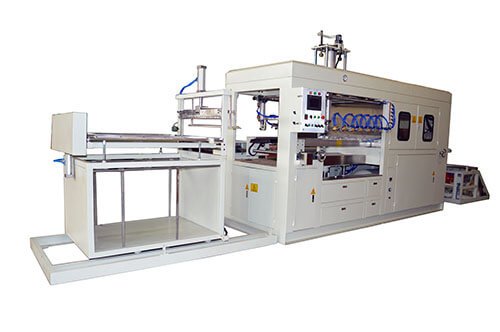
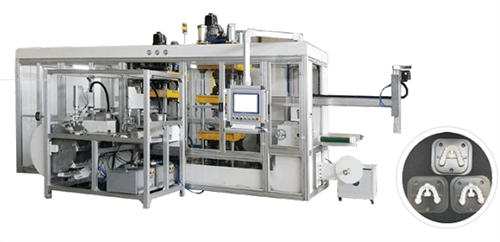
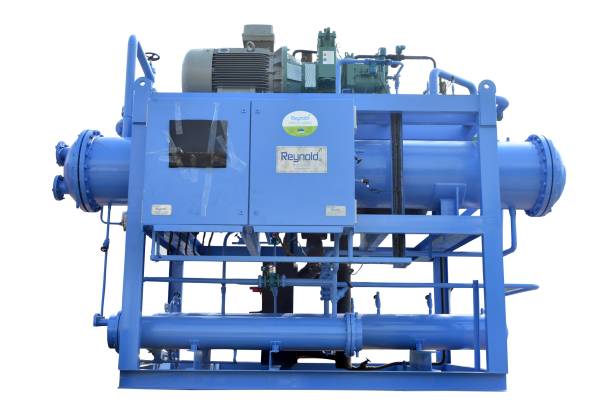
Advanced and modernized Heavy Duty 10W Industrial Water Chiller with Multi-Layer Circuit Control manufactured by Reynold India is available for industrial and commercial use.
The Function of Industrial Chiller for Multi-LayerThe water chiller for multilayer utilizes a steam solidity mechanical coolant system that attaches to the water system through an evaporator machine.Coolant flows via an evaporator, compressor, and extension equipment of a chiller.
Thermodynamic procedures take place in all parts of a chiller.
The evaporator operates as heat replacement, so that heat squeezed by process refrigerant circulates to the coolant.
When heat transmission occurs, coolant evaporates, converting low-temperature fluid into steam, whereas the temperature of the procedure refrigerant is eliminated.
Take a look at the different features of industrial chiller for multi-layer circuit control:- The multilateral circuit control framework Top efficiency green shade wooden box packing water chiller Single slice accuracy communication framework Save high raising power bills As far as thermoforming is concerned, it is a manufacturing procedure in which a polymer sheet is warmed up to adjustable temperature to a particular figure in a mold and cropped down to make working goods.
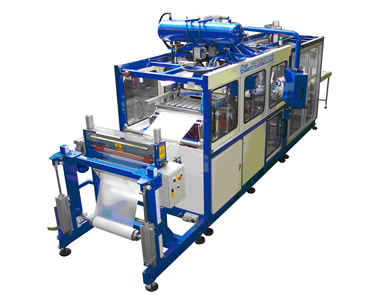
Thermoformed plastic packaging technique that involves heating a plastic sheet until it becomes malleable, shaping it into a particular shape, and trimming it to make a finished product.
Many types of packaging, such as plastic clamshell trays, blisters, and lidding film, are made using thin-gauge thermoforming.