Introduction
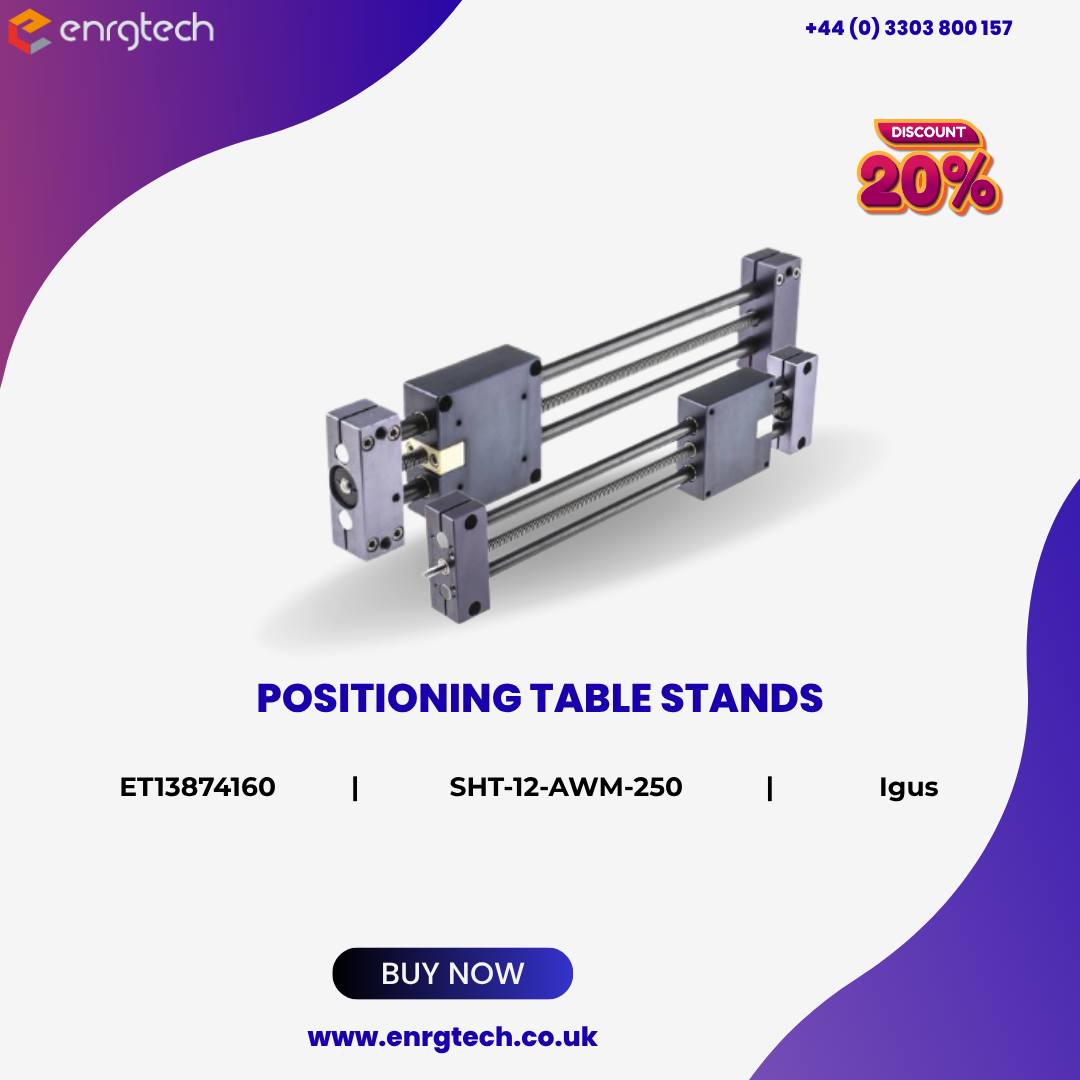
When selecting a powerful and reliable positioning system for industrial automation, the SHT-12-AWM-250 positioning table offers a compelling package of durability, precision, and adaptability. Below we explore how its features align with performance-driven applications in electronics and electrical component manufacturing.
Key Specifications of the SHT-12-AWM-250 Positioning Table
This positioning table is built to perform in demanding environments with the following core attributes:
Static radial load capacity of up to 2,800 N, enabling heavy duty support.
Dynamic radial load capacity of up to 2,000 N, ensuring smooth motion under moving loads.
Stroke length of 250 mm, carriage width of 85 mm, and overall length of about 395 mm.
Maintenance-free design: uses DryLin® R bearings and Iglidur® W300 trapezoidal leadscrew nut for lubrication-free operation.
Lightweight construction combining anodised aluminium and polymer components, suited for automated and dusty environments.
These technical specifications provide a strong starting point when evaluating suitability for your production or inspection workflows.
Why the SHT-12-AWM-250 Positioning Table is Ideal for Automation and Precision Systems
Enhanced Load-Handling and Stability
In automated manufacturing, especially when handling large or heavy assemblies, the ability to maintain rigidity is critical. The SHT-12-AWM-250 positioning table’s ~2,800 N static load rating means fewer compromises when integrating with conveyor systems, pick-and-place robots, or heavy tooling. A stable base reduces deflection and improves positional repeatability.
Low Maintenance and Long-Term Reliability
One of the standout features is the lubrication-free DryLin® bearings and Iglidur® nut, which eliminate standard maintenance routines related to greasing or cleaning. This is especially valuable in environments with contamination risks (dust, fibers, ambient particles). Lower maintenance translates into higher uptime and fewer process interruptions.
Seamless Integration into Diverse Workflows
With its modular yet robust architecture, the positioning table can be readily integrated into broader systems—metrology stations, automated inspection rigs, component assembly lines, or robotics end-effectors. The stroke length and carriage size make it flexible enough for many formats without requiring bespoke motion solutions.
Precision and Performance in Compact Form
In many electronics or electrical component workflows, space is at a premium. This unit combines high load capacity with a relatively compact footprint and a 250 mm travel. It enables designers to implement high-precision motion without oversizing the machine frame.
Crucial Considerations for Specifying the Positioning Table
When incorporating the SHT-12-AWM-250 positioning table into your system, keep in mind these practical and forward-thinking considerations:
- Verify that the actual load path (axial or radial) matches the specification: while radial static is rated at 2,800 N, axial static is ~700 N in this module.
- Ensure your drive system (manual or motorised) suits the leadscrew specification (TR10×2 in this size) and traverse speed limitations (max feed rate ~1 m/min).
- Consider the environment: this unit excels in conditions where lubrication is undesirable (clean rooms, contamination-sensitive zones).
- Plan for mounting and alignment: the modular nature facilitates integration, but proper alignment remains critical to achieving full performance.
- Explore longer stroke or ball-bearing variations if your motion profile demands higher speeds or longer travel; the SHT series supports configurations up to 750 mm stroke for this size.
Applications Where the SHT-12-AWM-250 Positioning Table Adds Real Value
This positioning table is particularly suited to high-precision and high-throughput use-cases in electronics and electrical component manufacturing, for example:
- Automated inspection stations for PCBs or component assemblies where fine positioning and constant repeatability matter.
- Robotics end-effectors that require a stable, linear base for pick-and-place operations with heavy tooling or sensor modules.
- Assembly operations where motion must be controlled, smooth, and maintenance-light—such as in production lines for connectors, modules, or electromechanical systems.
- Laboratories and test rigs where motion must remain uncontaminated by lubricants, and reliability over many cycles is required.
- Packaging or labeling systems where precise linear translation and high load capacity are needed and downtime must be minimised.
Final Thoughts on Specifying the Right Positioning Table for Your Setup
In summary, the SHT-12-AWM-250 positioning table stands out as an industry-ready solution when precision, durability, and integration ease are required. For a sourcing leader like yourself in electronic and electrical components, specifying this module means choosing a component that aligns with best-practice automation design: strong load capacity, low maintenance, and modular integration. Make sure you match the motion profile (stroke, speed, direction), load scenario (radial vs axial), and environmental requirements (clean, dusty, high cycle) to fully leverage the benefits.