

In today’s rapidly evolving digital landscape, Generative AI (Gen AI) is transforming how organizations design products, deliver services, and create customer experiences. From text and image generation to predictive analytics and decision-making, Gen AI applications are unlocking new possibilities across industries.
However, the power of Gen AI lies not only in its algorithms but also in the architecture that supports it. Building a scalable, secure, and efficient Gen AI application architecture is essential to turning generative capabilities into real-world business impact.
In this post, we’ll explore what Gen AI application architecture is, its key components, best practices, and how enterprises can design it to accelerate innovation.
What is Gen AI Application Architecture?
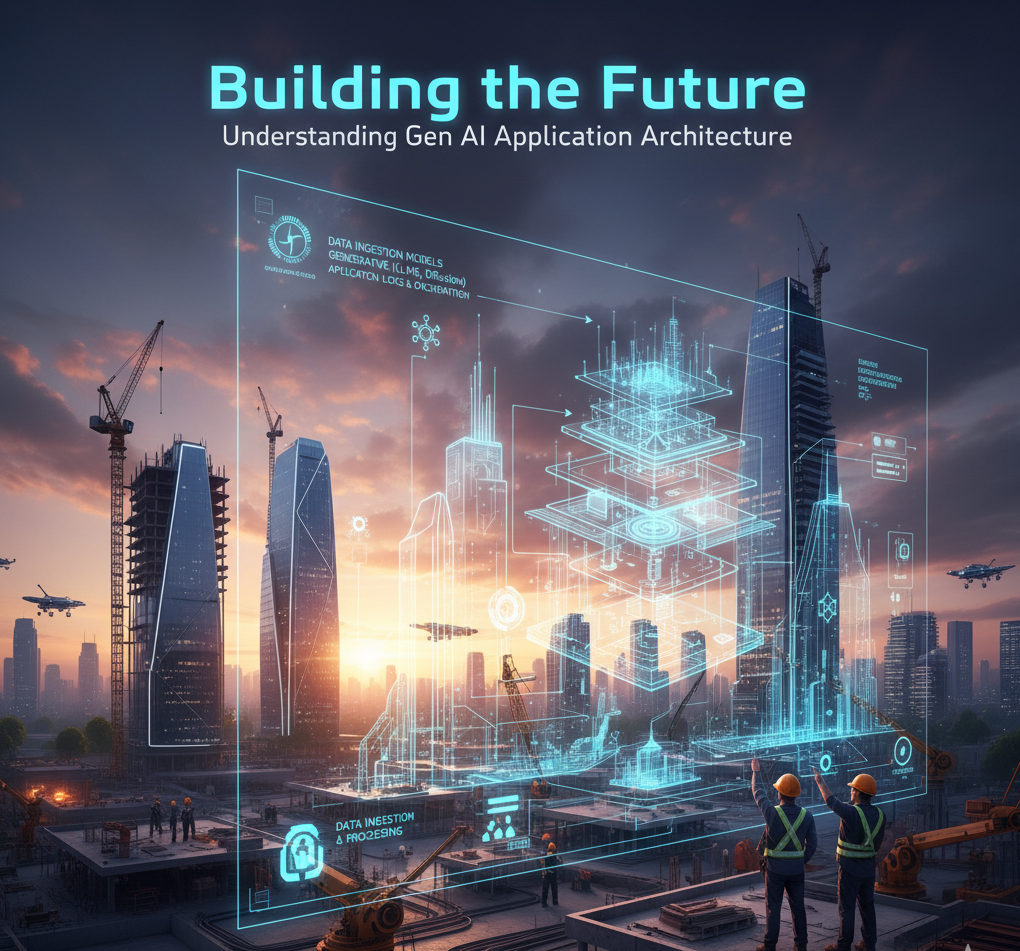
Gen AI application architecture refers to the structured framework that defines how generative AI systems are designed, integrated, and deployed within an enterprise ecosystem.
It’s a combination of data pipelines, AI models, orchestration layers, and deployment infrastructure that together enable the AI to process inputs, generate outputs, and improve continuously through feedback loops.
Unlike traditional AI systems that rely on predefined rules or models, Gen AI solutions are creative and dynamic, requiring architectures that support continuous learning, adaptability, and ethical governance.
Core Layers of Gen AI Application Architecture
A robust Gen AI architecture is built on a multi-layered design that ensures scalability, flexibility, and security. Let’s break it down:
1. Data Layer
This is the foundation of any AI system. The data layer gathers, stores, and preprocesses data for model training and inference.
• Sources: Internal enterprise data, customer data, public datasets, IoT feeds, or third-party APIs.
• Key Tools: Data lakes (like AWS S3, Azure Data Lake), ETL pipelines, and vector databases (like Pinecone or Milvus) for managing embeddings.
• Governance: Data quality, lineage, and compliance (GDPR, HIPAA) are essential for trustworthy outputs.
2. Model Layer
The model layer hosts the foundation models (such as GPT, LLaMA, or Claude) and fine-tuned domain-specific models.
Organizations may:
• Use pre-trained LLMs via APIs for generic tasks.
• Fine-tune models on proprietary data for industry-specific outcomes.
• Employ model orchestration to dynamically route requests between different models based on context.
This layer also includes prompt engineering, reinforcement learning from human feedback (RLHF), and model versioning to ensure continuous improvement.
3. Integration and Orchestration Layer
This is where AI intelligence meets business logic. The orchestration layer manages workflows and integrates AI models with enterprise systems (ERP, CRM, CMS, etc.).
Technologies like LangChain, LlamaIndex, and Semantic Kernel are used to orchestrate LLM workflows, connect data sources, and manage memory.
For example:
• A Gen AI customer service bot integrates with CRM for personalized responses.
• A generative design system connects to PLM software to create product prototypes.
This layer ensures seamless interaction between Gen AI capabilities and existing digital ecosystems.
4. Application Layer
At this stage, the user interacts with the AI through various interfaces—chatbots, dashboards, APIs, or mobile apps.
Key aspects include:
• UI/UX Design: Focused on transparency, feedback, and ease of use.
• APIs: RESTful or GraphQL endpoints for connecting to third-party tools.
• Security: Authentication, authorization, and usage monitoring.
This is where the AI experience becomes tangible, turning raw intelligence into practical business solutions.
5. Infrastructure and Deployment Layer
The performance and scalability of Gen AI depend on the computational infrastructure.
• Cloud Platforms: AWS, Azure, or Google Cloud for hosting and scaling AI workloads.
• Containerization: Docker and Kubernetes for flexible deployment.
• MLOps Pipelines: Tools like Kubeflow, MLflow, or Vertex AI automate training, testing, and deployment.
• Edge Deployments: In some cases, running models locally ensures low latency and privacy.
This layer enables enterprises to scale Gen AI applications efficiently while maintaining cost control and compliance.
Key Design Principles for Gen AI Architecture
To maximize the potential of Gen AI systems, architects should follow several core principles:
1. Scalability and Elasticity
Design the architecture to handle high data throughput and variable workloads. Cloud-native and microservices-based designs make scaling easier.
2. Modularity
Each layer (data, model, integration, etc.) should be independent yet interoperable. This allows for flexible upgrades without disrupting the entire system.
3. Security and Compliance
Implement strong access controls, data encryption, and audit trails. With Gen AI systems often handling sensitive data, compliance with global standards is critical.
4. Human-in-the-Loop (HITL)
Human oversight is crucial to ensure quality and ethical standards. Include feedback loops for continuous fine-tuning and error correction.
5. Observability and Monitoring
Track model performance, drift, and user interactions. Monitoring tools can help detect bias, hallucination, or system degradation early.
Best Practices for Implementing Gen AI Application Architecture
1. Start Small and Scale Fast: Begin with a specific use case (e.g., content generation or predictive analytics) before expanding to other areas.
2. Use APIs and Managed Services: Leverage pre-built APIs like OpenAI or Anthropic to save development time.
3. Adopt MLOps Practices: Automate CI/CD pipelines for data and model updates.
4. Prioritize Explainability: Design transparent AI systems that provide reasoning or confidence scores.
5. Embed Governance: Ensure ethical AI usage through defined policies, audits, and accountability mechanisms.
Real-World Applications of Gen AI Architecture
• Healthcare: Intelligent diagnostic assistants and patient data summarization tools.
• Finance: Automated report generation, fraud detection, and market analysis.
• Manufacturing: Generative design optimization for components and predictive maintenance.
• Retail: Personalized shopping assistants and dynamic content generation.
• Education: AI-powered tutoring systems and content curation engines.
Each of these use cases is powered by a robust architecture that ensures data integrity, model accuracy, and real-time responsiveness.
The Future of Gen AI Application Architecture
The next evolution of Gen AI architecture will integrate multimodal capabilities, agentic workflows, and edge intelligence.
Future systems will be:
• Context-Aware: Understanding user intent through memory and history.
• Composable: Allowing developers to plug in new AI components seamlessly.
• Ethically Aligned: With embedded safeguards for bias and misinformation.
As organizations continue to invest in Gen AI, architectural design will be the cornerstone of sustainable innovation—bridging human creativity with machine intelligence.
Conclusion
Building a successful Gen AI application architecture is more than a technical task—it’s a strategic endeavor. It requires aligning data strategy, model engineering, integration, and governance under a unified framework.
Enterprises that design their architectures with scalability, security, and adaptability in mind will be the ones leading the next wave of AI-driven digital transformation.
By investing in the right architecture today, organizations can unlock the full potential of Generative AI—creating intelligent, adaptive, and human-centric applications for tomorrow.