Some brands can explain what they do, while others make you feel it. The difference often lies in storytelling — and when you mix that with the visual and emotional pull of video, you get a marketing force that not only captivates but converts.
In 2025, video storytelling has evolved from being a trend to becoming the heartbeat of successful marketing strategies. It’s no longer enough to post clips or ads; brands are now expected to deliver stories that resonate, educate, and ultimately drive people to take action. And yes, that means every marketer who wants stronger SEO and deeper audience engagement needs to master the art of the marketing video.
The Emotional Hook: Why Storytelling Still Works
Humans are wired for stories. A study from Stanford University found that stories are 22 times more memorable than facts alone. That’s why a marketing video that tells a story is more likely to stay in someone’s mind than a static infographic or a product feature list.
Take Nike, for instance. Their videos rarely focus on the shoes themselves. Instead, they tell stories of perseverance, grit, and self-belief — emotions that stick and get shared. Similarly, Airbnb leans into user-generated stories to show how travel connects people across cultures. These brands know that when a story connects emotionally, the message follows naturally.
Storytelling turns a viewer into a participant. It pulls them into a world where your brand has meaning beyond a product label — and that’s the secret to sustained engagement.
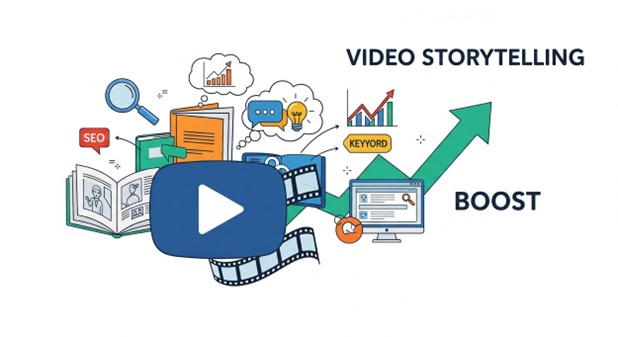
How Video Storytelling Impacts SEO
Search engines reward content that people love to engage with and video storytelling checks every box.
- Longer Watch Time and Reduced Bounce Rate
A compelling video keeps visitors glued to your page longer. According to Wyzowl’s 2024 Video Marketing Statistics Report, 88% of marketers say video increases dwell time on their websites. That’s a signal search engines interpret as “valuable content.”
- Improved Click-Through Rates
Thumbnails with people or movement grab attention faster than text-based previews. Adding marketing videos to landing pages can boost conversions by up to 80%, as reported by EyeView Digital.
- Video Transcripts and Metadata
Adding transcripts, structured data, and keyword-rich descriptions help search engines “read” your videos better. When done right, your marketing video can appear in both text and video search results — a double SEO win.
- Engagement Signals as Ranking Boosters
Metrics like shares, comments, and watch duration influence how algorithms perceive your content’s quality. Video storytelling that sparks emotion encourages interaction, which strengthens your SEO over time.
Crafting a Marketing Video That Converts
It’s not about fancy effects or expensive cameras — it’s about the message. A high-performing marketing video follows the same principle as a great novel: it has a clear plot, relatable characters, and a satisfying resolution.
Here’s a quick framework:
- The Hook – Start strong within the first 5 seconds. A question, a visual surprise, or a relatable scenario draws attention instantly.
- The Build-Up – Present a problem your audience cares about.
- The Resolution – Show how your brand or product fits naturally into the solution.
- The Call to Action – End with a specific next step — not just “learn more,” but something that connects to your story’s outcome.
Even short-form content, like the ones on TikTok or Instagram Reels, benefits from structure. Look at Duolingo’s playful videos: each one builds a mini-story using humor and consistency, turning language learning into entertainment that drives massive engagement.
Professional video companies in the field suggest that the best marketing videos break complex ideas into clear, relatable narratives. For instance, one of the best examples is Burnwe. The videos they create for major AI and SaaS platforms usually follow this approach: identifying the audience’s key challenge, crafting engaging characters and scenarios, and guiding viewers naturally from problem to solution, making stories memorable and messages stick.
They are perfect to streamline your video creation and distribution workflow - good for teams that want to focus more on creative storytelling rather than technical production.
You can see this storytelling in action in their own Showreel, which perfectly captures how they turn complex ideas into compelling visual stories.
Making the Most of Distribution
A marketing video isn’t meant to sit quietly on YouTube. To truly boost SEO and engagement, it needs to be seen, embedded, and shared across your digital ecosystem.
- Embed videos in blog posts to increase on-page time and add context to written content.
- Post short teasers on social channels that link back to your website or main video page.
- Include them in email campaigns — video thumbnails can increase click-through rates by up to 300%.
- Repurpose content — turn long videos into short clips, highlight reels, or even GIFs for different platforms.
Each channel acts as an amplifier, signaling to search engines that your content is fresh, relevant, and engaging.
Measuring What Matters
Not all video views are created equal. To understand whether your video storytelling truly boosts SEO and engagement, track these key metrics:
- Watch Time – The longer viewers stay, the stronger your engagement signal.
- Click-Through Rate (CTR) – Indicates how compelling your title, thumbnail, or intro is.
- Social Shares – Reflects emotional impact; people share content that resonates.
- Conversion Rate – The ultimate indicator of whether your storytelling led to action.
Consistently measuring these numbers helps fine-tune your future marketing videos. For example, if viewers drop off early, your hook might need work. If engagement spikes near your CTA, that’s a cue to emphasize it more prominently next time.
The Future of Video Storytelling and SEO
As algorithms grow smarter, they’re not just crawling keywords — they’re understanding context, sentiment, and relevance. This means authentic storytelling will play a bigger role in SEO success.
Expect to see more:
- Interactive videos that let viewers choose story paths.
- AI-personalized storytelling, tailoring narratives to individual viewers.
- Voice and visual search optimization, where video metadata becomes essential.
Brands that embrace video storytelling early will stand out. It’s not just about ranking higher — it’s about creating meaningful moments that people actually want to experience.
Conclusion
Storytelling is how humans make sense of the world — and video is the modern language of that instinct. Together, they form a marketing tool powerful enough to influence emotions, decisions, and search rankings.
A well-crafted marketing video doesn’t just tell a story; it invites the audience to become part of it. Whether you’re a founder sharing your brand’s journey or a marketer optimizing for SEO, video storytelling remains your most human — and effective — advantage in 2025.