

In the last two years alone, nearly 90% of the world’s existing data has been generated. Yet, many organizations still struggle to extract even a small share of the online information they need to stay competitive. The problem isn’t data scarcity—it’s outdated data extraction practices.
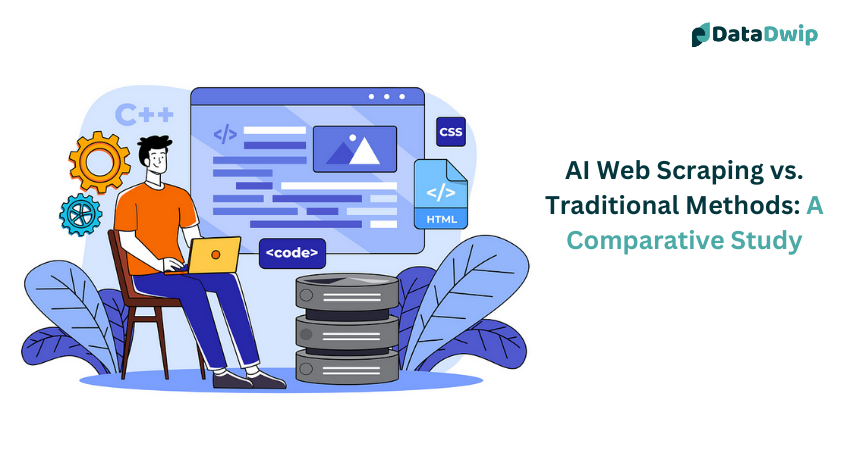
AI web scraping introduces a new era of intelligent, automated data collection. By combining machine learning, NLP, computer vision, and adaptive models, AI scrapers can interpret web content contextually and adjust to website changes—without human intervention.
Conventional scraping methods are rapidly becoming obsolete. Websites constantly update layouts, implement stronger anti-bot measures, and require ongoing manual fixes. These challenges result in slow, inaccurate, and expensive data operations.
For industries such as retail, e-commerce, manufacturing, and supply chains, this leads to major setbacks: delayed price intelligence, incomplete insights, and missed opportunities.
This article explores how AI-powered scraping tackles these issues, how businesses are already leveraging it, and how you can adopt it to scale your data strategy efficiently.
What Is AI Web Scraping and How Does It Work?
AI web scraping represents a shift from rigid, rule-based scripts to adaptive, intelligent extraction systems. While a traditional scraper breaks when a CSS selector changes, an AI scraper understands content in a human-like manner—interpreting text, visuals, and context.
Traditional scrapers depend on HTML tags. AI scrapers analyze patterns, semantics, and visual cues, making them far more resilient.
Traditional Scraping vs AI Web Scraping
Aspect Traditional Scraping AI Web Scraping
Maintenance Manual updates needed frequently Automatically adapts (self-healing)
Scalability Costs grow per site Scales across thousands with ease
Setup Time Days–weeks A few hours
Accuracy Breaks often 95%+ success rate
Cost High long-term maintenance Higher initial, lower lifetime cost
Technologies Fueling AI Web Scraping
AI scraping works through a combination of advanced systems:
1. Computer Vision
These algorithms visually understand web pages, detecting elements like prices or product names based on layout, font, or placement—rather than markup.
2. Natural Language Processing (NLP)
NLP models extract meaning from text, identify product specs, detect sentiment, and understand descriptions without predefined rules.
3. Deep Learning
Neural networks learn from thousands of website layouts. Once trained, they can extract data even from previously unseen websites.
4. Adaptive Learning Algorithms
The scraper self-corrects when extraction fails. It learns from errors and continuously improves—making the system progressively more accurate and reliable.
Why Enterprises Are Switching to AI-Based Scraping
Organizations are adopting AI scraping not only for technical benefits but for strategic and economic advantages.
1. Massive, Effortless Scalability
AI scrapers can monitor hundreds or thousands of websites at once without additional manual effort.
Example:
A manufacturing firm that previously tracked 50 competitor sites with a team of three developers scaled to 2,500+ sources using AI scraping—receiving hourly updates instead of weekly ones.
2. Dramatically Lower Maintenance Costs
Website updates often cripple traditional scrapers. AI scrapers automatically detect layout changes and adapt instantly.
Companies report 80–90% reduction in maintenance overhead after switching to AI-based systems.
AI scrapers don’t just work—they fix themselves.
3. Higher Data Quality With Context Awareness
AI scrapers interpret data meaningfully.
For example, they can differentiate:
- a price from a dimension
- a model number from a SKU
- a date from a product attribute
This validation ensures clean, structured, ready-to-use data without heavy manual cleansing.
4. Improved Cost Efficiency Over Time
The initial investment for AI scraping is higher, but as maintenance drops and accuracy increases, the long-term cost becomes significantly lower.
Within 3–6 months, AI and traditional scraping costs align.
Within 1 year, AI approaches typically cut total cost by 40–60% while delivering far more data.
Real-World Applications of AI Web Scraping
AI-powered scraping is already generating measurable results across industries.
1. E-commerce & Competitive Intelligence
Retailers track:
- competitor prices
- promotions
- stock levels
- product trends
In real time.
Results include:
- 2–4% margin improvement
- 8–12% higher conversions
- pricing updated hourly instead of weekly
2. Financial Services & Alternative Data
AI extracts signals from:
- social media
- news articles
- job listings
- real estate postings
Trading firms report a 15–30% accuracy boost in predictive models using AI-scraped alternative data.
3. Real Estate Intelligence
AI scrapers pull information from MLS databases and global listing sites to analyze:
- price trends
- inventory shifts
- investment opportunities
Investors using AI-driven insights identify deals 40% faster and achieve 25% better ROI.
4. B2B Lead Generation
AI scrapes the web to find:
- decision-makers
- technology stacks
- funding updates
- firmographic data
Companies see:
- 3–5× more qualified leads
- 30–40% lower acquisition cost
5. Brand & Reputation Monitoring
AI aggregates reviews and analyzes sentiment across multiple platforms.
Brands leveraging AI scraping detect negative trends 70% faster, preventing reputational damage.
How to Implement AI Web Scraping Effectively
A structured approach ensures smooth adoption.
Step 1: Define Data Requirements Clearly
Be specific about:
- websites
- fields needed
- update frequency
- formats
- quality expectations
Clear requirements prevent scope creep and ensure business value.
Step 2: Select Your Implementation Path
You may choose to:
Build an in-house system (requires ML expertise, 6–12 months)
Use a managed service like WebDataGuru
Combine both in a hybrid model
Step 3: Ensure Legal & Ethical Compliance
Follow:
- robots.txt
- Terms of Service
- GDPR, CCPA
- rate limitations
Avoid collecting personal data unless legally justified.
Step 4: Monitor and Improve Continuously
Track:
- success rate
- accuracy
- anomalies
- cost per record
Continuous optimization allows AI systems to improve automatically.
Challenges to Expect in AI Web Scraping
AI scraping is powerful but not without challenges:
- Complex initial setup and training
- Some manual validation required
- Evolving anti-scraping technologies
- Compliance variations by region
- Higher upfront investment
Acknowledging these early ensures realistic planning.
What’s Next for AI Web Scraping?
The future promises even more advanced capabilities:
- Generative AI for deeper interpretation
- No-code scraping built through natural language
- Conversational queries (“Show me reviews mentioning battery life…”)
- Predictive scraping based on user behavior
- Blockchain-based provenance for data transparency
Companies adopting AI scraping today will gain long-term competitive advantage.
Final Thoughts
AI web scraping has evolved from a technical solution to a core strategic capability. It offers accuracy, scalability, lower costs, and smarter decision-making.
If you're ready to transform your data ecosystem, AI scraping is no longer optional—it's essential.
Ready to Unlock Smarter Data?
WebDataGuru helps organizations worldwide collect clean, reliable, and scalable web data using advanced AI-powered scraping and intelligence systems. Whether you need pricing intelligence, market insights, competitive monitoring, or large-scale automated extraction, our solutions are built for enterprise performance.
Start your journey toward intelligent, future-ready data collection.
Connect with WebDataGuru today to explore what’s possible.