

In 2025, business problems rarely come in neat packages. A single decision today can have a ripple effect across supply chains, regulatory frameworks, employee well-being, investor expectations, and planetary boundaries simultaneously. Leaders face questions like, "How do we adopt generative AI without creating ethical or legal risks? How do we adopt generative AI without creating ethical or legal risks?" How do we grow revenue while cutting Scope 3 emissions by 42% by 2030? How do we rebuild trust after a major cyber breach while keeping costs under control? These are not simple operational puzzles; they are multi-faceted strategic challenges that demand deep expertise, rigorous evidence, and practical wisdom.
This is precisely where a Doctor of Business Administration (DBA) professional becomes invaluable. A DBA is not equivalent to an MBA, nor is it a traditional academic PhD. It is a professional doctorate designed for experienced executives who want to solve real organisational problems at the highest level. While an MBA teaches you how to manage a business and a PhD teaches you how to study business, a DBA teaches you how to fix business systematically, defensibly, and sustainably.
The DBA Mindset: Applied Research Meets Executive Experience
The typical DBA applicant is a person with a 10-20 year career who frequently holds titles such as Vice President, Director, or a member of the C-suite. They are the ones who provide the programme with context; at the same time, they are the ones who bring rigour. The DBA curriculum is akin to investing in education, worked out in terms of strategy, finance, organisational behaviour, and research methods at the doctoral level, blended with a dissertation that has solved a real business problem, most often within their own organisation or sector.
A PhD dissertation could scrutinise "theoretical contribution to the stakeholder theory". In contrast, a DBA dissertation could be titled "The Global Supply Chain of a Fortune 500 Manufacturer Redesigning to Achieve Net-Zero Carbon by 2035 and Still Keeping 98% On-Time Delivery". The university might not end up with just a bound thesis; what they get is a blueprint that is not only implemented and measured but also regularly published internally or as industry white papers.
This blend of executives' experience and doctoral-level research creates a rare capability: the ability to see both the forest and the trees, then redraw the map entirely.
The DBA Problem-Solving Framework in Action:
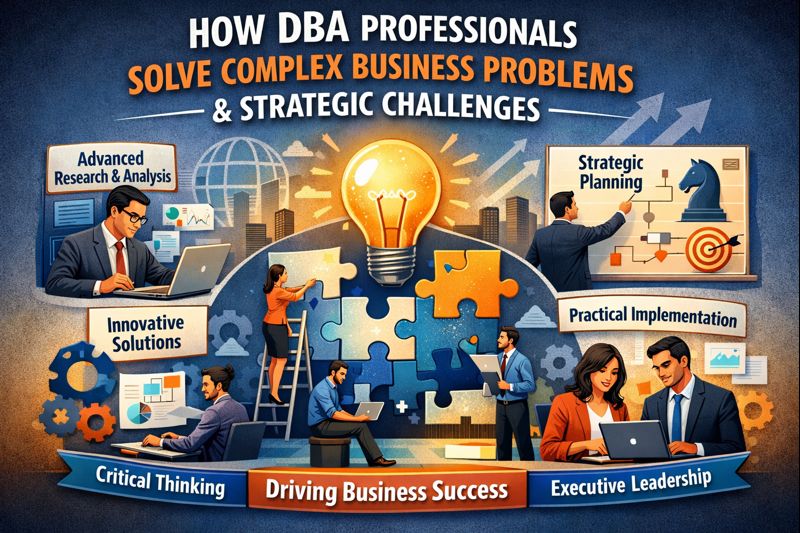
DBA professionals tackle the intricate problems by relying on a framework that is not only evidence-based but also repeatable, which the average manager can comprehend, but very few are able to implement at a large scale:
Systems Thinking with Problem Definition: They begin by visualising the problem as a system, rather than as a series of events. High employee turnover, for instance, might be viewed as an HR issue, whereas a DBA's perspective on mid-management training and changes in the labour market. Techniques such as causal loop diagrams or fishbone analysis are used to uncover hidden root causes that may be obscured to others.
Fast but Strict Evidence Gathering: DBA professionals are skilled in both qualitative approaches (in-depth interviews, ethnography, and focus groups) and quantitative approaches (regression analysis, structural equation modelling, and machine learning validation). They can decide whether it is better to conduct a survey of 5,000 employees or to make a deep dive with 15 executives for better insights.
Theory-Informed, Practice-Tested Solution: They utilise well-established theories – Porter's Five Forces, Resource-Based View, and Dynamic Capabilities – but they test their validity with modern data. A DBA director is aware that the time of digital disruption will not merely quote Clayton Christensen; instead, they will assess the degree of disruption in their sector and create models for predicting the future.
Stakeholder-Centred Design: Solutions are the result of collaboration with the users who have to accept the solutions. A DBA introducing a new AI-based pricing mechanism will include sales, finance, legal, and customer-service functions right from the start to avoid the "perfect-on-paper, disaster-in-practice" scenario.
Pilot, measure, iterate: The change will be implemented through controlled experiments. Real-time monitoring is done for key performance indicators (KPIs) and key risk indicators (KRIs). If the pilot indicates a 12% gain in productivity but a 28% decline in the engagement of employees, the DBA intervenes and makes adjustments prior to the full-scale launch.
Institutionalising the Fix: The final step is to integrate the solution into the organisation's culture, processes, and governance. The organisation is not allowed to fall back into old practices as soon as the project team departs, which is why policies are revised, training programmes are launched, and rewards are realigned.
Real 2025 Case Studies
Case 1: AI Adoption in a Global Bank
The Chief Data Officer of a European bank, who has a DBA, was put under pressure to use generative AI in customer service, fraud detection, and credit underwriting, all at the same time. The difficulty was to meet the target of 30% cost reduction, keep up with the changing EU AI Act requirements, and avoid model bias against minority borrowers, and, at the same time, not lose the best talent that is already worried about job security.
Through her DBA research, she was able to analyse 42 financial institutions and create a "Responsible AI Maturity Model". After that, she was able to test conversational AI in one area while measuring not only the cost savings but also weekly customer trust scores and employee sentiment. The outcome was a 28% reduction in costs, no regulatory fines, and employee turnover that was 40% below the industry average. The framework is now being implemented across the entire group and has already been adopted by two competing banks.
Case 2: Net-Zero Supply Chain in Consumer Goods
A graduate of the DBA, leading the sustainability department of a major beverage company, has addressed the problem of Scope 3 emissions, which account for 80% of the company's total footprint. The situation was complicated in that the farmers were asking for more money, the consumers were looking for lower prices, and the regulators were implementing carbon border taxes.
He did the research using different methods across four continents. He came up with an idea for a blockchain-enabled, regenerative agriculture project that would raise farmers' income by 35%, bring down emissions by 22% in pilot regions, and give birth to a new premium product line that will attract 18% more profit. The board of directors has voted for the global launch in 2028 with a budget of $180 million.
Case 3: Post-Merger Cultural Integration
A $14 billion tech merger resulted in a significant decline in employee engagement and a halving of innovation pipelines. A Chief Integration Officer trained in DBA used organisational network analysis to illustrate the informal influence patterns. Then he applied change theories (Kotter, Lewin, and the newer ambidextrous organisation models) to come up with interventions that were explicitly directed at the target. After eighteen months, the voluntary turnover rate was reduced from 24% to 9%, and the merged company introduced three innovative products earlier than expected.
Why Organisations Increasingly Seek DBA Talent in 2025
According to the talent surveys conducted by McKinsey for 2024 to 2025, the presence of "analytics translators" and strategic problem solvers" on the executives' boards leads to the performance of the companies with 33% and 42% higher increments in revenue and profits, respectively, during times of volatility, while the DBAs naturally take up both positions.
Furthermore, with AI taking care of the routine decision-making, the emphasis now goes to the human abilities of making judgements in times of radical uncertainty, moral reasoning, and unifying different parties around unclear objectives. These are actually the areas of strength that an arduous DBA journey requires of developers.
Is a DBA Right for You or Your Organisation?
When you are a seasonal leader and the same frustrating situations keep occurring, you and your team are familiar with the issues, but the solution is not sustainable. In such cases, the online DBA might be the right move for you. When your company relies on consultants who charge millions for suggestions only to let them gather dust, hiring someone with DBA-level competence could be more beneficial.
The programmes have changed as well. Nowadays, the best universities provide the option of attending classes either fully online or in a hybrid way, and have tiny groups that allow real peer learning, and offer a dissertation structure that enables you to solve employers' most significant problem and gain the degree at the same time. The average time required for part-time students to complete their studies is 3-4 years, which is less than the number of years many top managers typically stay in one position.
Final Thought:
In an era where artificial intelligence can crunch faster than humans, and strategy frameworks are a Google search away, the scarce resource is no longer information or even intelligence. It is the ability to turn insight into impact at scale, even in high-pressure situations, with imperfect data, and across boundaries.
That is what a Doctor of Business Administration delivers: not just another credential, but a proven, repeatable capability to solve the hardest, messiest, most consequential problems facing organisations today.