

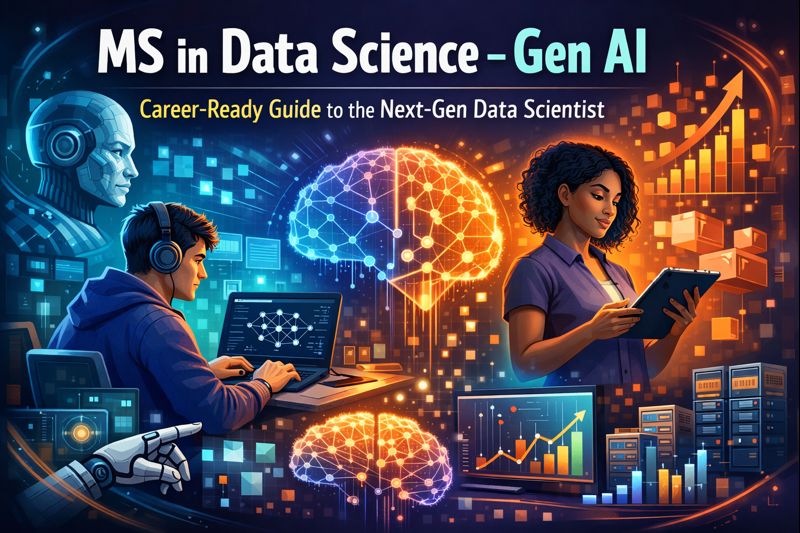
Generative AI (GenAI) has shifted data science from "predict what will happen" to "create what's possible." If classic machine learning is about learning patterns from historical data to make forecasts, GenAI adds a new layer: models that can generate text, code, images, audio, synthetic data, and even structured outputs like SQL queries or JSON—often from plain-language prompts. That capability is changing how products are built, how analytics are consumed, and what employers expect from data professionals.
A Master of Science in Data Science - Gen AI sits at this intersection: it gives you a rigorous data science foundation (statistics, machine learning, and data engineering) and adds modern GenAI skills (transformation, LLM fine-tuning, retrieval-augmented generation, evaluation, safety, and deployment). This blog breaks down what such a program typically covers, the technical competencies you should graduate with, and how to judge whether a curriculum is actually industry-relevant.
What is the Master of Science in Data Science (GenAI) program about?
The Master of Science in Data Science - Generative AI is an advanced, interdisciplinary program designed to train professionals in both traditional data science and modern generative artificial intelligence systems. At its core, the program focuses on how data is collected, processed, analyzed, and transformed into intelligent models that can not only predict outcomes but also generate new content, insight, and solutions.
Unlike conventional data science degrees that emphasize analytics and predictive modeling alone, this program integrates machine learning, deep learning, and large language models (LLMs) to prepare students for the evolving AI-driven economy. Students learn how to work with structured and unstructured data, build scalable AI systems, and deploy generative models responsibly in real-world environments.
The program is fundamentally application-oriented. It teaches how GenAI technologies—such as text generation, conversational AI, recommendation engines, synthetic data generation, and intelligent automation—are built and used across industries like technology, healthcare, finance, education, e-commerce, and enterprise analytics. Emphasis is placed on understanding both the theory behind models and the engineering pipelines required to move from experimentation to production.
Another defining aspect of the program is its focus on end-to-end AI systems rather than isolated algorithms. Students are trained to design complete workflows that include data ingestion, feature representation, model training, retrieval-augmented generation, evaluation, monitoring, and governance. This system-level perspective ensures graduates are capable of building reliable, scalable, and ethical AI solutions rather than standalone prototypes.
Equally important, the program addresses the responsible use of generative AI. Topics such as data privacy, bias mitigation, model transparency, security risks, and regulatory considerations are integrated into the curriculum to ensure students understand the broader implications of deploying GenAI in real-world settings.
In essence, the Master of Science in Data Science - Gen AI is about developing next-generation data scientists—professionals who can combine statistical reasoning, machine learning expertise, and generative AI capabilities to solve complex problems, drive innovation, and lead AI-powered initiatives across industries.
Why GenAI Belongs Inside a Data Science Master's
Traditional data science already spans a wide stack: probability, experimentation, supervised/unsupervised learning, feature engineering, data pipelines, and model monitoring. GenAI expands the scope in three important ways:
1. From features to representations:
Classic ML often relies on structured features you design and maintain. Gen AI models—especially transformers—learn representation directly from unstructured data like text and images. That changes how problems are framed and how data is prepared.
2. From single-task models to general-purpose systems:
Many GenAI solutions aren't "one model—one prediction." They're systems:
- an LLM that reasons and generates,
- a retriever that pulls relevant context,
- a safety layer that filters or rewrites,
- an evaluator that checks correctness,
- monitoring for drift, cost, latency, and hallucinations
3. From static predictions to interactive experiences
GenAI is often embedded into products as a conversational or agentic interface: search assistants, customer support copilots, internal knowledge bots, document intelligence, code assistants, and content generation workflows. The DS professional becomes closer to product engineering, UX constraints, and governance.
So a GenAI-focused MS program should train you to build end-to-end AI applications—not just models.
Core Curriculum: The Non-Negotiables
A strong MS in Data Science - GenAI still begins with fundamentals. If these are missing or watered down, the program risks producing "prompt users" rather than advanced practitioners.
Probability, Statistics, and Inference:
You should become fluent in:
- probability distributions, expectations, variance
- Statistical inference, hypothesis testing, confidence intervals
- Bayesian thinking (beneficial for uncertainty and decision-making)
- casual inference basics (counterfactual reasoning, confounding)
Why it matters for GenAI: evaluation is tricky. You need principal approaches to measure quality, reduce bias, and estimate uncertainty—even when the ground truth is fuzzy.
Linear Algebra, Optimization, and Numerical Methods
- GenAI is built on matrix operations. Expect:
- vectors/matrices, eigenvalues/eigenvectors, SVD
- Gradient-based optimization, regularization
- numerical stability, computational complexity
Why it matters: understanding how training behaves (vanishing/exploding gradients, learning rate schedules, normalization) makes you dramatically better at debugging model training and inference issues.
Machine Learning Foundations:
A rigorous ML sequence typically includes:
- regression/classification, trees/boosting, SVMs.
- clustering, dimensionality reduction
- bias-variance tradeoff, cross-validation
- metrics, calibration, interpretability
- imbalanced learning and anomaly detection
Why it matters: In production, classic ML still solves a considerable share of problems cheaper and more reliably than LLM. The best team uses both.
The GenAI/LLM Track: What "Technical and Real" Looks Like:
Here's what separates a serious GenAI program from a marketing-heavy one:
Deep Learning Fundamentals:
You should cover:
- Feedforward networks, CNNs, and RNNs (historical context).
- Attention mechanism and why it replaced recurrence
- normalization, dropout, regularization, initialization
- losses (cross-entropy, contrastive losses) and training dynamics
Transformers and Large Language Models
A strong course won't just say "transformers are great." It should
- transformer blocks: multi-head attentions, FFNs, residuals
- positional encoding, tokenization (BPE/WordPiece/SentencePiece)
- pertaining objectives: casual LM vs masked LM
- Scaling laws intuition and compute/data tradeoffs
- inference: decoding strategies (greedy, beam search, top-k, top-p), temperature
- context windows, KV caching, latency implications
Embeddings and Vector Search:
Embedding is the backbone of modern GenAI products. Experts:
- embedding quality and domain adaptation
- similarity metrics (cosine, dot product)
- approximate nearest neighbor search (HNSW, IVF)
- vector databases vs self-managed indexes
- chunking strategies and semantic search
Retrieval-Augmented Generation (RAG):
RAG is often the most practical way to ground LLM outputs and make them enterprise-ready. A robust program should teach:
- document ingestion pipeline (parsing, cleaning, chunking)
- hybrid retrieval (BM25 + vectors) and rerankers
- preference optimization basics (e.g., RLHF concepts, DPO-style ideas)
- when to fine-tune vs when to RAG vs when to use tools/agents
- data curation: filtering, deduplication, quality labeling
Evaluation: The Hard Part Everyone Skips:
GenAI evaluation is not just BLEU scores. You should learn:
- task-specific metrics (exact match, F1, ROUGE—when appropriate)
- human eval design (rubrics, pairwise ranking, inter-rater reliability)
- LLM-as-a-judge patterns—and how to reduce bias/leakage
- hallucination measurement, factuality checks, citation validation
- red-teaming, adversarial prompts, stress tests
- regression testing for prompts and pipelines
Data Engineering & MLOps for GeAI: Production Skills
A GenAI MS should not end at notebooks. You need the engineering layer:
Data Engineering:
Expect training in:
- relational modelling, SQL mastery
- distributed processing concepts (spark-like thinking)
- orchestration, ETL/ELT, data quality checks
- governance: lineage, access control, PII handling
For RAG systems, data engineering is often the majority of the work.
MLOps and LLMOps:
Modern deployment skills include:
- experiment tracking, reproducibility
- CI/CD for models and prompts
- model registry and versioning
- monitoring: latency, cost, token usage, drift, feedback loops
- canary releases, A/B tests, rollback plans
- observability for the retrieval and generation stages
A great curriculum will also introduce:
- batching, catching, and quantization basics
- GPU fundamentals and inference optimization
- safety filters and policy enforcement
Responsible AI, Security, and Compliance:
This is no longer optional—especially in regulated industries.
A strong GenAI program should cover:
- bias and fairness (data and model behavior)
- privacy: PPI redaction, differential privacy concepts, secure data handling
- prompt injection and jailbreak risks
- data leakage risks in fine-tuning
- content filtering and safe completion strategies
- intellectual property consideration (training data + generated outputs)
- governance frameworks and documentation
You should graduate knowing how to build systems that are not just impressive but also defensible.
Typical Capstone Projects (What Recruiters Actually Like):
A GenAI master's should force you to ship something real. A good capstone often looks like this:
Enterprise RAG assistant:
- ingest PDFs, wikis, internal docs
- citations and grounded answers
- access control + audit logs
- evaluation harness + monitoring dashboards
Domain fine-tuning projects:
- curate a high-quality instruction dataset
- LoRA fine-tunes an open model
- compare against the base and the RAG baselines
- analyze failure modes and safety concerns
Agnostic workflow automation
- tool-using LLM that calls search/SQL/APIs
- structured outputs, retires, and guardrails
- cost and latency optimization
- robust testing for edge cases
The best programs require a written report, reproducible code, and an evaluation section—not just a demo.
Roles You Can Target After This Degree:
A specialized MS in Data Science-GenAI can prepare you for roles like
- Data Scientist (GenAI / AppliedML)
- LLM Engineer / GenAI Engineer
- Machine Learning Engineer (NLP/LLM)
- AI Product Analyst / Analytics + GenAI
- Data Engineer (RAG pipelines, vector search)
- AI Solutions Architect (Implementation-focused)
The real differentiators are whether you can show end-to-end skill: data-model/system-evaluation-deployment.
How to Choose a Strong Program (Quick Checklist)
Look for:
- solid math/stats + ML foundations (not optional)
- transformer/LLM theory + hands-on labs
- RAG + embeddings + vector search training
- evaluation and testing frameworks for GenAI
- MLOps/LLMOps with monitoring and deployment
- a capstone that requires measurable outcomes
- instructors who teach tradeoffs: cost, latency, accuracy, safety
If a program focuses mostly on “prompting” and tool tutorials without fundamentals, it won’t hold up long-term.
Conclusion
A Master of Science in Data Science – Gen AI is valuable when it’s truly technical: strong fundamentals, deep understanding of transformer-based models, practical system-building skills (RAG, fine-tuning, evaluation), and the engineering discipline to deploy safely and reliably. GenAI isn’t replacing data science—it’s expanding it. The data scientist of the near future will be someone who can connect business questions to data pipelines, choose between classical ML and GenAI approaches, build systems that are measurable and trustworthy, and continuously improve them using feedback and monitoring.