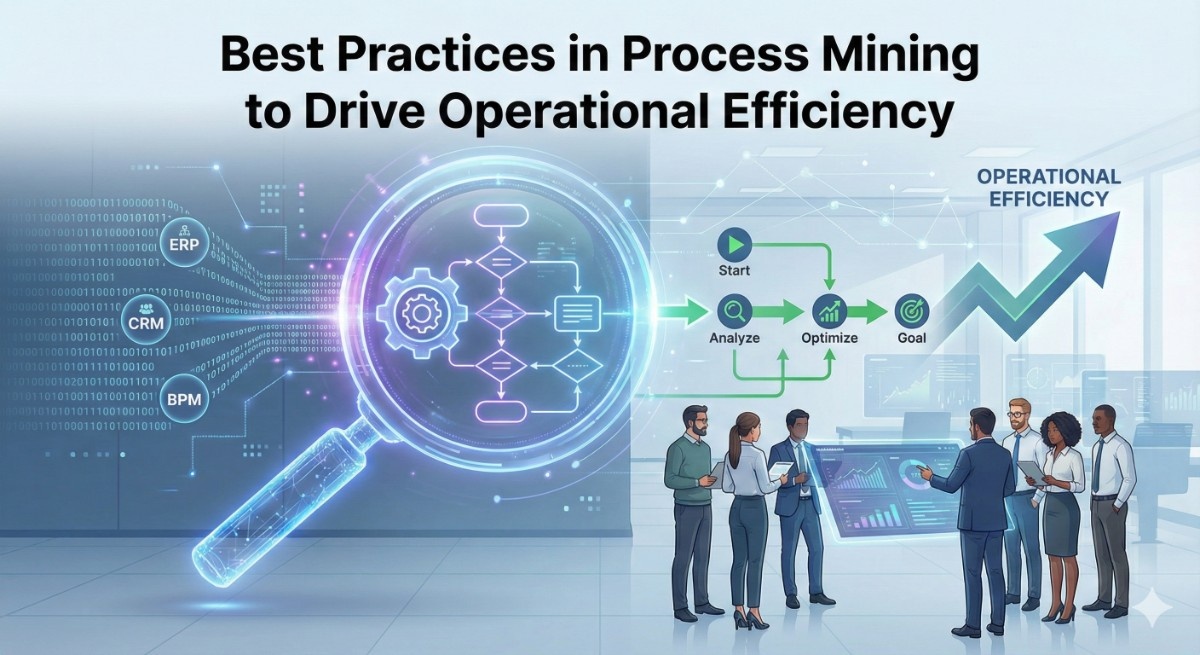
In today’s highly competitive and fast-evolving business world, organizations are always searching for innovative ways of increasing operational efficiency and effectiveness, as well as reducing costs and enhancing customer satisfaction levels. Process Mining is one of the most powerful data-driven approaches to achieve these goals. Process mining uses event data from enterprise systems such as ERP, CRM, and BPM tools to visualize, analyze, and improve real business processes. When implemented correctly, it helps organizations move from assumptions to facts. Many modern process mining solutions now integrate advanced analytics and automation capabilities, making it easier for businesses to identify inefficiencies and take corrective action more quickly.
1. Start with Clear Business Objectives
One of the most important practices in the context of process mining is the need to set business goals before starting the process. Many organizations fail by treating process mining as only a technical venture.
For instance, instead of saying we want to analyze our order-to-cash process, it's better to state a specific goal, such as reducing invoice processing time by 20%. This ensures that the knowledge derived from process mining gets converted into actions.
2. Focus on High-Impact Processes First
Not all processes deliver the same value when they are optimized. The best approach would be to select the processes that have a large volume, are high-cost, or are highly business-critical. Typically, such processes include procure-to-pay, order-to-cash, claims management, customer onboarding, or incident management.
High-impact processes can help organizations achieve quick wins and build confidence among various stakeholders in process mining initiatives by concentrating on these processes as their top priorities.
3. Ensure High-Quality and Relevant Data
Process Mining relies entirely on data-driven fields, which makes data quality a crucial factor for success. Poor and inaccurate data result in misleading insights. The best practices include checking data sources for accuracy, ensuring timestamp consistency, and checking if all key activities related to cases are captured correctly.
Additionally, it is important to integrate information from multiple systems when the process crosses various departments of the organization. Clean and accurate information enables process mining software to generate valid process models.
4. Involve Business and Process Owners
A common mistake is limiting process mining to an IT or analytics team. Best practice involves active collaboration with business users and process owners who understand how processes actually work on the ground. Their domain knowledge helps interpret findings correctly and identify realistic improvement opportunities.
When integrated with artificial intelligence services, process mining insights are much more powerful, enabling predictive analytics, anomaly detection, and intelligent recommendations. This collaboration ensures that insights are not only data-driven but also practical and business-ready.
5. Visualize the “As-Is” Process Before Optimization
Before diving into optimization, it's critical for an organization to understand the current state of processes. Process mining is great at revealing the ttrue ‘as-is’ process, including hidden loops, such as hidden loops, rework, bottlenecks, and deviations from standard procedures.
Best practice is to analyze process variants, identify frequent paths, and compare the expected workflow to the actual execution. This transparency helps organizations pinpoint inefficiencies invisible to traditional process-mapping methods.
6. Identify Bottlenecks and Root Causes
Operational efficiency can be optimized by looking at data that lies beneath the surface. Process mining can reveal information about where delays occur, why rework happens, and which activities create inefficiencies.
A best practice is integrating performance data, such as cycle time, waiting time, and costs, with root cause analysis. Delays can be created by manual approvals, handoffs in the system, and the lack of standard processes. A key point is that addressing root causes leads to sustainable improvements rather than temporary fixes.
7. Use Conformance Checking for Compliance and Standardization
Another powerful best practice in process mining is conformance checking. This involves comparing actual process executions against predetermined models, rules, or compliance criteria. It helps in detecting deviations, violations of policies, and non-standard behaviors in organizations.
With continuous conformance monitoring, organizations can minimize the risk of non-compliance, optimize audit readiness, and ensure the consistency of business process execution across regions.
8. Integrate Process Mining with Continuous Improvement Initiatives
Process mining delivers the greatest value when it becomes part of an ongoing continuous improvement strategy rather than a one-time project. Best practice integrates process mining with Lean, Six Sigma, BPM, or digital transformation programs.
Continuous monitoring enables an organization to follow up on the results of changes, validate improvements made, and quickly identify emerging inefficiencies as processes evolve over time.
Conclusion
Process mining has emerged as an innovative game-changer in improving operational efficiency for modern organizations. However, its success depends on following best practices, such as setting objectives, ensuring data quality, stakeholder involvement, identifying root causes, and embedding insights into continuous improvement.
Process mining, when applied strategically, brings deep visibility into real business processes, enables smarter decisions, and ensures measurable performance improvements. Organizations that adopt these best practices become more capable of operational optimization and cost reduction, enabling them to stay competitive.