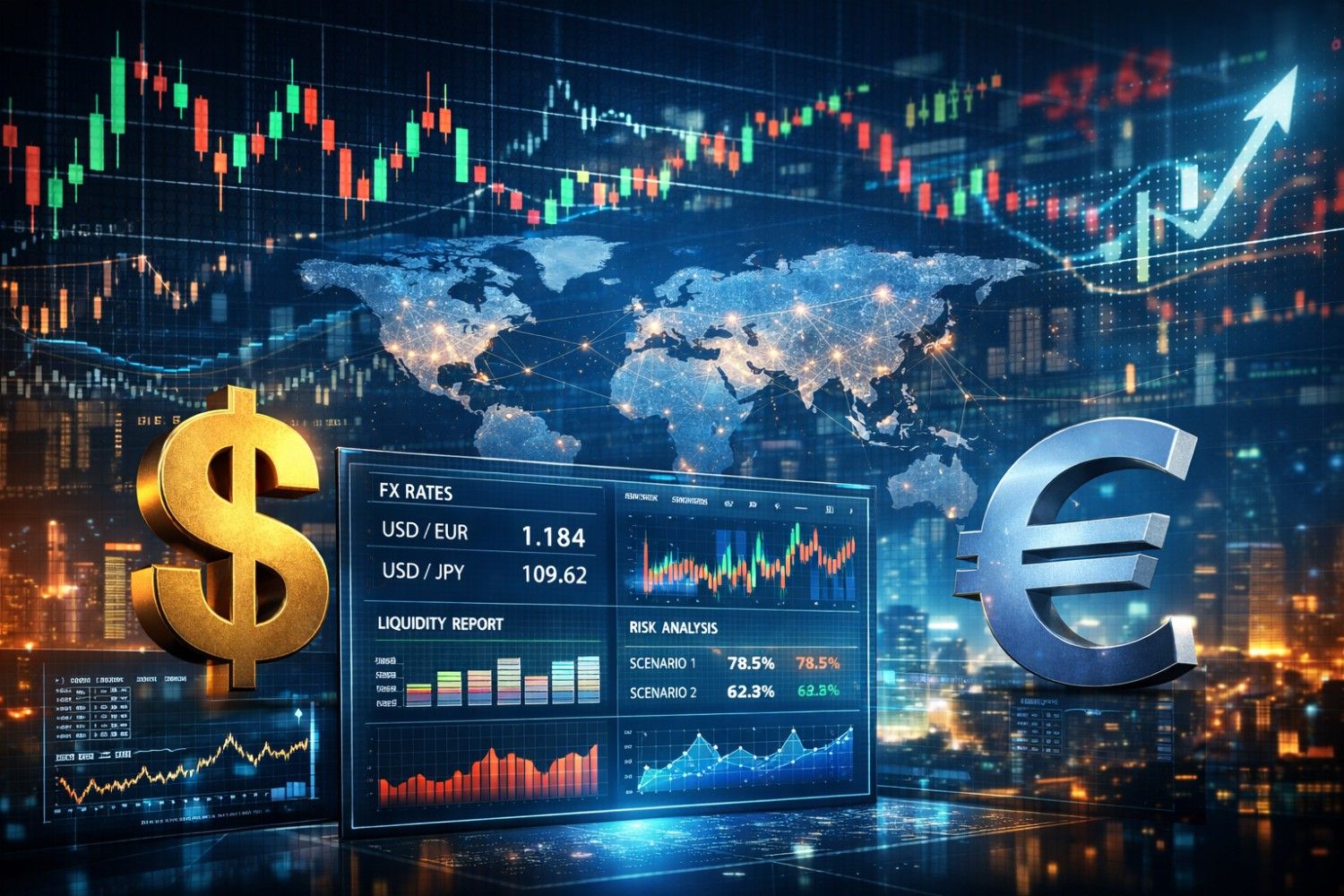
Treasury & Risk Management Solutions
In an era defined by market volatility, geopolitical uncertainty, and rapid shifts in monetary policy, treasury functions are under more pressure than ever. Exchange rates fluctuate intraday, liquidity conditions tighten unexpectedly, and leadership teams demand forward-looking clarity rather than backward-looking reports. As a result, Treasury and risk management solutions are no longer operational utilities—they are strategic infrastructure.
Yet, much of the conversation around treasury technology remains surface-level, focusing on automation or compliance. What is rarely discussed is how modern treasury platforms fundamentally change how organizations think, plan, and make decisions under uncertainty.
This article explores that overlooked dimension.
The Market Signals a Structural Shift, Not a Trend
The growth of treasury and risk technology reflects a deeper transformation in how organizations manage financial uncertainty.
According to Market Research Future, the global treasury and risk management market is projected to grow from approximately USD 17.4 billion in 2025 to over USD 32.7 billion by 2035, representing a compound annual growth rate of about 6.5%. This expansion is not driven by regulatory pressure alone, but by the need for real-time financial control and predictive insight.
A more focused view of treasury platforms shows even sharper acceleration. Coherent Market Insights estimates that the global treasury management market will reach USD 16.31 billion by 2032, growing at a CAGR of 13.8%, highlighting how quickly organizations are moving away from manual, spreadsheet-based treasury operations.
Despite this growth, adoption remains uneven. PwC’s Global Treasury Survey reports that only 57% of organizations currently use a dedicated treasury management system for managing financial risk. The remainder still rely heavily on disconnected spreadsheets and fragmented rate sources—an approach increasingly misaligned with today’s market speed.
What Rarely Gets Discussed: Treasury as a Strategic Intelligence Function
1. Treasury Is Becoming the Organization’s Financial Early-Warning System
Most discussions frame treasury as a control function. In reality, when powered by live market data and historical depth, treasury becomes a predictive engine. Access to real-time FX rates, policy signals, money-market conditions, and macro indicators allows treasury teams to detect financial stress before it appears in financial statements.
This shift enables leadership to respond proactively rather than defensively.
2. Historical Depth Matters More Than Algorithms Alone
Advanced analytics are valuable, but without long-term historical context, they are incomplete. Scenario analysis built on 30+ years of FX, interest rate, and macroeconomic data allows organizations to stress-test assumptions across multiple cycles—not just recent volatility. This capability is still underutilized and rarely emphasized in mainstream treasury discussions.
3. Data Consistency Is a Governance Issue, Not Just an Efficiency One
Disconnected spreadsheets and inconsistent rate sources do more than slow teams down—they introduce governance risk. When treasury, finance, risk, and leadership teams operate from different data sets, confidence in decisions erodes. Centralized treasury platforms create a single source of truth, improving internal coordination and auditability while accelerating decision-making.
Where Modern Treasury Solutions Deliver Real Impact
Leading treasury platforms now support outcomes that go well beyond operational efficiency:
FX Risk Management: Reliable OTC FX rates, including specialized regional pairs such as USD/PKR, enable more accurate exposure monitoring and hedging decisions.
Budgeting and Forecasting: Structured FX, interest rate, and macroeconomic data replace manual spreadsheets, reducing forecasting errors and shortening planning cycles.
Liquidity Visibility: Real-time money-market rates, policy signals, and short-term funding indicators provide clarity during volatile liquidity conditions.
Scenario Analysis and Stress Testing: Long-term historical data supports board-level discussions with evidence-based scenarios rather than assumptions.
These capabilities collectively move treasury from retrospective reporting toward forward-looking financial leadership.
Why Specialized Platforms Are Gaining Ground
Not all treasury platforms are built with the same philosophy. Solutions designed by market practitioners—rather than generic data vendors—tend to focus on accuracy, regional depth, and real-time usability. This is particularly important for organizations operating in emerging, frontier, or region-specific markets where public data sources often fall short.
Platforms that combine:
- Specialized OTC market rates
- Deep historical datasets
- Integrated analytics
- API connectivity with ERP, TMS, and BI systems
are increasingly becoming the standard for treasury teams where timing and precision directly affect financial outcomes.
A Subtle but Meaningful Advantage
Some modern treasury management suites stand out by bringing FX exposure tracking, money-market intelligence, macro data, and scenario analysis into a single environment. This unified approach reduces uncertainty, improves internal alignment, and enables faster, more confident decisions—especially in high-volatility environments across Asia, the GCC, and frontier markets.
Rather than reacting to yesterday’s numbers, these platforms help institutions operate in real time.
Final Thoughts
The future of treasury is not about more reports—it is about better decisions. Organizations that invest in integrated, data-driven Treasury and risk management solutions position themselves to manage volatility with confidence, support leadership with clarity, and transform treasury into a strategic function rather than a reactive one.
As markets continue to move faster than ever, the true competitive advantage lies not in having more data—but in having the right data, at the right time, in one place.