


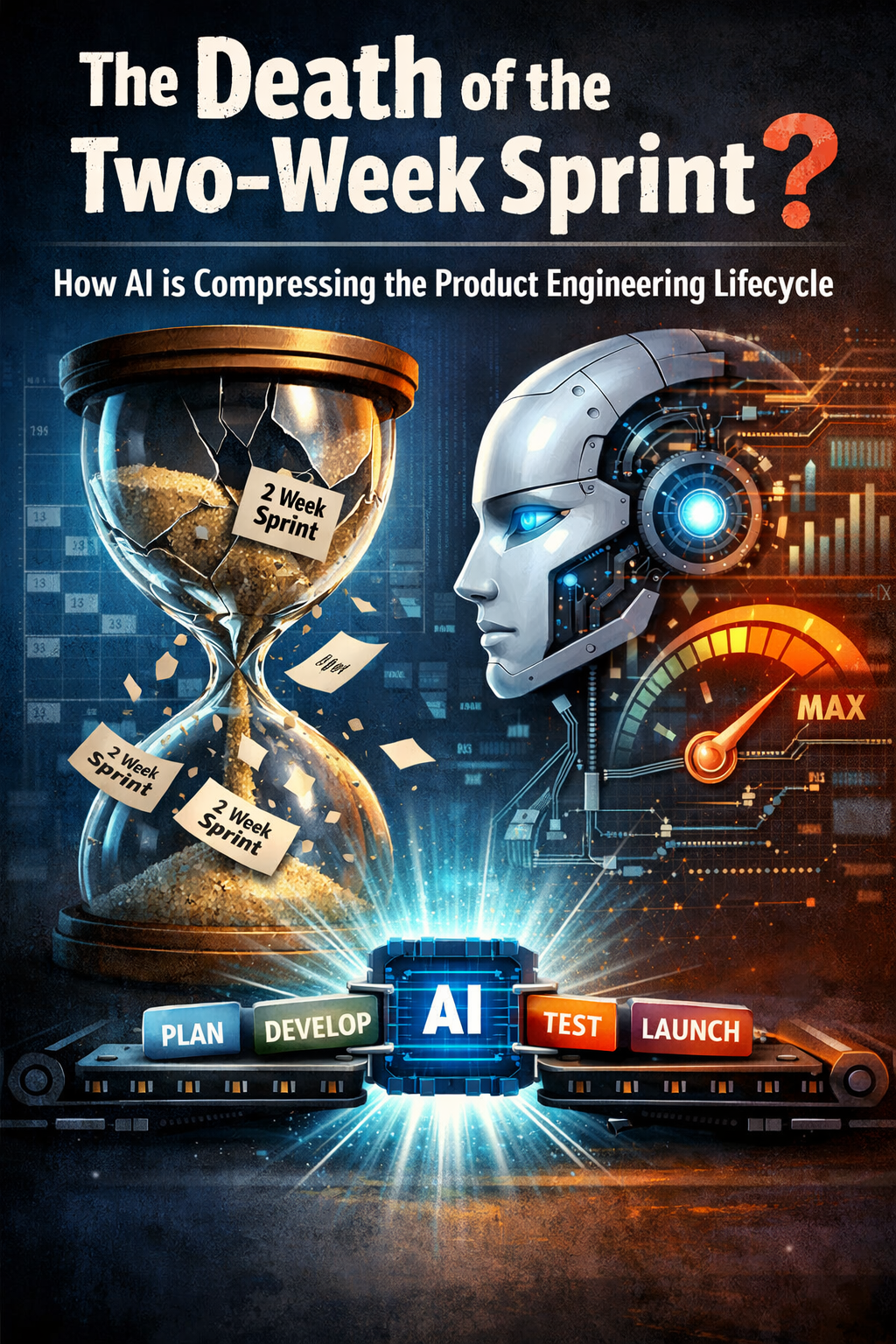
For the last 20 years, the rhythm of software development has been defined by Agile Methodology. We break work into two-week sprints: planning, coding, testing, and reviewing. It was a massive improvement over the rigid "Waterfall" model, but it still has a fundamental speed limit: the typing speed and cognitive load of human developers.
Artificial Intelligence is currently shattering that speed limit.
We are witnessing the emergence of AI-Augmented Product Engineering. This isn't just about developers using ChatGPT to write a function; it is a holistic reshaping of the entire lifecycle. Phases that used to take days (like requirement gathering and UI design) now take hours. Tasks that were manual bottlenecks (like writing unit tests or documentation) are becoming automated byproducts of the coding process.
Phase 1: Requirements & Discovery (The End of the Blank Page)
In the traditional cycle, a Product Manager (PM) starts with a blank page, interviews stakeholders, and spends days drafting a Product Requirement Document (PRD).
The AI Shift: The PM now acts as an "Editor." They feed raw notes, meeting transcripts, and competitor URLs into an AI model.
The Output: The AI generates a structured PRD, user personas, and a list of "Jobs to Be Done" in minutes. It even suggests edge cases the PM missed.
Impact: The "Definition Phase" is accelerated by 70%, allowing the team to align on the what and why almost instantly.
Phase 2: Design & Prototyping (Generative UI)
Traditionally, designers would build wireframes in Figma, iterate for a week, and then hand them off to developers to manually translate into CSS/HTML.
The AI Shift: Generative UI tools allow teams to go from text-to-interface. A prompt like "Create a dashboard for a logistics manager showing real-time fleet map and fuel costs" generates a fully coded React component, not just a picture.
Impact: The "Hand-off" friction between design and dev is eliminated. Developers start with working frontend code, not just a JPEG.
Phase 3: Development (The Copilot Era)
Coding has historically been 20% logic and 80% syntax/boilerplate.
The AI Shift: AI Coding Assistants (Copilot, Cursor) handle the syntax. They auto-complete entire functions, generate boilerplate for API endpoints, and refactor messy code on the fly.
The New Skill: The developer's role shifts from "Typist" to "Reviewer." They spend less time writing for loops and more time architecting the system and reviewing the AI's output for security and logic flaws.
Traditional Agile vs. AI-Augmented Agile: The Shift
The following table highlights how AI changes the physics of the engineering cycle.

Phase 4: Testing & QA (The Safety Net)
Writing tests is the vegetable of software engineering—everyone knows it's good for you, but no one wants to do it.
The AI Shift: AI Agents can analyze a block of code and generate a comprehensive suite of unit tests, integration tests, and even security vulnerability scans.
Impact: Testing becomes continuous. "Test-Driven Development" (TDD) becomes the default because the AI writes the tests for you. This dramatically reduces the bug rate in production.
The Risk: The "Review Gap"
While AI accelerates output, it introduces a new risk: generating code faster than humans can understand it. If an AI writes a complex algorithm in seconds, can the human developer maintain it six months later?
This requires a new engineering discipline: AI Literacy. Teams must enforce strict code review standards where developers are required to explain how the AI-generated code works before merging it.
How Hexaview Adapts the Cycle
At Hexaview, we have evolved our product engineering services to embrace this new reality. We don't just sell "hours"; we sell "velocity."
AI-Native Workflows: Our teams use a curated stack of AI tools (Copilot for code, Midjourney for assets, ChatGPT for logic) to bypass the mundane parts of the SDLC.
Prompt Engineering for Devs: We train our engineers in advanced prompting techniques, ensuring they get high-quality, secure code from the models.
Automated Governance: We implement AI-driven guardrails in the CI/CD pipeline to catch "hallucinated" code or security flaws before they reach your repository.
We help you build better software, faster, by treating AI as the newest member of the engineering team.


From idea to demand analysis and development to maintenance, get the complete range of software product engineering life cycle produced in one place.
At Zealous System, we offer trusted software product engineering using latest technologies, design strategies and development techniques to build cutting edge software products.For more information: https://bit.ly/2qRSrT5
A strategic implementation combined with appropriate data training constitutes the layers of AI-driven business automation.We, at Oodles, as an emerging Artificial Intelligence Development Company, decode business automation while highlighting key AI applications for attaining operational efficiency.
As an established Computer Vision Development Company, the Oodles’ AI team has built a CNN-based employee attendance system.
The model is integrated with a front-desk video camera that tracks employee movements with over 95% accuracy achieved.Learn more: AI Applications For Business Automation