


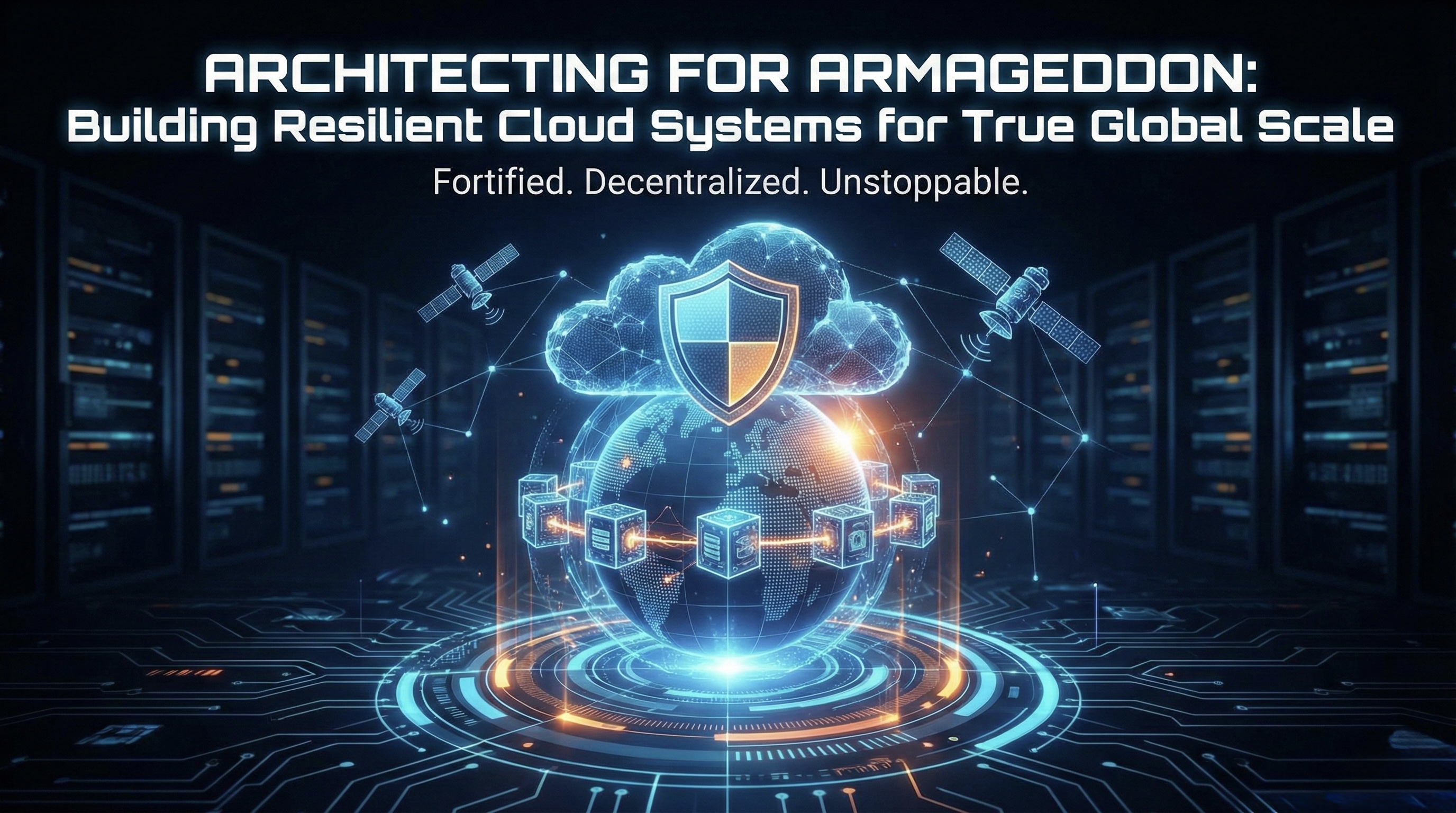
Deploying an application to the cloud is easy. Ensuring that application remains available, performant, and consistent for millions of users across multiple continents, even in the face of infrastructure failures, network partitions, or regional disasters, that is the formidable challenge of building for global scale. Simple high availability within a single data center is no longer sufficient. True resilience in the cloud era demands a sophisticated resilient cloud architecture designed explicitly to withstand failures at every level.
This isn't just about disaster recovery; it's about building systems that are inherently fault-tolerant, self-healing, and globally distributed. Achieving this requires moving beyond basic custom software development and embracing advanced engineering practices deeply rooted in cloud-native architecture principles. It demands a proactive, multi-layered approach that anticipates failure and automates recovery. For businesses aiming for worldwide reach, mastering these architectural patterns is not optional, it's the price of entry.
The Challenge of Global Scale: Beyond Single-Region Thinking
Operating at a global scale introduces complexities that single-region architectures don't face:
- Latency: Users accessing an application hosted halfway around the world will experience significant delays.
- Regional Failures: Entire cloud regions can (and occasionally do) experience outages due to natural disasters, power failures, or major network issues. Relying on a single region creates a massive single point of failure.
- Data Sovereignty: Regulations like GDPR require user data to be stored and processed within specific geographic boundaries.
- Varying Load Patterns: Traffic patterns differ significantly across time zones, requiring infrastructure that can scale dynamically and globally.
A resilient cloud architecture must address all these factors simultaneously.
Pillar 1: Geographic Redundancy – Spreading the Risk
The foundational layer of global resilience is distributing your application across multiple, geographically isolated locations.
- Core Concepts:
- Multi-Availability Zone (AZ): Deploying application instances across multiple physically separate data centers within the same cloud region. This protects against failures impacting a single data center (e.g., power outage, fire). Most cloud load balancers can automatically route traffic away from a failed AZ.
- Multi-Region: Deploying the entire application stack (or critical components) across multiple independent cloud regions (e.g., US-East, EU-West, AP-Southeast). This protects against failures impacting an entire geographic region.
- Implementation: Requires sophisticated global load balancing (like AWS Route 53 or Azure Traffic Manager) to direct users to the nearest healthy region. Data replication strategies (discussed next) are crucial for multi-region consistency. This leverages core cloud-native architecture principles.
Pillar 2: Application Resiliency – Designing for Failure
Individual application components will fail. Resilient architecture assumes this and builds mechanisms to handle it gracefully.
- Core Concepts:
- Microservices & Loose Coupling: Breaking the application into independent services means the failure of one non-critical service (e.g., a recommendation engine) doesn't necessarily bring down the entire system (e.g., the core checkout process).
- Health Checks & Self-Healing: Container orchestrators (like Kubernetes) and cloud platforms constantly monitor the health of application instances. If an instance fails, it's automatically terminated, and a new, healthy instance is started to replace it.
- Circuit Breakers & Timeouts: Implementing patterns where calls to potentially failing downstream services are automatically stopped for a period after detecting failures, preventing cascading failures and allowing the failing service time to recover.
- Graceful Degradation: Designing the application so that non-essential features can be temporarily disabled during high load or partial failures, ensuring core functionality remains available.
- Implementation: Requires careful custom software development incorporating fault-tolerance patterns and leveraging platform features for health monitoring and auto-scaling.
Pillar 3: Data Resiliency & Consistency – Protecting Your Most Critical Asset
Ensuring data availability and consistency across geographically distributed locations is often the most complex challenge.
- Core Concepts:
- Automated Backups: Regularly backing up critical data to a separate location (ideally another region).
- Database Replication:
- Multi-AZ Replication: Most managed cloud databases offer synchronous or semi-synchronous replication to a standby instance in another AZ within the same region for automatic failover.
- Multi-Region Replication: Asynchronously replicating data to read replicas or standby instances in other regions for disaster recovery and lower read latency for global users.
- Global Databases: Utilizing globally distributed databases (like Amazon Aurora Global Database, Azure Cosmos DB, Google Cloud Spanner) designed for multi-region consistency and low-latency reads/writes.
- Consistency Models: Understanding and choosing appropriate data consistency models (e.g., strong consistency vs. eventual consistency) based on application requirements, as achieving strong consistency across regions can impact performance.
- Implementation: Requires careful selection of database technologies and replication strategies, often involving trade-offs between consistency, availability, and performance.
Pillar 4: Automation & Proactive Testing – Building Confidence
Manual processes are too slow and error-prone for managing global, resilient systems. Automation and proactive failure testing are essential.
- Core Concepts:
- Infrastructure as Code (IaC): Defining all infrastructure (networks, servers, databases, load balancers across all regions) as code allows for repeatable, automated provisioning and recovery.
- Automated Failover: Scripting and automating the process of detecting a regional failure and failing over traffic and data services to a secondary region.
- Chaos Engineering: Proactively and intentionally injecting failures into the production environment (e.g., terminating instances, introducing network latency) in a controlled manner to test the system's resilience and ensure automated recovery mechanisms work as expected. This is a mature DevOps automation practice.
- Implementation: Requires robust CI/CD pipelines, sophisticated monitoring/alerting, and a strong culture of automation and testing, often facilitated by expert product engineering services.
Layers of a Resilient Global Architecture
Building resilience requires addressing redundancy, application design, data strategy, and operational automation holistically.

How Hexaview Engineers Your Globally Resilient Platform
Architecting and implementing a truly resilient cloud architecture for global scale is a complex undertaking requiring deep expertise across multiple domains. At Hexaview, this is a core competency of our product engineering services.
Our certified cloud architects specialize in designing multi-region, fault-tolerant systems based on cloud-native architecture principles. We leverage advanced engineering practices to build applications with inherent resilience, incorporating patterns like self-healing, circuit breakers, and graceful degradation. As a custom DevOps automation partner, we implement sophisticated IaC, automated failover mechanisms, and help establish chaos engineering practices.
Whether you are scaling an existing application or building a new global platform, Hexaview provides the custom software development and cloud-native product development expertise to ensure your architecture is not just scalable, but also highly resilient, available, and ready to withstand the unexpected, keeping your business always online.


From idea to demand analysis and development to maintenance, get the complete range of software product engineering life cycle produced in one place.
At Zealous System, we offer trusted software product engineering using latest technologies, design strategies and development techniques to build cutting edge software products.For more information: https://bit.ly/2qRSrT5
