According to a new report published by Allied Market Research, the geophysical services market size was valued at $16.2 billion in 2023 and is projected to reach $24.5 billion by 2033, growing at a CAGR of 4.3% from 2024 to 2033. The steady expansion of energy exploration, renewable projects, and infrastructure development is driving long-term growth across the global market.
Introduction
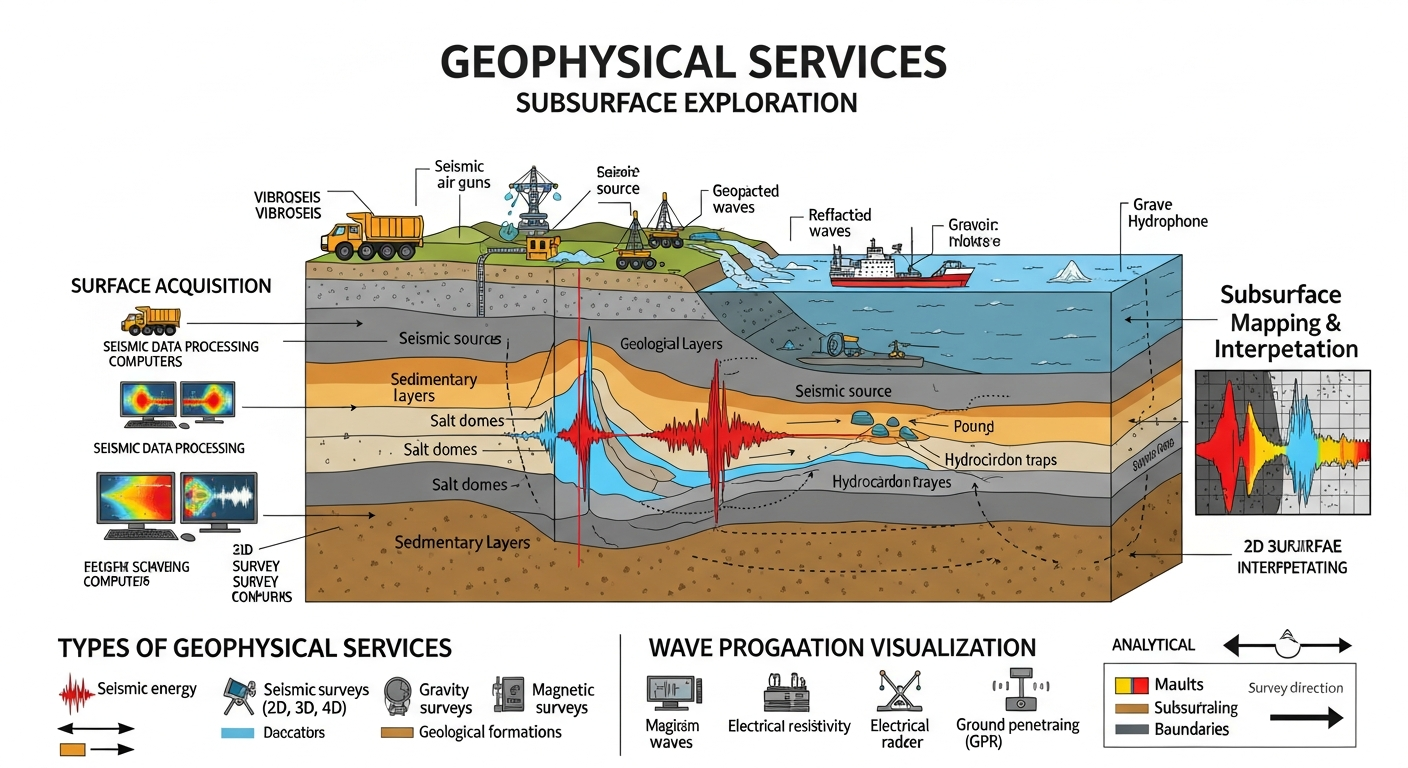
The geophysical services market plays a crucial role in collecting, processing, and interpreting subsurface data using advanced scientific methods. Geophysical surveys help identify geological structures, mineral deposits, groundwater reserves, and hydrocarbon resources beneath the Earth’s surface. These surveys employ techniques such as seismic, magnetic, electromagnetic, gravity, and LiDAR to deliver accurate insights into subsurface formations.
Download PDF Brochure: https://www.alliedmarketresearch.com/request-sample/A17403
Geophysical services are widely used across industries including oil & gas exploration, mineral mining, wind energy development, water exploration, archaeological research, and infrastructure construction. In the construction sector, geophysical data supports site assessment for wind turbines, power plants, bridges, and large industrial facilities, ensuring safety and operational efficiency.
Market Dynamics
Rising Demand from Oil & Gas and Mining Industries
One of the primary drivers of the geophysical services market growth is the rising demand from the oil & gas and mining sectors. Energy companies are investing heavily in advanced geophysical surveys to discover new reserves and optimize extraction processes. Increasing urbanization and industrial expansion are fueling demand for raw materials, further boosting the need for accurate subsurface data.
Seismic and marine-based surveys are particularly critical for offshore oil & gas exploration, enabling companies to reduce exploration risks and improve drilling success rates.
Expansion of Wind Energy and Renewable Projects
Rapid industrialization and climate commitments have significantly increased demand for green energy sources. Governments worldwide are investing in onshore and offshore wind energy projects, which require extensive geophysical assessments to determine soil stability, seabed conditions, and subsurface characteristics.
The growing deployment of wind farms is accelerating demand for geophysical services related to wind energy planning and site evaluation, making renewable energy a key growth avenue for the geophysical services market outlook.
Increasing Water Exploration and Archaeological Applications
The decline in freshwater resources across developed and developing nations has intensified the exploration of underground water reserves, especially in the LAMEA region. Geophysical services such as electromagnetic and gravity surveys are increasingly used to locate groundwater efficiently.
In addition, the growing application of seismic and acoustic technologies in archaeological research is positively influencing market demand. These services help uncover ancient structures without excavation, preserving cultural heritage while reducing operational costs.
Market Restraints: High Cost of Data Acquisition
Despite strong growth drivers, the high cost of geophysical data acquisition remains a major restraint. Advanced technologies such as 3D and 4D seismic imaging require expensive equipment, skilled professionals, and significant operational investments. Smaller companies and developing regions often face financial barriers, limiting adoption.
Furthermore, fluctuations in oil prices directly affect exploration budgets. During periods of low oil prices, energy companies reduce exploration spending, which negatively impacts demand for geophysical services.
Opportunities from AI and Machine Learning Integration
The integration of artificial intelligence (AI) and machine learning (ML) presents lucrative opportunities for the geophysical services market. These technologies enhance data processing accuracy, automate interpretation, and reduce turnaround times.
AI-driven analytics improve subsurface imaging, predict resource potential, and minimize exploration risks. By lowering operational costs and improving efficiency, AI and ML are attracting investments from oil & gas, mining, civil engineering, and renewable energy sectors.
Segment Overview
The geophysical services market is segmented by technology, type, end-use, and region.
By Technology
Based on technology, the market is categorized into seismic, magnetic, electromagnetic, gravity, LiDAR, and others. Among these, the seismic segment accounted for the largest market share in 2023. Seismic surveys are widely used due to their high accuracy in identifying subsurface structures, particularly in oil & gas and mineral exploration.
By Type
By type, the market is segmented into aerial-based surveys, marine-based surveys, and land-based surveys. The marine-based survey segment dominated the market in 2023, accounting for nearly half of the geophysical services market size. The growth of offshore oil & gas exploration and offshore wind energy projects has significantly increased demand for marine geophysical surveys.
By End-Use
On the basis of end-use, the market includes minerals & mining, oil & gas, wind energy, water exploration, archaeological research, and others. The oil & gas segment held the largest share in 2023, driven by continuous exploration activities and technological advancements in subsurface imaging.
Regional Analysis
Region-wise, the geophysical services market is analyzed across North America, Europe, Asia-Pacific, and LAMEA.
North America dominated the global market in 2023, accounting for more than two-fifths of total revenue, driven by strong oil & gas exploration activities and technological advancements. Europe follows due to offshore wind and marine exploration projects, while Asia-Pacific is emerging as a high-growth region supported by mining and renewable energy investments.
Get a Customized Research Report: https://www.alliedmarketresearch.com/request-for-customization/A17403
Competitive Landscape
Leading players in the geophysical services market include Schlumberger, CGG, Petroleum Geo-Services, TGS, Shearwater Services, Fugro, SGS SA, Ramboll Group A/S, Getech, Spectrum Geophysics, Abitibi Geophysics, and Xcalibur Multiphysics.
These companies focus on strategies such as capacity expansion, mergers & acquisitions, partnerships, and technological innovation to strengthen their global presence and enhance service offerings.
Conclusion
The global geophysical services market is set for steady growth through 2033, supported by rising energy demand, renewable investments, and technological advancements. While high costs pose challenges, AI-driven innovations and expanding applications across water exploration and infrastructure development are expected to unlock new growth opportunities.
About Us
Allied Market Research (AMR) is a full-service market research and business-consulting wing of Allied Analytics LLP based in Portland, Oregon. Allied Market Research provides global enterprises as well as medium and small businesses with unmatched quality of "Market Research Reports" and "Business Intelligence Solutions." AMR has a targeted view to provide business insights and consulting to assist its clients to make strategic business decisions and achieve sustainable growth in their respective market domain.
Pawan Kumar, the CEO of Allied Market Research, is leading the organization toward providing high-quality data and insights. We are in professional corporate relations with various companies and this helps us in digging out market data that helps us generate accurate research data tables and confirms utmost accuracy in our market forecasting. Each and every data presented in the reports published by us is extracted through primary interviews with top officials from leading companies of domain concerned. Our secondary data procurement methodology includes deep online and offline research and discussion with knowledgeable professionals and analysts in the industry.