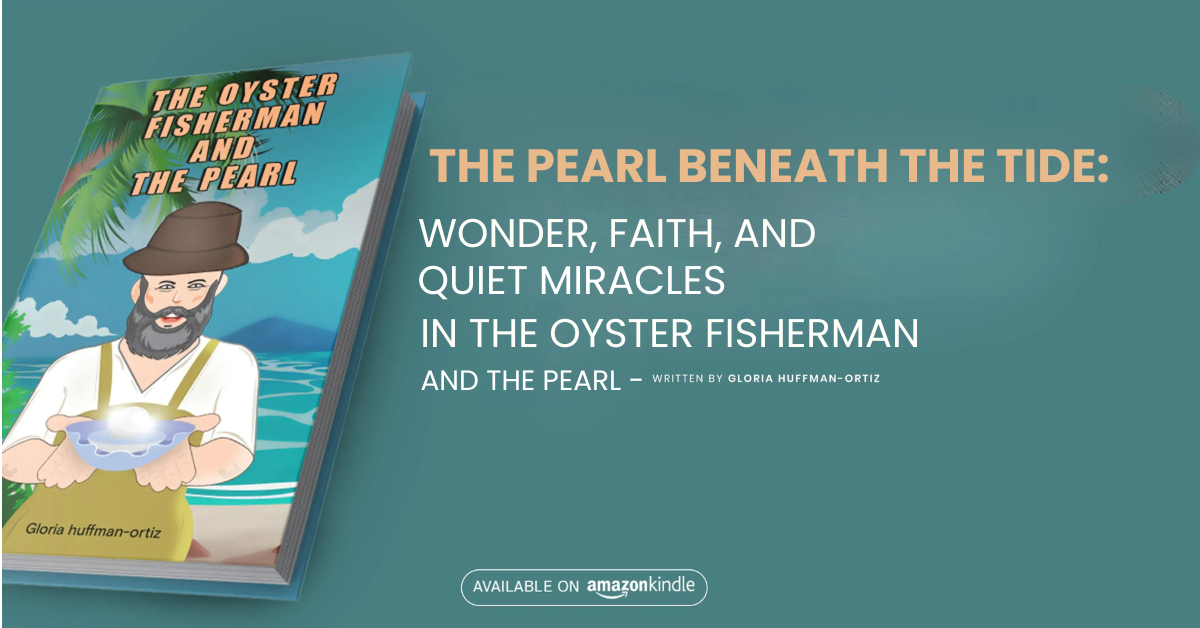
In a world that often rushes children toward noise, speed, and spectacle, The Oyster Fisherman and the Pearl by Gloria Huffman offers something beautifully rare: stillness. Set against the gentle rhythm of the sea, this tender story unfolds like a whisper, reminding young readers and the adults who read with them that life’s greatest treasures are often hidden in ordinary moments.
At the heart of the tale is a humble fisherman whose days follow the steady cadence of tides and nets. His life is simple, grounded in routine, shaped by the ocean’s endless ebb and flow. He does not chase glory or wealth. He rises with the sun, works with his hands, and listens to the sea. It is within this quiet existence that a single pearl becomes a turning point, not because of its monetary value, but because of what it awakens in him.
Huffman’s narrative does not rely on spectacle. Instead, it leans into reflection. The pearl is not a prize in a grand adventure; it is a symbol of perception. Through it, the fisherman begins to see the world differently. Each shell becomes a possibility. Each wave carries meaning. The story gently teaches children that wonder is not something we travel far to find; it lives in what we already hold.
This is where the book’s quiet faith begins to glow. The story never preaches. It invites. It suggests that gratitude can reshape the way we experience life, that belief does not need thunder to be powerful, and that blessings often arrive in disguise. The fisherman’s journey mirrors a child’s growing awareness of the world: the realization that there is more beneath the surface, more meaning than meets the eye.
The seaside setting plays a vital role in shaping this message. The ocean is both constant and mysterious, vast, calming, and unknowable. For young readers, it becomes a metaphor for life itself. Just as the fisherman never knows what each oyster might hold, children learn that each day carries unseen possibilities. The sea teaches patience. It teaches humility. It teaches trust.
In a culture saturated with instant gratification, The Oyster Fisherman and the Pearl restores the value of waiting. It shows that beauty forms slowly, often in darkness, just as pearls do. This metaphor resonates deeply with children, who are themselves in the process of becoming. They, too, are forming quietly, shaped by experiences they may not yet understand.
Huffman's language is gentle and precise, allowing the emotional weight of the story to remain accessible. The fisherman is not extraordinary in his abilities; he is exceptional in his openness. This distinction is powerful for young readers. It communicates that you do not need to be heroic to be meaningful. You simply need to be present, grateful, and willing to see.
Parents and educators will recognize the book’s subtle ability to start conversations. What is a “pearl” in your own life? What small gift might you be overlooking? How does gratitude change the way we see? These are not heavy questions, yet they carry lasting resonance. The story creates a bridge between generations, inviting adults to slow down alongside children and rediscover wonder together.
What makes The Oyster Fisherman and the Pearl especially valuable is their emotional safety. There is no fear-driven urgency, no overwhelming conflict. Instead, the book provides a calm space in which children can reflect. It reassures them that growth does not need to be loud and that meaning can be found in gentleness. In doing so, it becomes a comforting presenceideal for bedtime reading, classroom discussions, or quiet afternoons.
The pearl itself becomes more than an object. It is a reminder that life is layered, that what appears plain on the outside may hold brilliance within. For a child, this idea is transformative. It suggests that people, moments, and even they themselves may be more precious than they realize.
Ultimately, The Oyster Fisherman and the Pearl is not about the sea, nor even about the fisherman. It is about learning to see. It is about recognizing that faith can be soft, that miracles can be quiet, and that the world is richer when we approach it with gratitude.
In a time when stories often shout to be heard, Gloria Huffman’s book chooses to whisper. And in that whisper, it offers young hearts something enduring: a way to look at life not as a race, but as a gift, one pearl at a time.
Amazon Link: The Oyster Fisherman and the Pearl