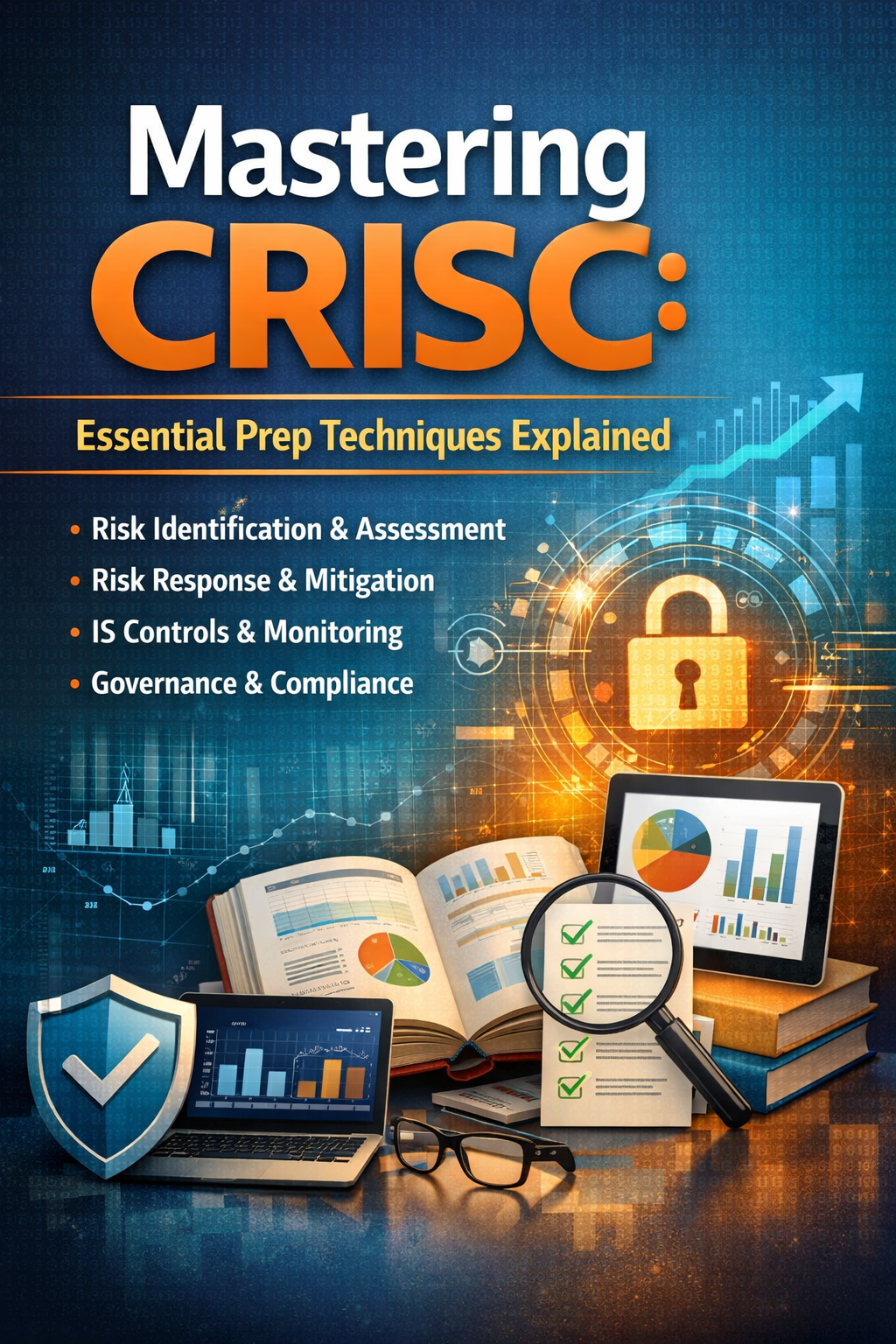
To master the CRISC certification in 2026, you must evolve from a technical "troubleshooter" to a strategic "risk advisor." Since the exam was updated in late 2025, prep techniques now emphasize emerging technologies like AI governance and high-level decision-making.
Here are the essential prep techniques to ensure success on your first attempt.
1. The "ISACA Mindset" Technique
The most common reason for failure is answering from a technical perspective.
Think Like a Manager: When a question asks for the "BEST" or "FIRST" action, avoid the technical fix (e.g., "patch the server"). Instead, look for the administrative or strategic action (e.g., "conduct a risk assessment" or "inform the risk owner").
Eliminate "Correct" but "Wrong" Answers: Often, all four choices are technically valid. Use the Business Alignment filter: Which answer protects the organization’s most critical objectives?
2. Advanced Question Analysis (S.W.O.T. for Questions)
CRISC questions are notoriously wordy. Use this tactical approach:
Spot the "Suspicious" Words: Beyond the bolded MOST or LEAST, look for adjectives like widespread, supervisory, or critical. These narrow the scope significantly.
The "Double-Pass" Strategy: Skim the question, skim the answers, then re-read the question carefully. This gives you the context of what ISACA is trying to "trap" you with before you commit to an answer.
3. Leverage the QAE Database (Correctly)
The Questions, Answers & Explanations (QAE) database is your most powerful tool, but most people use it wrong.
Don't Memorize, Analyze: If you get a question right, read the explanation for the wrong answers. Understanding why a choice is "suboptimal" is more valuable than knowing why one is correct.
Identify Question Patterns: If you see the same concept (e.g., Residual Risk) asked in five different ways, highlight it. That is a "high-yield" topic guaranteed to be on your specific exam form.
4. The 10-Week "Sprint" Schedule
Consistency beats intensity. Aim for a structured timeline:
Weeks 1-4 (Foundation): Read the CRISC Review Manual (7th Edition) cover-to-cover. Don't take notes yet; just absorb the flow of the 4 domains.
Weeks 5-8 (Drilling): Use the QAE Database. Target a first-pass score of 75% or higher.
Weeks 9-10 (Simulation): Take three full-length, 4-hour mock exams. This builds the "mental stamina" needed to stay focused for all 150 questions.
5. Master the "Golden Trio" of Indicators
In Domain 3 (Risk Response), candidates often confuse these three. Mastering the difference is worth at least 5-10 points on the exam:
KPI (Key Performance Indicator): Measures how well a process is doing (e.g., "How fast did we patch?").
KCI (Key Control Indicator): Measures how well a security control is working (e.g., "Is the firewall blocking 100% of unauthorized traffic?").
KRI (Key Risk Indicator): An early warning signal that a risk is about to exceed appetite (e.g., "We've had a 20% increase in failed login attempts this week").
Pro Tip for 2026: Ensure your study materials cover the NIST AI Risk Management Framework. The updated exam now includes questions on AI data governance and the ethics of automated risk responses.

In 2001, the term agile programming was stamped by the advocates of XP, DSDM, SCRUM, Adaptive Software Development, Crystal, and other methods of programming.
According to VerizonOne's survey, there are four major types of scaling methods used today.
5% use Discipline Agile Delivery, or DAD, and another 5% use the Large-Scale Scrum Framework or LeSS.
And second, the hybrid methodology coordinates teams by using predictive, or traditional, controls, such as stage-gates, to manage delivery.
At these meetings, the representatives focus on reporting out completed stories and blockers.
Scrum of Scrums provides an opportunity to identify the need for coordination among team members.