Why Enterprise Systems Still Shape AI Outcomes
Enterprise AI strategies often focus on models, data platforms, and automation frameworks. While these elements are essential, they do not operate in isolation. The systems that execute transactions, enforce rules, and connect business processes ultimately determine whether AI delivers measurable value.
In many organisations, these execution responsibilities still rest on legacy systems. These platforms were designed to prioritise stability and control, often at the expense of flexibility. As AI initiatives mature, the limitations of such systems become increasingly apparent.
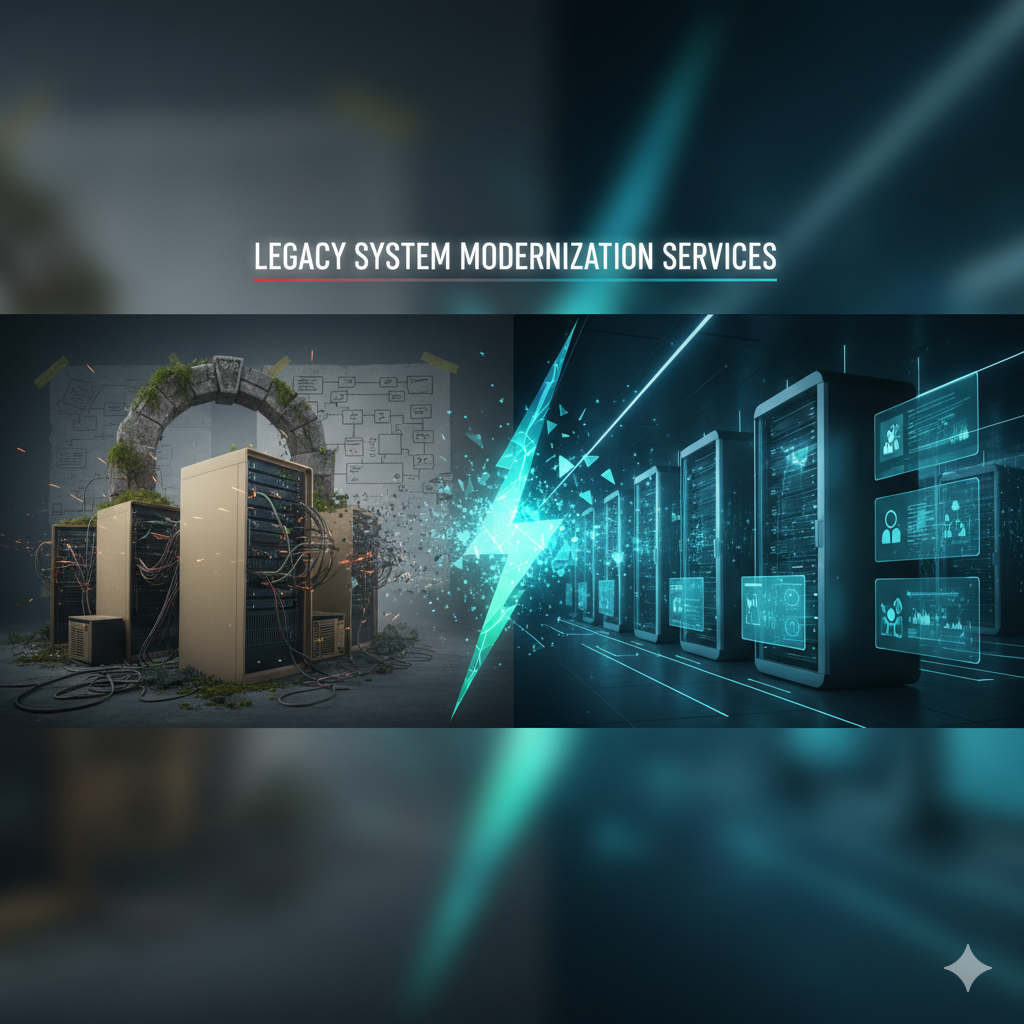
Legacy system modernization addresses this challenge by evolving execution environments so they can respond dynamically to AI-driven intelligence without compromising reliability.
The Execution Gap Between AI Insight and System Action
AI systems excel at generating insight. They identify patterns, predict outcomes, and recommend actions. However, enterprises frequently struggle to translate this intelligence into timely execution.
The root cause is structural. Legacy systems rely on tightly coupled logic, sequential workflows, and batch-oriented processing. These characteristics introduce latency and limit responsiveness.
As a result:
• AI insights are delayed before action
• Automation requires manual intervention
• Decision-making becomes fragmented across systems
Legacy system modernization closes this execution gap by redesigning how systems interact with intelligence.
Rethinking Legacy Systems Beyond Stability
Legacy systems are often perceived as barriers to innovation. In reality, they represent accumulated business knowledge and operational trust. The objective of modernization is not to discard this value but to extend it.
Legacy System Modernization focuses on restructuring how systems expose capabilities, manage logic, and integrate with modern platforms. This allows enterprises to preserve core functionality while enabling adaptability.
Through modernization, legacy platforms evolve from static processors into responsive execution layers.
The Role of Legacy Application Modernization in AI Enablement
AI-driven execution often depends on application-level behaviour. Business rules, validations, and workflows are embedded within applications that were not designed for dynamic decisioning.
Legacy Application Modernization addresses this challenge by decoupling business logic from application code. Decision-making becomes configurable and responsive, allowing AI outputs to influence execution in real time.
This shift is critical for embedding intelligence directly into business processes.
Reducing Risk Through Legacy Application Modernization Services
Modernizing enterprise systems introduces legitimate concerns around stability and risk. Changes to core applications can affect mission-critical operations if not managed carefully.
Legacy Application Modernization Services mitigate this risk through structured assessment, phased execution, and continuous validation. Enterprises gain confidence that modernization efforts will enhance capability without disrupting operations.
This disciplined approach ensures that modernization delivers predictable outcomes.
Addressing Regional and Regulatory Complexity
Global enterprises often operate legacy systems across regions with differing regulatory and operational requirements. Modernization must account for this complexity.
Legacy System Modernisation supports regional adaptability by enabling configurable execution paths and policy-driven controls. AI-driven decisions can be tailored to local constraints without duplicating systems.
This flexibility is essential for scaling AI across diverse environments.
Enabling Event-Driven and Real-Time Execution
AI-driven environments benefit from event-driven architectures that respond immediately to changes. Legacy systems traditionally operate in batch modes that delay response.
Modernized systems support event-based execution by exposing services and integration points that react in real time. AI outputs trigger actions as conditions change, reducing latency and improving responsiveness.
This capability transforms how enterprises operate under dynamic conditions.
Governance and Transparency in Modernized Systems
As AI influences execution, governance becomes more complex. Enterprises must explain how decisions were made and ensure that execution aligns with policy.
Legacy system modernization enhances transparency by externalising decision logic and making execution paths explicit. This improves auditability and strengthens trust in AI-driven operations.
Governance becomes embedded rather than enforced retrospectively.
Measuring Business Impact of System Modernization
The success of modernization is measured by outcomes, not technology adoption. Enterprises evaluate impact through:
• Faster execution cycles
• Increased automation coverage
• Reduced manual intervention
• Improved system resilience
These metrics demonstrate whether modernization efforts support strategic objectives.
Why Legacy System Modernization is a Strategic Imperative
Legacy system modernization is often positioned as a technical necessity. In reality, it is a strategic enabler for enterprise AI.
Without modernized systems, AI remains an overlay. With them, AI becomes integral to execution.
This distinction determines whether enterprises achieve transformation or remain constrained by legacy limitations.
Preparing Systems for Continuous AI Evolution
AI capabilities will continue to evolve. New models, use cases, and regulatory expectations will emerge. Systems must remain adaptable to accommodate these changes.
Legacy system modernization provides this adaptability by creating execution environments that can evolve without large-scale disruption.
Conclusion: From System Constraint to Execution Advantage
Legacy systems have long been viewed as constraints on innovation. Through modernization, they become sources of competitive advantage.
By enabling responsive execution, improved governance, and AI-driven adaptability, legacy system modernization allows enterprises to move confidently from insight to action.
For organisations pursuing sustainable AI adoption, modernizing legacy systems is not optional. It is foundational.
________________________________________
Have Questions? Ask Us Directly!
Want to explore more and transform your business?
Send your queries to: info@sanciti.ai