


Mafatlal Industries- Fall, Climb, & Time
My son is only eleven. Far too young to care about balance sheets or boardroom turnarounds. His world right now is all cricket scores and Messi reels, not margins and ROCE. But sometimes I wonder: what if he were 21, curious enough to ask about the businesses that lasted? And what if I, a little older and hopefully a little less dumb than now, could sit him down and share not just a stock tip, but a story? This conversation is imagined, yes, but only just.
Origins: Batman Begins
Son: Dad, you keep talking about old companies as if they’re superheroes. But all the action is in startups, right? I mean, who cares about a 120-year-old textile company?
Source: Mafatlal Industries FY25 Annual Report
Father: Funny, you say “superheroes”. Have you watched The Dark Knight Rises?
Son: Of course. I’ve watched it like five times. Bane breaks Batman. Bruce falls into the pit, climbs out, and becomes stronger.
Dark Knight Rises - Prison Escape - Complete
Father: Exactly. Most people think the story is about the fight at the end. But it isn’t. It’s about the pit. The humiliation. The breaking. The slow rebuilding of body, bone, and spirit, and then the climb. Remember? Without the rope.
Mafatlal’s story is the same.
For decades, it was a respected business house. Mills in Ahmedabad and Bombay, a proud textile name. Then a series of mistakes, external shocks, global competition, and suddenly, it was in the pit. Literally under BIFR. As good as dead. But it didn’t die. It climbed back. Not in a blaze of glory. But with quiet discipline. Lean. Focused. Smaller than before, but sharper than ever.
Son: Wait. You’re telling me a textile company had its own “Bane moment”?
Father: Oh, several. The world changed. The market shifted. The old tools stopped working. And like Bruce Wayne, Mafatlal had to choose: rot in the pit, or climb without the rope. It climbed.
Why Do Some Companies Live So Long?
Son: But Dad, how do businesses even survive 100+ years? Most startups die in five.
Father: Exactly. There’s a reason we remember so few. Look at Japan. A company called Kongō Gumi has been building temples since 578 AD.
Over 1,400 years.
Son: How is that even possible?
Father: Because businesses that endure don’t chase fashion. They chase continuity. They understand that survival isn’t momentum, it’s meaning. They remember what they exist for. And they’re willing to shrink, reinvent, and rebuild to stay true to that purpose. Remember, you get so bored by my same old phrases of “Survive To Thrive” and “Consistency > Intensity.” I don’t think I will ever get bored by them.
Mafatlal did the same. They survived. Not intensely. But consistently. Let me show you its four eras, four distinct lifetimes.
Era 1 1905–1990s: The Age of Building (Scale, Steel & Sweat)
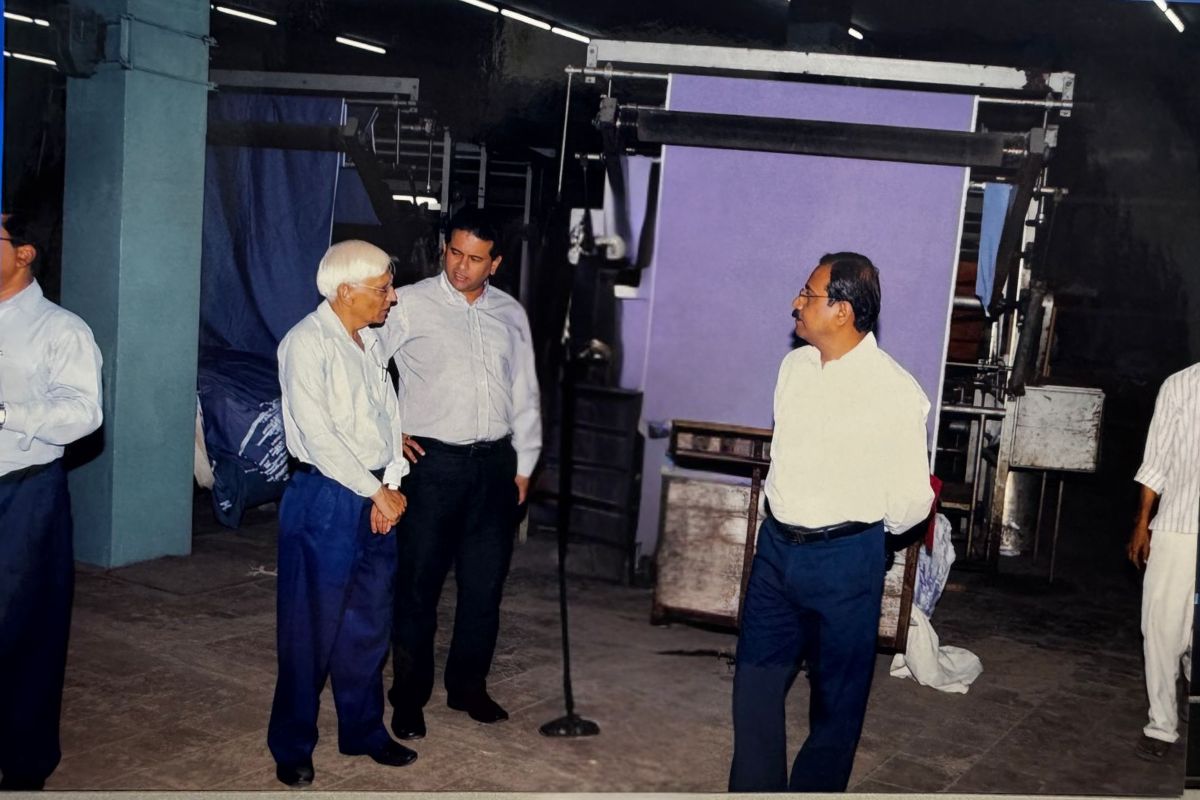
Father: In 1905, when Gagalbhai Mafatlal set up the first mill, India didn’t even produce most of its own cloth. He wasn’t chasing valuation; he was chasing relevance. Like young Bruce Wayne learning to fight, Mafatlal Industries spent its youth building muscle. Mills, spindles, supply chains, and manufacturing culture. It grew across Ahmedabad, Nadiad, and Bombay. For nearly 80 years, it simply built capacity and earned trust.
Source: Mafatlal Website
The family baton passed, not with noise but with quiet dignity, to Arvindbhai in 1954, Gagalbhai’s grandson, and a man known more for his calm resolve than flamboyance. In the quiet arc of time, not all legacies are measured in numbers. Some are etched in grace. Years after he passed the torch, Shri Arvindbhai Mafatlal was honoured by none other than Prime Minister Narendra Modi, not with noise, but with reverence. A commemorative postal stamp now bears his name, not just as a businessman, but as a builder of trust, industry, and values that endured. India paused, briefly, to remember a life that shaped more than balance sheets; it shaped character.
Source: Mafatlal Industries Website
Son: So, it became big by doing the boring stuff?
Father: Exactly. Brick by brick. Spindle by spindle. Not glamorous. But foundational. That’s how long lives are built.
Era 2 2000–2015: The Age of Strain (Fatigue, Diversion & Denial)
Son: Let me guess. This is when Bane showed up.
Father (smiles): You’re catching on. Yes, globalization hit. Cheaper imports flooded India. Fast fashion changed demand. Margins collapsed. In response, Mafatlal tried several new things. Chemicals, plastics, then denim. Some bets worked. But denim became its Gotham mistake. Wrong market, late entry, low differentiation. Losses mounted. Debt rose. Eventually, BIFR. Its back was broken.
It’s no easy thing, son, to build for decades and wake up one morning to headlines that speak of dismantling. For those who carry a business like legacy, news like this doesn’t just hit balance sheets; it bruises the soul.
Source: LiveMint 2000 Article
By 2002, Mafatlal was fighting for breath. Burdened by debt, selling mill land for survival, and offering half its workforce a way out. It wasn’t just restructuring; it was a quiet dismemberment, sanctioned by the state, so that something leaner and more enduring could live on.
Source: Google News on the Mafatlal BIFR case.
In 2002, like a wounded knight shedding his armor to survive, Mafatlal stripped itself down to its textile core. Spinning off its chemicals business and hiving off prized real estate into a special entity. What remained wasn’t an empire, but a survivor. Leaner, humbled, and holding just enough to make one last climb.
Source: Economic Times
It took over a decade of bleeding red ink, selling assets, and swallowing pride, but by 2010, Mafatlal’s net worth finally turned positive. Like Bruce trying to climb from the pit, the company didn’t rise overnight; it clawed back inch by inch, year after painful year.
In 2011, Mafatlal sold its Byculla mill land. Once the symbol of industrial pride, now a lifeboat. ₹600 crore changed hands, not for growth, but for survival. A windfall that bought it breath, repaid debt, and nudged it back from the edge. Sometimes, resurrection starts with letting go of history.
Source: ET Article
Between 2012 and 2015, Mafatlal shed the clutter. Merging its denim unit, trimming the fat, and turning quietly toward uniforms and value-added fabrics. It wasn’t glamorous, but it was sane. By stepping away from low-margin temptations and into focused execution, the old warrior began to breathe easy again.
Source: Business Standard
Son: So that was the pit.
Father: Yes. Now comes the question: What do you do in the pit? Most companies die there.
Mafatlal didn’t.
Era 3 2016–2022: The Age of Repair (Pruning, Lightness & Learning)
Father: When Bruce Wayne can’t use gadgets, he returns to basics. Push-ups. Discipline. Pain.
Mafatlal did the same. No heroics. Just hard decisions.
• Denim shut
• Workforce rationalised (VRS)
• Debt repaid
• Manufacturing outsourced
• Focus returned to uniforms & institutions
This was surgery. Cut what doesn’t serve survival.
Son: That must’ve hurt.
Father: Every good turnaround does. But it worked. The balance sheet healed, risk reduced, discipline returned. The company regained the right to dream again.
In the years between 2016 and 2022, Mafatlal didn’t sprint; it shed weight, learned to walk lighter, and recalibrated its stride. Like a battle-worn knight rediscovering discipline, it trimmed away what didn’t serve. Denim, distraction, drag. And poured its focus into uniforms, its strongest limb.
By 2017, it was speaking with newfound clarity: ₹1,000 crore in 5 years, a sharp pivot to school and corporate fabrics, and the birth of an e-commerce leg.
Source: Fashion News Article
Indeed, the ₹1,000 crore dream for FY21 fell short by half. But then again, who among us foresaw a world locked indoors, schools shut, uniforms untouched? You may not like it, but I’ll say it.
“Don’t Predict, Prepare!”
Losses that once bled steadily were halved by 2019, even as revenues rose. And then, when COVID hit and uniforms froze, it didn’t flinch; it transformed the uniform business into “Uniform Junction,” a full-stack ed-tech supply platform.
Priyavrata Mafatlal Indian Businessman And Vice-Chairman Of The Arvind Mafatlal Group
Source: Indian Textile Magazine
From a lumbering industrial relic, Mafatlal had become a nimble, asset-light thinker. Not loud. Not flashy. But smarter, leaner, and listening closely to where the world was headed.
Era 4 2023–2025: The Age of Rebirth (Focus, Futures & Fresh Soil)
Father: Now, imagine Bruce climbing out of the pit without the rope. Slow. Deliberate. Certain. This is Mafatlal after 2023. It went back to its spine, uniforms, a boring but beautiful niche. Stable. Recurring. Institutional. Then it added a new muscle. Digital learning infrastructure: Personalized Adaptive Learning [PAL] labs in schools. And built a stabiliser. Consumer durables for welfare programs. Touching 6.6 lakh households across 358 talukas of Maharashtra. Exports grew. Technology via PieFlowTech strengthened. And suddenly, the old textile mill looked younger than many startups.
Son: Just like Bruce Wayne. Smaller, lighter, smarter.
Father: Exactly.
The Turnaround Evidence (H1FY26)
Father: Here’s the fun part, numbers. After years in the pit, look what the company did:
H1 FY26
•Revenue: ₹2,269.9 crore (+56.8% YoY)
•Operating EBITDA: +53.5% YoY
•PBT: +63.7% YoY
•ROCE: ~21% (FY25)
•Gross Debt: ₹58 crore
•Finance cost: ↓ 70% since FY23
•Interim dividend declared
That is not luck. That is discipline and endurance compounded.
Son: So it came back stronger. Like Batman with better intuition?
Father: No gadgets. No rope. Just clarity.
Startups vs. Survivors
Son: But startups are cooler, aren’t they?
Father: Cool doesn’t mean durable.
Startups chase:
•TAM
• Funding
• Valuation
Survivors chase:
• Customers
• Balance sheet health
• Time
Startups want to grow fast. Survivors want to grow correctly. Startups scale first, and then ask if the idea was worthwhile. Survivors begin with meaning and scale only what aligns. Most startups are fireworks. Beautiful, loud, short. Companies like Mafatlal? They’re furnaces. Quiet, hot, continuous. The ones still burning when everyone else has gone cold.
What Makes the Climb Work? (The Engines Today)
Son: What exactly is working for them now? Like, what are the engines?
Father: Three engines. Each is very different. Each is deliberately chosen.
Engine 1 — Textiles & Uniforms (The Spine)
Source: Q2FY26 PPT
This isn’t just cloth. It's a recurrence. Schools, hospitals, institutions. They give repeat business.
H1FY26:
• ₹801.9 crore revenue (+35.6% YoY)
• EBIT margin: 6.9% → up from 5.9%
Steady. Predictable. This is Batman’s training. Not flashy, just reliable.
Engine 2 Consumer Durables (The Stabiliser)
Source: Q2FY26 PPT
A business that isn’t glamorous but touches lives. Welfare kits, household items, toys, and furniture, distributed across the country.
H1FY26: ₹1,445.6 crore revenue (+82% YoY). Low margin, yes. But high reach + volume. A cash-flow cushion. When Gotham goes quiet, this business pays the bills.
Engine 3 Digital Infrastructure (The New Muscle)
Source: Q2FY26 PPT
The youngest muscle. PAL (Personalised Adaptive Learning) labs. Used in Tripura schools and beyond.
H1FY26:
• ₹22.4 crore revenue
• EBIT margin ~18% (highest among all verticals)
Son: Wait. A 120-year-old textile business is doing digital infrastructure? Isn’t it looking like a reckless start-up pivot?
Father: That’s what I meant when I said, it’s climbing without the rope. No legacy ego. No “hum toh textile wale hain.” Just what does the future need, and how can we serve? That’s what makes the comeback credible.
The Future (Hope + Headwind)
Son: So, where does it go from here? What’s the next act, Batman, after Gotham?
Father: Good question. Every company has future fronts, new arenas in which it must fight.
For Mafatlal, I see four.
1) Uniforms: Deepening the Moat. Institutional uniforms are sticky. Once you win a school or a PSU, you’re in for years. Winning more states, more industries, that’s a huge runway. It’s the dependable old ally.
2) Digital Infra: Quiet Optionality. This is the wildcard. It could scale state by state. Govt + education + hardware + software. If they execute well, this could be a high-margin annuity machine. It’s like when Bruce discovers the Batplane. No one saw it coming. But once deployed, the game changes.
3) Consumer/Welfare: The Reach Engine. Government beneficiaries aren’t small. There are millions. That’s a scale you don’t get in private retail easily. If they continue executing, they stay nationally relevant. This is Alfred. Supportive, grounded, and dependable.
4) Export Apparel: New Geography. A slow but interesting angle. If they leverage trusted Indian sourcing + brand reliability, exports can become margin accretive over time. Call this Robin. Young, uncertain, but full of promise.
Is the Dark Knight Really Going To Rise?
Son: Wow. What a story, Dad. But wait. If it’s this compelling, why aren’t you buying the stock? Or, for that matter, why is the market still ignoring it?
Father: (Smiles) That’s the paradox, son. On paper, the numbers scream undervaluation. 10 times earnings, 5 times EV/EBITDA, 1.5 times book, and barely 0.3 times sales. But storytelling and stock picking aren’t the same thing. Between the two stands the Great Wall of China. You know what’s stopping me, and frankly, most of Gotham, from jumping in?
Son: The narrative is rich. A heroic fall, a painful climb, patient time, and now value on the table. What’s missing?
Father: Trust. Gotham’s citizens, like stock markets, are slow to believe, quick to doubt. Even when Batman reappears, people ask: Is he real? Will he endure? Is this just a phase? That’s where Mafatlal stands today. Fresh out of the pit, but still facing suspicion.
Pull up the H1FY26 deck and look closely. The story lies in the details.
Three segments, each with its own destiny. Consumer durables dominate revenue but offer razor-thin margins, and are heavily dependent on government schemes. Digital infra boasts the highest margins but saw a 64% YoY contraction in H1FY26. Textile, the historical core, has seen its contribution fall from 44% to 35% in less than a year. The picture is shifting fast, and execution discipline becomes the tightrope.
Mafatlal’s risks are real. Government-driven demand can be fickle. Managing uniforms, consumer goods, digital projects, and exports is a juggling act. And digital’s promise rides on state rollouts like PAL Labs, early-stage, with no guaranteed ramp. One or two missteps, and momentum stalls. Just as Batman doesn’t fight every battle, Mafatlal too must choose its arenas wisely.
Yet, optimism, not caution, builds fortunes. The stock has already rebounded 50% from its March 2025 lows, with healthy volumes.
The climb has begun. Bane reminds us in The Dark Knight Rises:
“Every man who has rotted here over the centuries has looked up to the light and imagined climbing to freedom.”
Mafatlal too is looking up. Toward that light. And imagining.
https://zennivesh.substack.com/p/mafatlal-industries-fall-climb-and?img=https%3A%2F%2Fsubstack-post-media.s3.amazonaws.com%2Fpublic%2Fimages%2F7e8ad38b-a8db-43c2-9e1b-d7342dc404f2_1280x1280.jpeg&open=false



William Penn says, “Time is what we want most, but what we use worst”.
We all know how time is important to us. But we do forget about TIME MANAGEMENTwhile we’re busy sorting other things wisely.
If a lack of visibility on how time is spent and managed is an issue, efficient time management is simply the best way to curb this mess.
It makes teams or resources more effective, businesses more profitable and companies more prolific.
What is ‘Time Management’ exactly?
Time management is a process of planning and organizing how to divide time between several activities so that all the assigned work can be completed on or before time, within budget.
Good time management helps you to work smarter