Why Enterprise AI Fails without an Execution-Oriented Operating Model
Enterprise AI discussions often focus on algorithms, data platforms, and innovation velocity. While these elements are essential, they do not determine whether AI becomes operational at scale. The deciding factor is the enterprise operating model—the way systems execute decisions, enforce controls, and respond to change.
In many organisations, this operating model is still anchored in legacy systems. These systems are reliable and deeply trusted, but they were designed for static workflows and predictable change cycles. As AI introduces adaptive decision-making and automation, this mismatch becomes increasingly visible.
Legacy modernization is the catalyst that allows enterprises to evolve their operating model so AI can function as an integrated execution capability rather than a disconnected insight layer.
The Hidden Cost of Running AI on Legacy Operating Models
When AI is introduced into legacy-centric environments, enterprises often compensate through manual processes. Insights are reviewed by teams, decisions are overridden manually, and automation is limited to non-critical paths.
This approach creates hidden costs:
- Slower decision cycles
- Increased operational overhead
- Inconsistent execution across business units
- Elevated governance and compliance risk
Over time, these costs erode the value AI was expected to deliver. The issue is not AI performance—it is the inability of legacy operating models to absorb intelligence at speed.
Legacy modernization addresses this by reshaping how systems execute work.
Reframing Legacy Modernization for Enterprise Transformation
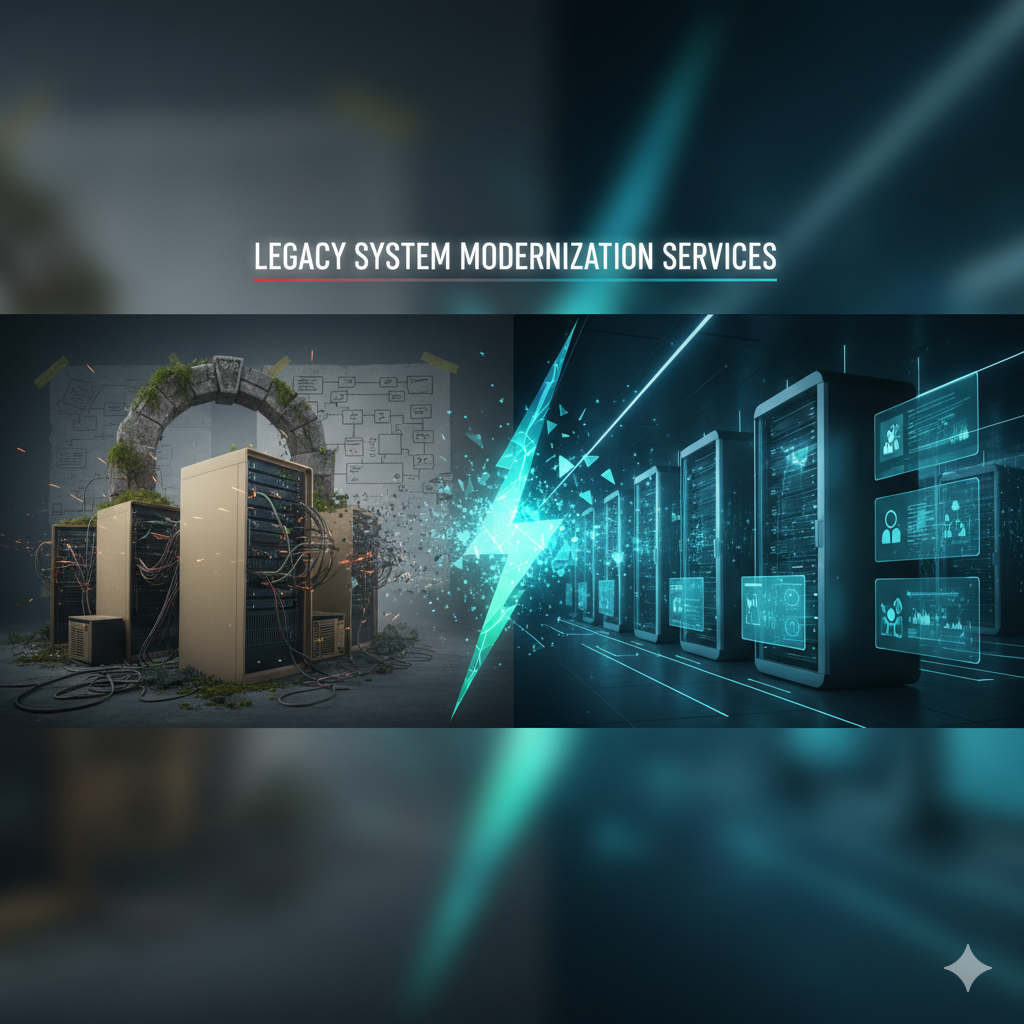
Legacy modernization is frequently perceived as technical refactoring. In reality, it is an operating model transformation.
Legacy Modernization focuses on enabling systems to respond dynamically to decision signals rather than following rigid, pre-defined flows. Execution becomes event-driven, configurable, and responsive to AI-generated outcomes.
This shift allows enterprises to retain trusted platforms while redefining how work moves through the organisation.
Building Execution Agility Through Legacy Modernization Services
To support AI-driven operating models, enterprises need execution agility. Systems must respond to changing data, evolving risk thresholds, and new business priorities without repeated redevelopment.
Legacy Modernization Services enable this agility by separating decision logic from transaction processing. AI insights influence execution through orchestration layers instead of embedded code.
This separation preserves system stability while introducing the flexibility AI demands.
Identifying High-Impact Change with a Legacy Modernization Tool
Large enterprises often struggle to determine where modernization delivers the greatest return. Not every system limits AI execution equally.
A Legacy Modernization Tool provides visibility into execution bottlenecks, dependency chains, and AI readiness across the application landscape. This insight allows leaders to prioritise modernization initiatives based on operational impact rather than intuition.
Targeted change accelerates transformation while controlling risk.
Managing Organisational Risk During Operating Model Evolution
Modernising execution layers affects revenue, compliance, and customer experience. Enterprises must evolve carefully to avoid disruption.
Legacy Modernisation programmes succeed when change is phased and governed. Capabilities are introduced incrementally, with continuous validation ensuring stability at every stage.
This disciplined approach allows enterprises to evolve operating models without sacrificing trust.
Enabling Cross-Functional AI Execution
AI-driven operating models cut across organisational silos. Decisions in one domain often trigger actions in another.
Modernised legacy systems enable cross-functional execution by exposing shared services and event-driven interfaces. AI outputs propagate consistently across workflows, reducing fragmentation and manual coordination.
This cohesion is critical for enterprise-scale AI impact.
Strengthening Governance in Adaptive Operating Models
As execution becomes more dynamic, governance must evolve. Enterprises need visibility into how decisions are applied and assurance that execution aligns with policy.
Legacy modernization strengthens governance by making execution paths explicit and configurable. AI-driven actions become traceable, auditable, and easier to explain.
Governance shifts from reactive oversight to embedded control.
Measuring Operating Model Transformation Outcomes
The success of legacy modernization is reflected in how the operating model performs.
Enterprises measure impact through:
- Reduced decision latency
- Increased automation of core workflows
- Lower manual intervention
- Improved consistency across regions and units
These outcomes demonstrate whether AI is truly integrated into execution.
Why Legacy Modernization Defines Enterprise AI Maturity
Enterprise AI maturity is not defined by model sophistication alone. It depends on how effectively intelligence is absorbed into day-to-day operations.
Legacy modernization defines this maturity by enabling operating models that are responsive, governed, and scalable. Without it, AI remains peripheral. With it, AI becomes operational.
Preparing Enterprises for Continuous AI Evolution
AI capabilities will continue to evolve. New decision models, regulations, and execution patterns will emerge. Operating models must remain adaptable.
Legacy modernization creates execution foundations that evolve alongside intelligence rather than resisting it.
Conclusion: From Static Operations to Intelligent Execution
Legacy systems are not obstacles by default. When modernised strategically, they become the backbone of intelligent operating models.
By evolving execution layers, enterprises can integrate AI deeply into how work is performed—without sacrificing stability, governance, or trust.
For organisations seeking sustained AI value, legacy modernization is not a technical upgrade. It is an operating model transformation.
Have Questions? Ask Us Directly!
Want to explore more and transform your business?
Send your queries to: info@sanciti.ai