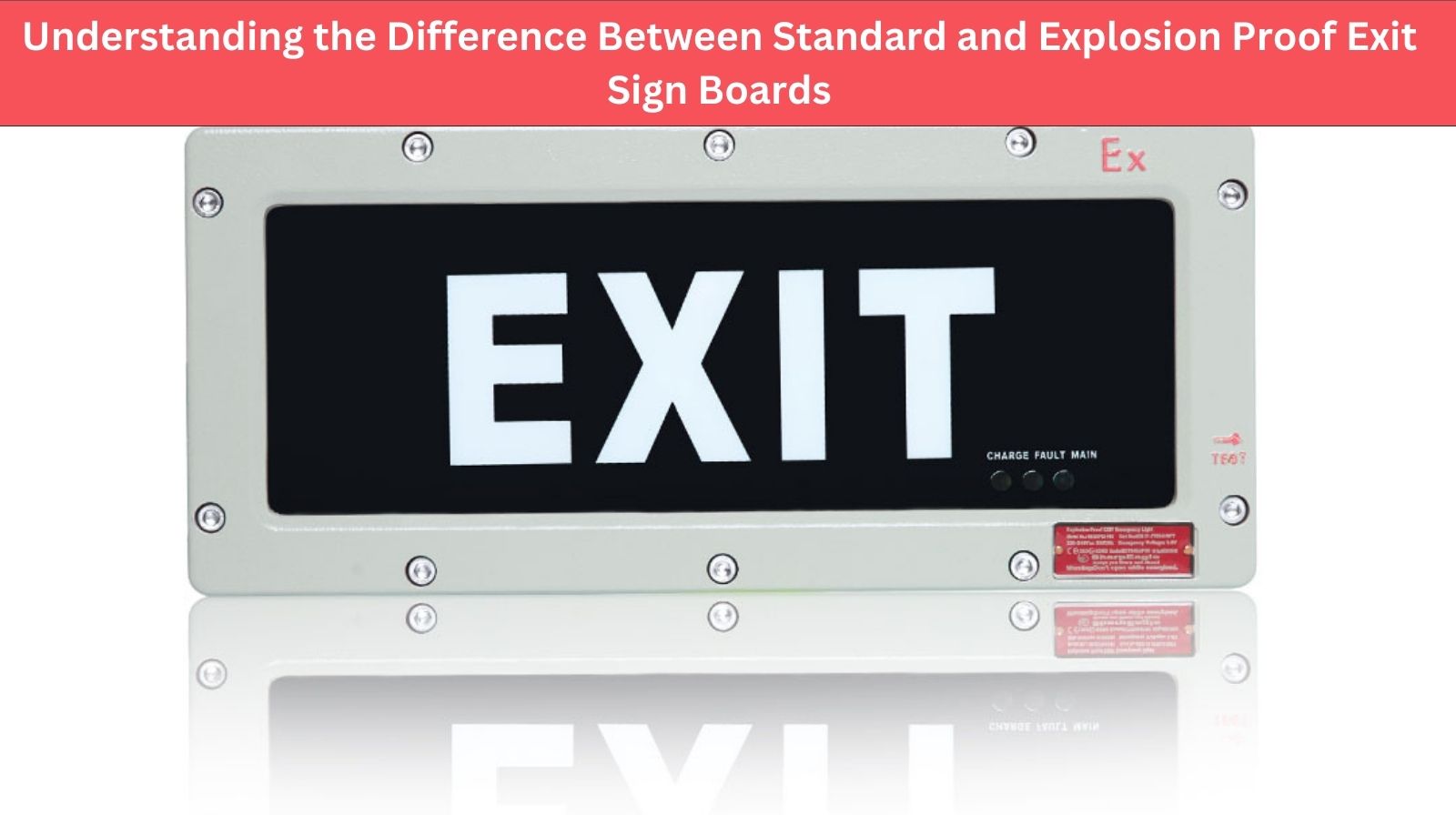
They hang on walls. They glow green. They point towards exits.
From ten metres away, a standard exit sign and an Explosion Proof Exit Sign Board might look virtually identical. Same pictogram. Same colour. Same general purpose. But put one in the wrong environment — a Zone 1 gas area, a solvent storage facility, a petrochemical processing unit — and that visual similarity becomes genuinely dangerous.
The differences between standard and explosion proof signage aren't cosmetic. They're engineering decisions that determine whether a piece of equipment becomes a life-saving navigational tool or an ignition source waiting for the right moment. If your facility handles flammable gases, vapours, or combustible dusts, understanding those differences isn't optional knowledge — it's fundamental to your duty of care.
Let's pull back the curtain on what actually separates these two product categories, and why the cost justification for explosion proof signage is far simpler than most procurement teams initially assume.
The Core Technical Differences
1. Enclosure Engineering: Built to Contain, Not Just Protect
A standard exit sign enclosure is designed to do one thing: keep the internal components protected from incidental physical contact and minor environmental exposure. Typically moulded from ABS plastic or standard polycarbonate, these enclosures meet basic IP ratings adequate for commercial and light industrial settings — but they were never designed with explosive atmospheres in mind.
An Explosion Proof Exit Sign Board, by contrast, is engineered around a fundamentally different principle. The enclosure isn't just protecting the internals from the outside world — it's designed to contain any internal fault, arc, or spark so completely that it cannot ignite the surrounding atmosphere, even if that atmosphere contains a flammable gas or dust cloud at explosive concentration.
This means:
Enclosure materials step up dramatically — GRP (Glass Reinforced Polyester), 316 stainless steel, or copper-free aluminium alloy, all selected for their ability to withstand mechanical stress, thermal shock, and corrosive environments without degrading their containment properties
Wall thickness and joint tolerances are engineered to specific flame path dimensions defined by IEC 60079-1, ensuring any internal combustion is quenched before it can exit the enclosure
Surface temperature of the enclosure exterior is controlled to remain below the auto-ignition temperature of the surrounding gas or dust — this is the Temperature Class (T-rating) marking you'll see on certified equipment
A standard sign has none of these properties. Its plastic housing, standard PCB components, and conventional LED drivers are perfectly adequate for a shopping centre or office block. In a hydrocarbon-rich atmosphere, they're a hazard.
2. Internal Components: Rated for the Environment
The enclosure is only part of the story. Everything inside an Explosion Proof Emergency Exit Sign — the PCB, LED drivers, battery management system, terminal blocks — must also be selected and assembled to prevent ignition under fault conditions.
Standard exit signs use conventional off-the-shelf electronics. Component selection prioritises cost and performance for normal atmospheric conditions. There's no requirement to consider what happens if a component fails in the presence of a flammable atmosphere, because in a commercial building, that combination simply doesn't occur.
In explosion proof variants, component selection follows entirely different criteria:
Current-limiting circuits prevent arcing at terminal connections — a common ignition source in conventional signage
Intrinsically safe battery management ensures that even a catastrophic battery failure cannot generate sufficient energy to ignite the surrounding atmosphere
Conformal-coated PCBs protect against condensation and chemical vapour ingress that could cause tracking faults or short circuits
Thermally managed LED drivers keep surface temperatures within the T-class rating under all load conditions
These aren't incremental improvements on standard components. They're purpose-engineered solutions to a fundamentally different engineering problem.
3. Certification: The Legal and Technical Dividing Line
This is where the difference becomes non-negotiable.
A standard exit sign carries CE marking for general product safety and may hold a fire safety certification for use in commercial buildings. That's where its certification trail ends.
An Explosion Proof Exit Sign carries ATEX certification (mandatory for UK and European hazardous areas under Directive 2014/34/EU) and/or IECEx certification (the internationally recognised standard accepted in the UAE, Kuwait, and across the Gulf). These certifications aren't self-declared — they're granted by accredited third-party notified bodies following rigorous testing of both the product design and the manufacturing process.
On the product marking, you'll see:
Ex symbol — confirming explosion protection
Equipment Group (II for surface industries)
Equipment Category (1G, 2G, or 3G for gas zones; equivalent D categories for dust)
Protection Concept (e.g., 'e' for increased safety, 'd' for flameproof)
Gas Group (IIA, IIB, or IIC — with IIC covering the widest range of flammable gases including hydrogen)
Temperature Class (T1 through T6 — higher numbers indicate lower maximum surface temperatures)
Installing uncertified standard signage in a classified hazardous area is a breach of DSEAR in the UK and equivalent regulations in the UAE and Kuwait. It invalidates your facility's insurance coverage, exposes your organisation and its directors to unlimited personal liability, and — most critically — creates a genuine ignition risk that your other safety systems may not be able to compensate for.
4. Environmental Ratings: Designed for Industrial Realities
Standard commercial exit signs typically carry IP20 or IP44 ratings — adequate for indoor, sheltered environments with no significant dust or moisture exposure.
An Explosion Proof Exit Sign Board for industrial use routinely carries IP66 as a minimum — fully dust-tight and protected against powerful water jets — with IP67 and IP68 variants available for submersion risk or high-pressure washdown applications.
In Gulf environments where ambient temperatures exceed 50°C, sand ingress is constant, and humidity swings dramatically between air-conditioned interiors and outdoor process areas, that IP rating gap between standard and explosion proof signage isn't a technical footnote. It's the difference between a sign that lasts 18 months and one that delivers 15 years of reliable service.

The Safety Implications of Getting It Wrong
Let's be direct about what "getting it wrong" actually looks like in practice.
In 2005, a major refinery explosion in Texas — one of the most studied industrial disasters of the modern era — was partly attributed to the cumulative effect of multiple safety system failures, including inadequate emergency signage and evacuation infrastructure. The investigation concluded that workers who survived did so largely through familiarity with the site rather than effective emergency guidance systems.
The lesson most facility managers take from events like this is reactive: upgrade equipment after an incident. The lesson that protects workers is proactive: recognise that every piece of electrical equipment in a classified zone — including something as seemingly innocuous as an exit sign — is part of your facility's ignition risk profile.
A standard sign installed in Zone 1 isn't a minor compliance gap. It's a potential initiating event in a catastrophic incident sequence. An Explosion Proof Emergency Exit Sign removes that risk category entirely.

The Cost Justification: Simpler Than You Think
Here's the objection that comes up in almost every procurement conversation: explosion proof signage costs more. That's true. But the cost justification calculus is far more straightforward than the price difference suggests.
Direct cost comparison. A standard commercial exit sign might cost £30–£80 per unit. An ATEX-certified Explosion Proof Exit Sign Board typically ranges from £200–£600 depending on zone rating, enclosure material, and battery specification. On a facility requiring 50 signs, that's a real budget difference.
But factor in what you're actually buying:
Insurance validity. Non-compliant equipment in a hazardous area can void your facility's liability insurance entirely. A single significant incident without valid coverage exposes your organisation to costs that dwarf any signage budget many times over.
Regulatory penalties. HSE enforcement in the UK and civil defence authority enforcement in the UAE and Kuwait carries financial penalties, mandatory improvement notices, and in serious cases, prosecution of responsible individuals. The cost of a compliance failure consistently exceeds the cost of compliance itself.
Service life. A well-specified Explosion Proof Emergency Exit Sign installed in a harsh industrial environment will deliver 10–15 years of reliable service. A standard sign in the same environment may fail within 12–24 months, creating ongoing replacement and maintenance costs that erode the apparent price advantage rapidly.
The cost of the alternative. No cost-benefit analysis of explosion proof signage is complete without acknowledging the cost — financial, legal, reputational, and human — of an incident that a correctly specified sign might have helped prevent or mitigate.
When you lay those factors against a unit price difference of £170–£520 per sign, the justification for explosion proof signage isn't difficult. It's obvious.
SharpEagle: The Right Sign for the Right Environment
At SharpEagle Technology, we work with facility managers, HSE directors, and EPC contractors across the UK, UAE, and Kuwait to ensure that every hazardous area gets equipment that's genuinely fit for purpose — not just visually similar to what would work somewhere less demanding.
Our range of Explosion Proof Exit Sign Boards covers Zone 1 and Zone 2 gas environments, Zone 21 and Zone 22 dust environments, and a wide range of temperature classes and gas groups. Every product carries verified ATEX and/or IECEx certification, and our technical team can help you navigate zone classifications, product selection, and compliance documentation from initial specification through to post-installation audit support.
If you're currently operating a facility where exit signage hasn't been reviewed against hazardous area classification requirements, now is the right time for that conversation — before an audit or incident forces it.
👉 Speak with a SharpEagle Technology specialist today and get expert guidance on selecting the right explosion proof signage for your specific facility and zone requirements.
Now that you understand why standard signage simply doesn't belong in classified hazardous areas, are you ready to take the next step and ensure your entire lighting infrastructure meets the same standard — and if so, have you read our Ultimate Guide to Explosion Proof Lighting for Hazardous Areas for the complete picture of what genuinely compliant hazardous area lighting looks like across your whole facility?