The enterprise workplace is undergoing a profound transformation. As hybrid work becomes standard practice and digital-first operations define competitiveness, enterprise social networks and online communities have evolved from optional communication tools into mission-critical infrastructure.
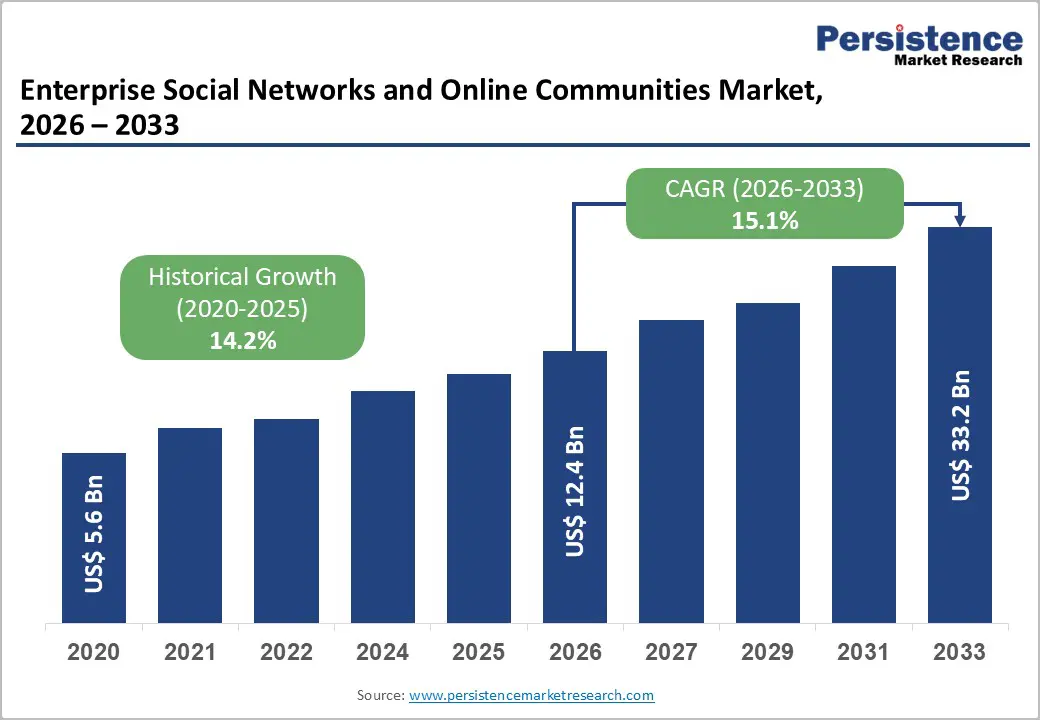
The global enterprise social networks and online communities market is projected to reach US$ 12.4 billion in 2026 and expand to US$ 33.2 billion by 2033, registering a strong CAGR of 15.1%. This sustained momentum reflects growing enterprise demand for centralized collaboration platforms that enable secure communication, intelligent workflows, and AI-powered knowledge management.
With organizations prioritizing productivity, compliance, employee engagement, and digital transformation, enterprise social platforms are becoming the digital backbone of modern enterprises.
Market Overview at a Glance
- Market Size (2026E): US$ 12.4 Billion
- Market Forecast (2033F): US$ 33.2 Billion
- CAGR (2026–2033): 15.1%
- Historical Growth (2020–2025): 14.2%
- Cloud Deployment Share (2025): 54.3%
- SME Revenue Contribution (2025): 51.7%
North America leads the market, while Asia Pacific emerges as the fastest-growing region. Cloud-based solutions dominate deployment models, and SMEs are driving a significant share of revenue growth.
Market Dynamics
Driver: Hybrid and Remote Work Reshaping Enterprise Collaboration
The global shift toward hybrid and remote work has permanently altered enterprise communication structures. Surveys indicate that nearly 60% of employees prefer hybrid work models, while about one-third favor fully remote arrangements.
In the United States, hybrid job postings increased from 15% in Q2 2023 to 24% in Q2 2025. This transition has intensified the need for real-time communication, asynchronous collaboration, and centralized knowledge repositories.
Platforms like Microsoft Corporation’s Teams and Google Inc.’s Workspace provide integrated messaging, file sharing, video conferencing, and workflow automation in unified ecosystems.
Enterprise social networks reduce information silos, preserve corporate culture, and ensure operational continuity across geographically dispersed teams. In a hybrid ecosystem, these platforms are no longer support tools—they are operational command centers.
Driver: Digital Transformation and Regulatory Compliance Pressures
Digital transformation investments continue accelerating across industries. Enterprises are modernizing legacy systems, automating workflows, and strengthening cybersecurity frameworks to remain competitive.
Regulations such as GDPR in Europe have significantly influenced enterprise communication strategies. The enforcement of GDPR, which carries penalties up to €20 million or 4% of annual global revenue, has prompted organizations to prioritize secure communication environments.
Enterprise platforms offering strong encryption, compliance certifications, audit trails, and granular access control are increasingly preferred. Vendors such as SAP SE, IBM Corporation, and Cisco Systems integrate compliance frameworks directly into collaboration tools.
As enterprises operate across multiple jurisdictions, compliant communication environments are becoming strategic assets rather than IT add-ons.
Restraint: Digital Infrastructure Gaps in Emerging Economies
Despite strong global growth, uneven digital infrastructure limits adoption in emerging markets.
Many organizations in Africa, parts of South Asia, and Latin America face:
- Unreliable broadband connectivity
- Limited IT budgets
- Low digital literacy
- Insufficient cybersecurity readiness
SMEs in these regions often struggle to deploy full-scale enterprise social networks due to financial and technical constraints. Adoption remains concentrated in digitally mature economies, slowing overall market penetration in lower-income regions.
Restraint: Data Privacy, Sovereignty, and Vendor Lock-In Concerns
Enterprises remain cautious about consolidating sensitive communications on third-party cloud platforms. Concerns include:
- Data sovereignty regulations
- Cross-border compliance complexity
- Cybersecurity risks
- Long-term vendor lock-in
Highly regulated industries such as healthcare and BFSI often prefer hybrid or on-premise models. This cautious approach moderates the speed of cloud-only adoption in compliance-sensitive segments.
Major Opportunities
SME Expansion Driving Platform Adoption
Small and Medium Enterprises (SMEs) represent the largest and fastest-growing segment, accounting for 51.7% of market revenue in 2025.
Subscription-based SaaS models have democratized access to advanced collaboration tools. Platforms like Zoho Corporation and VMware provide scalable solutions at affordable costs.
SMEs increasingly rely on enterprise social networks to:
- Improve employee engagement
- Attract skilled talent
- Enhance operational efficiency
- Compete with larger enterprises
With projected growth at 14.9% CAGR through 2033, SMEs present one of the strongest expansion opportunities.
AI and Autonomous Agents Revolutionizing Collaboration
Artificial Intelligence is transforming enterprise social networks from communication hubs into intelligent digital assistants.
For example, Salesforce integrated Slack directly with CRM systems, enabling seamless workflow automation and real-time data insights.
Similarly, Microsoft Teams incorporates AI-powered Copilot features, now used by a majority of enterprise users for summarizing meetings, drafting responses, and automating tasks.
AI-driven capabilities include:
- Smart recommendations
- Automated content tagging
- Predictive workflow management
- Real-time analytics
- Knowledge graph generation
Platforms that successfully embed AI and autonomous agents are positioning themselves as comprehensive digital workplace ecosystems.
Category-Wise Analysis
Deployment Model Insights
Cloud-Based Platforms (54.3% Market Share)
Cloud solutions dominate due to:
- Lower upfront costs
- Rapid deployment
- Automatic updates
- Scalability
- Seamless third-party integration
Cloud-based enterprise social networks eliminate heavy capital expenditures associated with on-premise systems, making them attractive to SMEs and large enterprises alike.
Hybrid Deployment (Fastest Growing)
Hybrid platforms allow enterprises to balance flexibility with regulatory compliance. Organizations can retain sensitive data on-premise while leveraging cloud scalability for collaboration.
Hybrid adoption is especially strong in BFSI and healthcare sectors.
Organization Size Insights
SMEs: Market Leaders and Growth Drivers
SMEs benefit from:
- SaaS pricing flexibility
- Minimal IT infrastructure requirements
- Rapid scalability
- User-friendly interfaces
Their adoption reflects the growing need for digital agility without high investment burdens.
Large Enterprises
Large organizations prioritize:
- Advanced compliance frameworks
- AI integration
- Cross-department collaboration
- Multi-region data governance
Enterprise-grade platforms integrate seamlessly with ERP, CRM, and analytics systems.
Industry Insights
IT & Telecom: 45% Market Share
Technology-driven enterprises lead adoption due to high digital maturity. Organizations use enterprise social platforms for agile development, DevOps coordination, and distributed project management.
Healthcare and BFSI: Fastest Growing
Regulatory complexity and operational sensitivity drive adoption in these industries. Enterprise social networks support:
- Secure communication
- Audit trails
- Knowledge management
- Compliance documentation
These sectors require secure, traceable collaboration environments.
Regional Insights
North America: Market Leader (32% Share)
North America remains the largest market due to:
- Mature IT infrastructure
- Strong cybersecurity standards
- High enterprise IT budgets
Adoption is strongest in the U.S., where millions of organizations rely on cloud collaboration platforms.
Microsoft Corporation’s Teams has become a default enterprise collaboration standard among Fortune 100 companies.
Integrated AI features and Microsoft 365 ecosystem compatibility drive continued expansion.
Europe: Compliance-Driven Growth
Europe represents the second-largest market, influenced heavily by GDPR enforcement.
Countries such as Germany, France, and the UK emphasize:
- Data sovereignty
- Transparent data processing
- Secure enterprise communication
Regulatory enforcement has made compliance-enabled collaboration tools essential for organizations operating within the EU.
Asia Pacific: Fastest Growing Region (28% Share)
Asia Pacific is experiencing rapid expansion due to:
- Government-led digital transformation programs
- Expanding SME ecosystems
- Rising AI investments
- Growing cloud adoption
Digital initiatives in China, India, and Japan are accelerating enterprise platform adoption. The region’s expanding workforce and manufacturing strength create sustained demand for scalable collaboration tools.
With substantial AI investment and digital literacy growth, Asia Pacific is projected to challenge North America in market size by 2033.
Competitive Landscape
The enterprise social networks market is moderately consolidated, with dominant global players competing alongside niche vendors.
Key companies include:
- Google Inc.
- Salesforce
- SAP SE
- Cisco Systems
- IBM Corporation
- Zoho Corporation
- VMware
Competition centers around:
- AI-powered differentiation
- Deep ecosystem integration
- Developer extensibility
- Advanced security frameworks
- Multi-region compliance support
Strategic acquisitions and integrations continue reshaping the landscape. The Slack integration into Salesforce’s ecosystem illustrates how collaboration platforms are evolving into full digital workplace operating systems.
Future Outlook (2026–2033)
The enterprise social networks and online communities market is entering a new phase defined by:
- AI-native collaboration environments
- Autonomous workflow automation
- Data-driven decision-making
- Integrated digital ecosystems
- Secure, compliance-first architectures
By 2033, enterprise social platforms will move beyond messaging and file sharing. They will function as intelligent operational command centers—integrating CRM, ERP, analytics, HR systems, and AI copilots within unified digital environments.
Organizations that leverage these platforms strategically will gain measurable advantages in:
- Productivity
- Innovation velocity
- Employee engagement
- Regulatory compliance
- Cost optimization
As hybrid work solidifies, digital transformation accelerates, and AI adoption expands, enterprise social networks and online communities will remain central to organizational resilience and competitive differentiation.
Conclusion
The global enterprise social networks and online communities market is poised for sustained, high-growth expansion through 2033. Driven by hybrid work adoption, regulatory compliance demands, SME expansion, and AI-powered innovation, the sector is evolving into a foundational pillar of modern enterprise operations.
Cloud dominance, rapid SME adoption, and intelligent automation are shaping the future landscape. While infrastructure gaps and regulatory complexities pose challenges, the long-term trajectory remains strongly upward.
By 2033, enterprise collaboration platforms will not simply connect employees—they will orchestrate entire digital ecosystems, enabling enterprises to operate smarter, faster, and more securely in an increasingly interconnected world.