


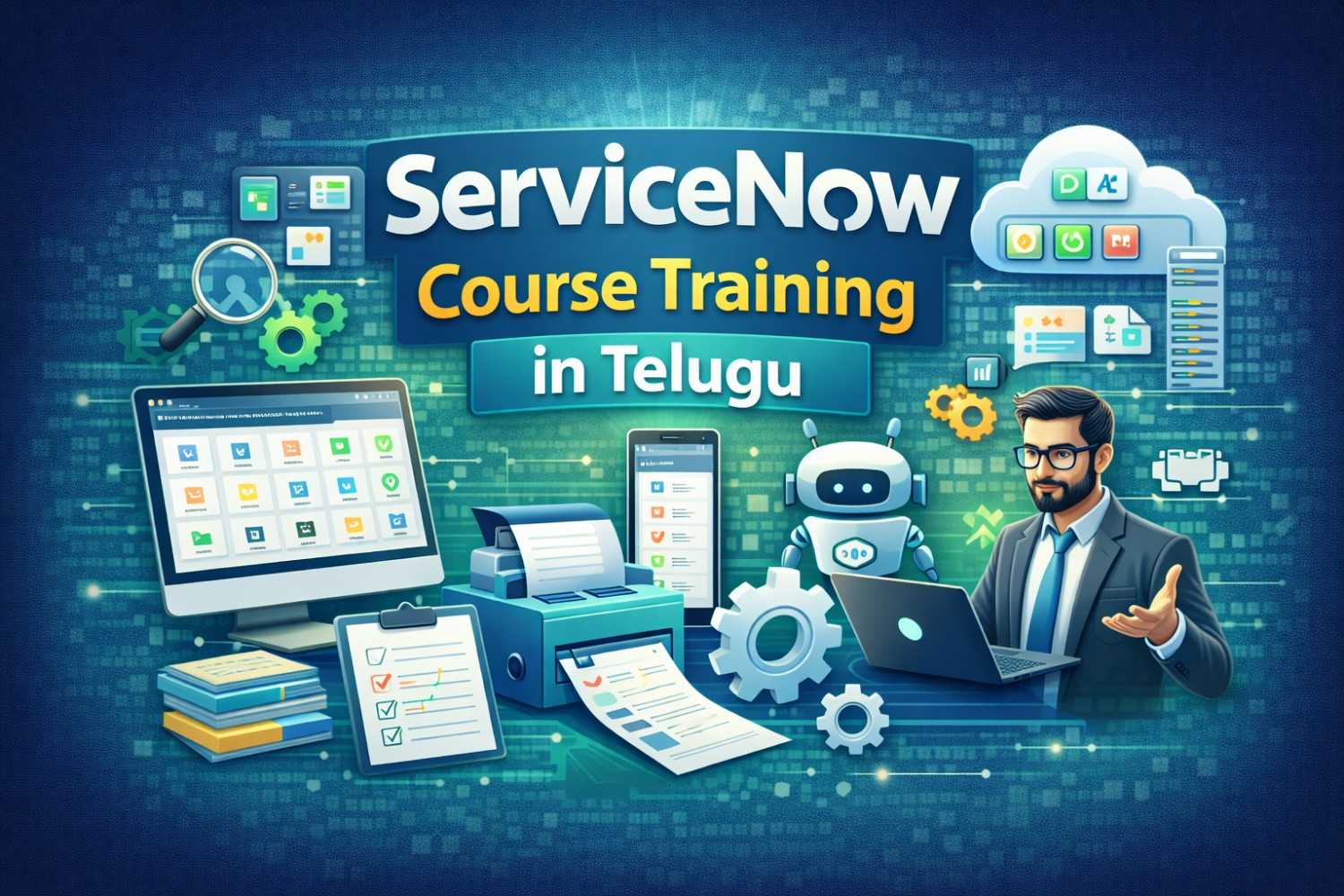
Introduction: The Framework Behind Organized IT
In a large enterprise, operations cannot depend on scattered communication. Every issue must be logged, every change must be approved, every request must be tracked, and every resolution must be documented.
If these processes are not structured, service quality declines and risks increase.
To avoid such operational chaos, organizations rely on enterprise workflow platforms. ServiceNow is one of the most widely used platforms for this purpose.
The growing importance of enterprise automation is why many learners search for ServiceNow Course Training in Telugu — to understand how digital service platforms manage workflows across departments.
ServiceNow acts as the framework that brings order to digital operations.
What Is ServiceNow?
ServiceNow is a cloud-based enterprise workflow automation platform that helps organizations manage and streamline service processes.
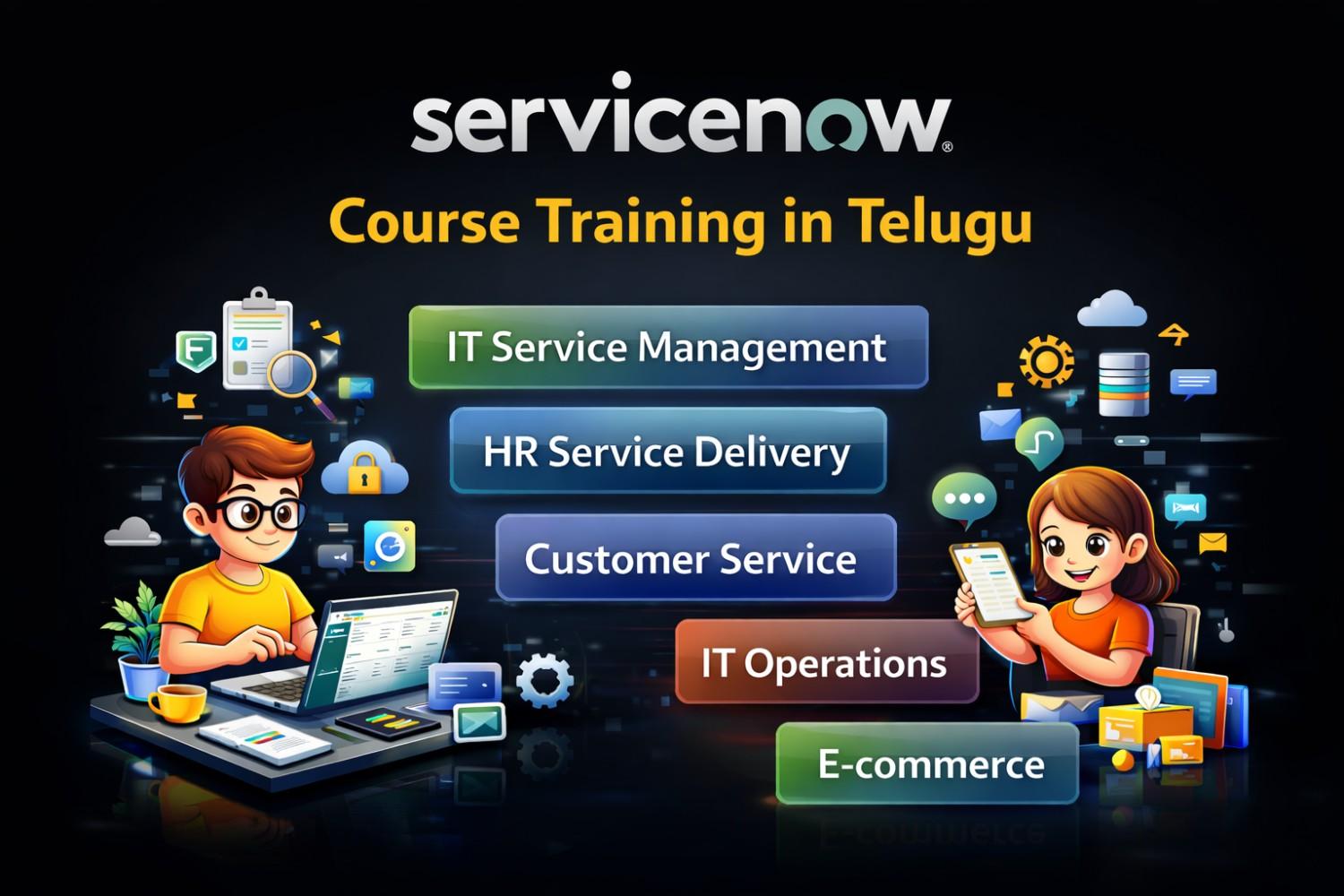
It began as an IT Service Management (ITSM) solution but has evolved into a comprehensive digital operations platform covering:
- IT Operations Management
- HR Service Delivery
- Customer Service Management
- Security Operations
- Governance, Risk, and Compliance
ServiceNow centralizes data, workflows, approvals, and performance tracking within a single cloud environment.
Why ServiceNow Is Relevant Today
Modern enterprises operate within environments characterized by:
- Cloud-native applications
- Hybrid infrastructure
- Continuous system updates
- Strict regulatory requirements
- Large-scale service operations
Managing these activities manually leads to inefficiencies.
ServiceNow allows organizations to:
- Automate workflow lifecycles
- Enforce structured approval processes
- Monitor service-level agreements (SLAs)
- Maintain audit-ready records
- Provide real-time dashboards
Its unified design reduces fragmentation across departments.
Core Modules That Power ServiceNow
Understanding ServiceNow requires familiarity with its primary modules.
IT Service Management (ITSM)
ITSM is the foundational module.
It includes:
- Incident Management
- Problem Management
- Change Management
- Service Request Fulfillment
- Knowledge Management
ITSM ensures standardized resolution of IT-related issues.
IT Operations Management (ITOM)
ITOM focuses on infrastructure visibility and monitoring.
It includes:
- Discovery
- Event Management
- Service Mapping
- Cloud Infrastructure Monitoring
ITOM helps organizations detect dependencies and maintain operational stability.
HR Service Delivery
ServiceNow automates HR workflows such as:
- Employee onboarding
- Case management
- Policy approvals
- Internal service tracking
This improves process efficiency and employee experience.
Customer Service Management (CSM)
Customer service workflows are managed through:
- Case management
- Automated routing
- SLA tracking
- Self-service portals
CSM enhances customer engagement and accountability.
ServiceNow Architecture Explained
ServiceNow operates on a multi-tenant cloud architecture.
Key architectural components include:
- Instance (cloud-hosted environment)
- Relational database tables
- Forms and list views
- Business rules
- UI policies
- Flow Designer
Client-side and server-side scripts
- Data is stored in structured relational tables.
- Customization and automation use JavaScript-based scripting.
- The platform integrates with external systems through APIs.
Essential Concepts to Master in ServiceNow
To build practical expertise, learners should focus on:
- Configuration Management Database (CMDB)
- Service Catalog configuration
- Role-based access control
- Access Control Lists (ACLs)
- Incident lifecycle
- Change management workflows
- SLA definitions and tracking
- Flow automation design
These concepts ensure reliable workflow automation.
Skills Required to Learn ServiceNow
Developing ServiceNow expertise requires:
- Understanding of ITIL best practices
- Basic database knowledge
- JavaScript fundamentals
- Analytical thinking
- Workflow mapping capability
- Problem-solving skills
ServiceNow professionals may work as administrators, developers, consultants, or analysts.
Why Learn ServiceNow in Telugu?
Understanding ITSM workflows, CMDB structures, and automation logic in Telugu can improve clarity during foundational learning stages.
Career Opportunities in ServiceNow
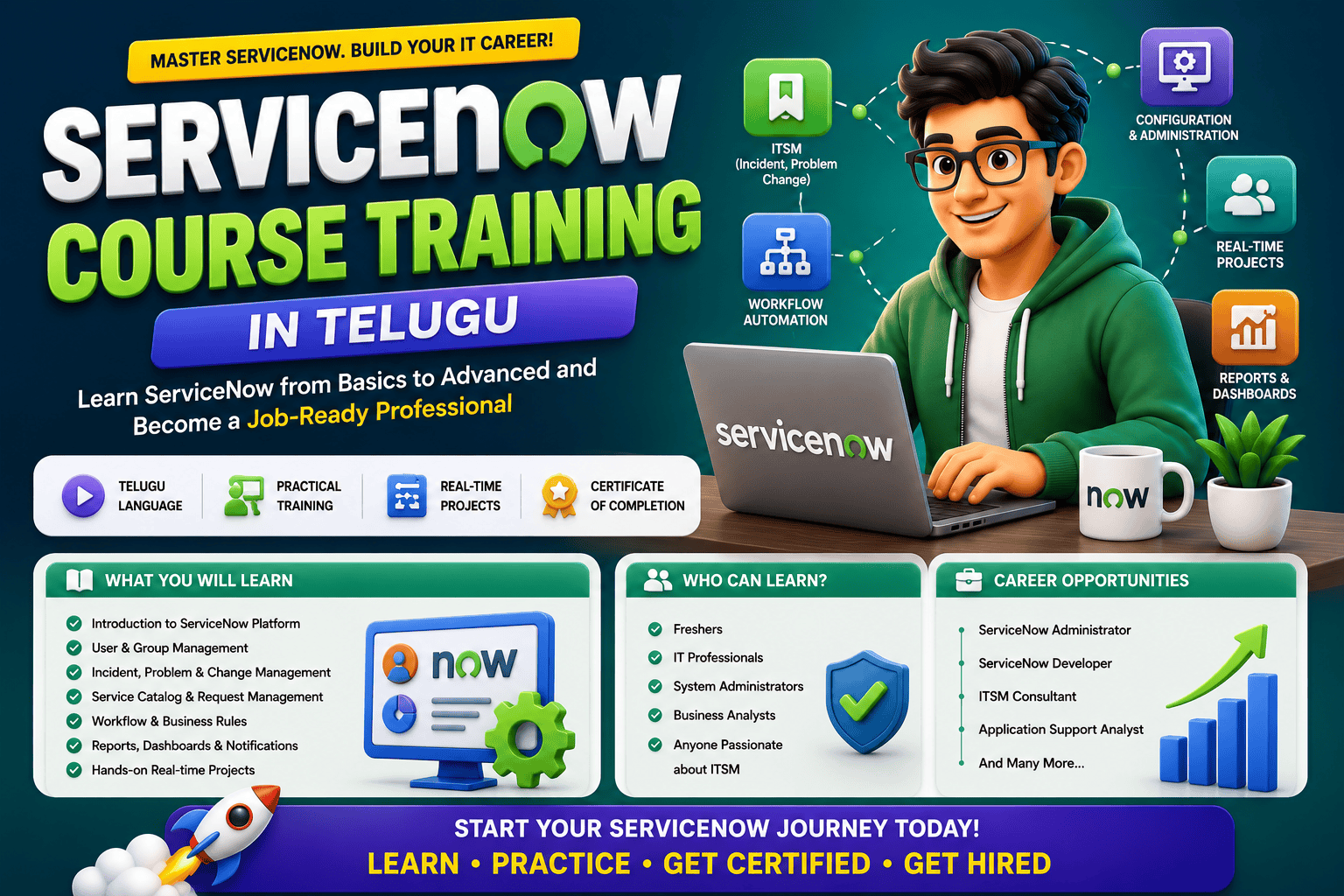
ServiceNow expertise enables roles such as:
- ServiceNow Administrator
- ServiceNow Developer
- ITSM Analyst
- Workflow Consultant
- Implementation Specialist
These roles are in high demand across enterprise organizations and IT services companies.
Industry Demand and Growth Trends
ServiceNow adoption continues to expand because:
- Enterprises are prioritizing automation
- Cloud migration strategies are accelerating
- Service management complexity is increasing
- Centralized workflow platforms are becoming essential
ServiceNow consistently ranks among leading enterprise workflow solutions.
Challenges in Learning ServiceNow
Learning ServiceNow involves challenges such as:
- Understanding enterprise-scale workflow structures
- Configuring modules correctly
- Managing secure access control
- Writing and debugging scripts
- Integrating third-party applications
Hands-on practice strengthens real-world understanding.
Future Outlook of ServiceNow
ServiceNow is evolving with:
- AI-powered workflow automation
- Predictive intelligence tools
- Robotic Process Automation (RPA)
- Advanced analytics dashboards
- Cross-functional digital workflow expansion
Its role in enterprise digital transformation is expected to grow significantly.
Broader Perspective on Workflow Platforms
ServiceNow represents a shift from traditional ticket management to intelligent digital workflow orchestration.
It enhances governance, improves operational transparency, and strengthens service delivery.
Understanding ServiceNow provides insight into how modern enterprises structure and manage digital ecosystems efficiently.
Conclusion
ServiceNow plays a crucial role in automating enterprise services and managing digital workflows at scale.
By understanding ITSM processes, system architecture, scripting, and workflow automation, professionals can contribute to structured and reliable enterprise environments.
As organizations continue investing in automation and digital transformation, the important question becomes — are you ready to understand how enterprise service ecosystems operate and position yourself within the evolving digital future?
Introduction
The IT industry is growing rapidly, and companies are looking for professionals with strong technical and practical skills. One of the best ways to build these skills is through