

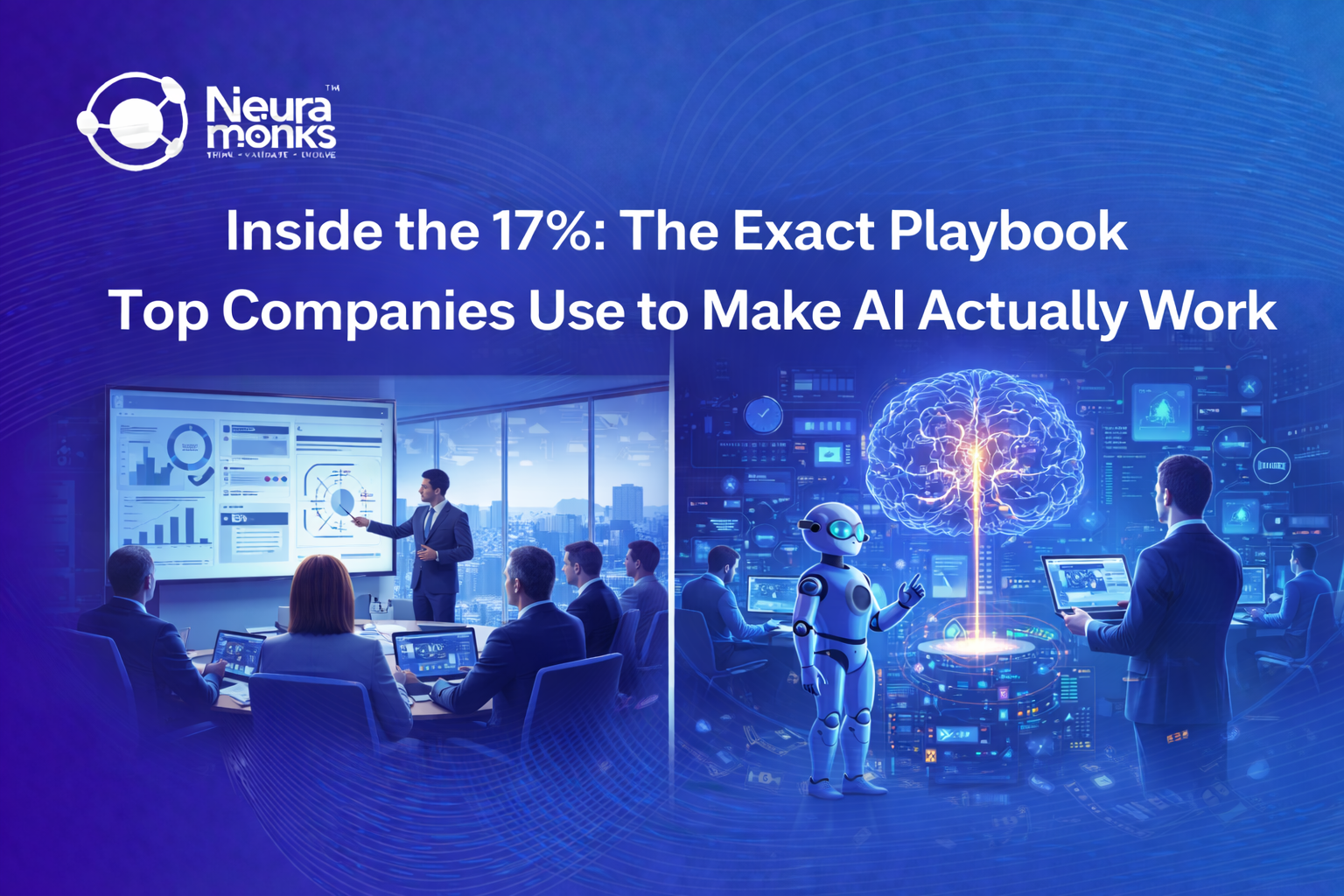
You've heard the failure statistics. You've probably lived some of them. Now let's talk about something far more interesting: the exact playbook that separates AI winners from AI cautionary tales. Because the 17% who get AI right aren't operating on luck — they're operating on a framework that's repeatable, scalable, and available to any company bold enough to follow it.
At Neuramonks, we've worked across industries helping companies transform from "AI curious" to "AI competitive." What we've seen consistently is that success isn't about the flashiest model or the largest budget. It's about five deeply intentional practices executed with discipline.
Practice 1: Solve Real Pain, Not Hypothetical Potential
Winning companies don't ask "Where can we add AI?" They ask "What is our most expensive, time-consuming, error-prone process — and can AI eliminate it?" This sounds obvious. It rarely happens in practice. The shift from AI-as-innovation to AI-as-problem-solver is the single most valuable mindset change in the entire journey.
"Don't start with AI and look for a problem. Start with the problem and let it demand the right AI solution."
Practice 2: Embrace Agentic AI — Not Just Automation
The next evolution isn't chatbots or basic automation. It's Agentic AI — autonomous systems that don't just respond to queries but proactively reason, plan, and execute multi-step tasks with minimal human intervention. Think: an AI agent that monitors your CRM, identifies at-risk accounts, drafts personalized outreach, and schedules follow-ups — all without a human in the loop. The companies racing ahead in 2026 are building agentic workflows, not isolated AI features.
Practice 3: Build on the Right Infrastructure Stack
The 17% invest in connective tissue. They understand that an isolated AI model is nearly useless — value comes from integration. Workflow orchestration platforms are central to this; connecting AI decisions to real business actions across CRMs, ERPs, databases, and communication tools is what turns intelligence into outcomes. This infrastructure layer is where most companies underinvest — and where winners quietly build moats.
- Workflow Automation
- Model Fine-Tuning
- Real-Time Data Pipelines
- Human-AI Collaboration Design
- Continuous Learning Loops
Practice 4: Leverage Generative AI as a Force Multiplier
Generative AI is not the whole AI story — but it's one of the most powerful chapters. The 17% use it strategically: to accelerate content creation at scale, to generate synthetic training data, to personalize customer experiences dynamically, and to enable their teams to output 10x more with the same headcount. But here's the key — they layer generative capabilities on top of solid data and workflow foundations, never as a standalone magic trick.
Practice 5: Partner With Specialists, Not Generalists
This is where the rubber meets the road. Successful AI implementation requires deep expertise in model selection, data engineering, integration architecture, security, and change management simultaneously. Most internal teams can't cover all of this. That's why the 17% choose to work with a focused AI Solution partner who has implemented these systems before, failed forward, and brings hard-won pattern recognition to the engagement.
At Neuramonks, this is precisely what we do. We don't sell AI products. We build AI capabilities — custom-fitted to your business model, your data reality, and your team's capacity to absorb change. The result isn't a pilot that impresses executives for one quarter. It's a system that compounds in value every month you run it.
"The 17% don't have a secret. They have a strategy. And strategies can be learned, adopted, and executed — starting today."
Your Move
The gap between the 83% and the 17% is not closing — it's widening. Every month of delayed, misaligned, or poorly executed AI implementation is a month your competitors use to build a lead that becomes harder to close. The technology is no longer the barrier. The strategy is.
You now know what separates the winners. The only question left is: which side of the statistic do you want to be on?
Join the 17% who get AI right. Let's audit your current AI posture and build a winning roadmap together.