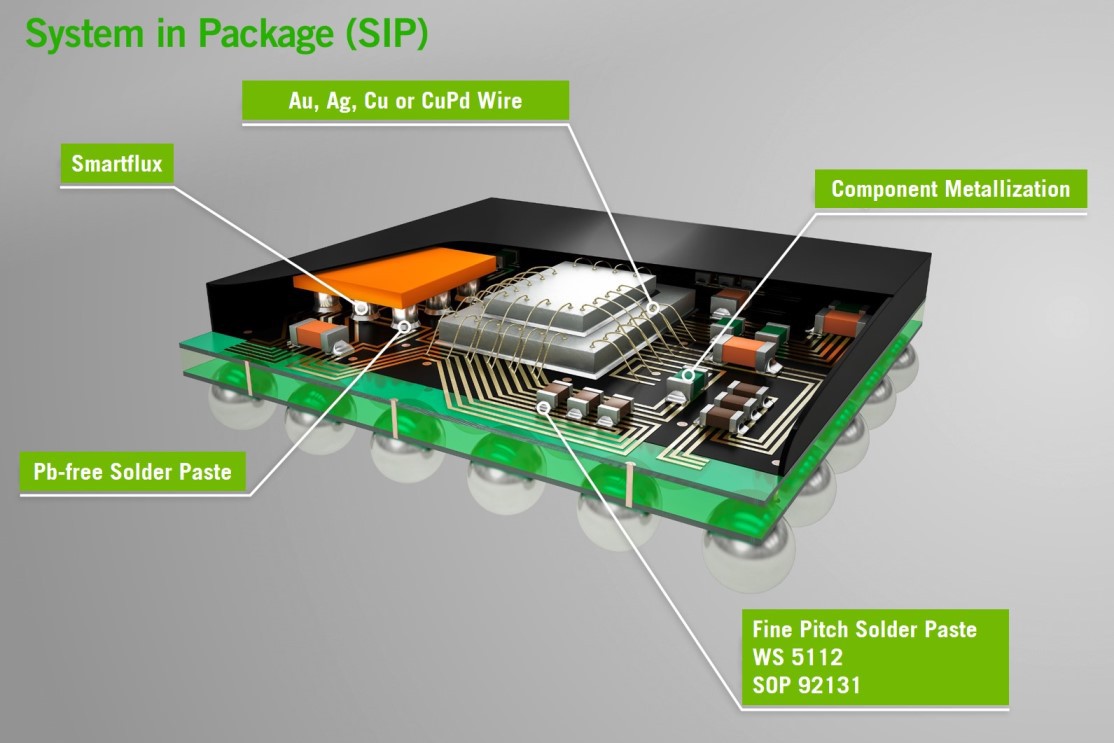
Innovation in the ever-changing electronics environment is still driven by one trend: miniaturization. Consumers want smaller, lighter and more powerful devices than ever before. It could be a smartwatch with sophisticated health sensors built into it or a smaller IoT device with the ability to process data in real-time, but the increasing demand for compact, high-performance technology continues to grow.
Central to this revolution is the System-in-Package (SiP) technology, a high-level packaging technology that allows a number of electronic functions to be packaged into a tiny module.
Understanding System-in-Package (SiP)
System-in-Package (SiP) is an advanced semiconductor packaging process in which several integrated circuits (ICs), passive components, and sensors, among other electronic components, are packaged into a single, small package. The outcome is a complete system that maintains itself as a single entity--although it may have a number of different chips internally.
SiP is a technology that combines many technologies inside an enclosure as opposed to traditional packaging, which aims at a single die. This makes it an option of choice in next-generation devices that have a strict size requirement.
SiP vs. SoC: Why It Matters
System-on-Chip (SoC) is commonly compared to SiP that has a different purpose. Whereas SoC incorporates all functionality in a single silicon die, SiP incorporates multiple chips together in advanced packaging technology. This is what causes a few advantages.
Flexibility: SiP is capable of being digitally, analog, RF, memory and sensor integrated into a single module.
Economy: SiP saves development time, and it is less costly to manufacture compared to a new SoC.
Quick Time-to-Market: Since SiP is able to utilize the existing chips, the product cycles become much quicker.
Whereas SoC best suits high volumes and products that need extreme integration, SiP is well-suited to provide modularity and other rapid scalability attributes that are needed in the modern fast-evolving technology era.
Why SiP Technology Is Transformative
Miniaturization at Its Finest: System in package is a radical decrease in the size of a device that achieves this by stacking and embedding several parts into a small space. This will enable manufacturers to add more features to miniature devices like wearables, wireless earbuds, portable medical devices, and IoT sensors.
Better Performance and Reliability: SiP reduces interconnect distances between chips to improve electrical performance, latency, and thermal efficiency. This advantage is especially important to wireless communications systems that need to transmit signals of high frequency and stability.
Integration of Multiple Technologies: SiP enables designers to combine and interchange different semiconductor technologies. This flexibility opens up unlimited opportunities for device functionality.
Rapid Product Development: SiP reduces product development time drastically. As there is no need to create a new silicon design to combine various parts into one module, companies can react to the market fast and can make products available sooner.
Inside the SiP Manufacturing Process
The SiP module is produced using a set of advanced processes:
High-density interconnects Flip-chip bonding.
Vertical integration of the dies through 3D stacking.
Wafer-level packaging to improve miniaturization.
Passive on-board components to minimize board components.
Such designs guarantee that the size of the SiP modules does not exceed, and their output is in terms of performance and reliability.
Real-World Applications of SiP
The packaging of systems is being used to transform a vast range of industries:
Consumer Electronics: AR/VR headsets, earbuds, smartwatches.
Auto Systems: ADAS-Sensors, infotainment, in-vehicle communication.
Healthcare: Wearable health devices, handheld diagnostic devices.
IoT Industry: Edge processing units, smart sensors.
Networking and Communications: 5G modules, Wi-Fi and Bluetooth combo chips.
With industries driving towards increased functionality in reduced designs, SiP is still winning ground as the technology of choice to use in small, high-performance systems.
The Future of SiP
As the 5G, edge AI, and ultra-low-power IoT continue to rise, the need to have electronics that are highly integrated and space-efficient will only increase. The next-generation in SiP technology will see the following improvements:
Heterogeneous three-dimensional integration.
Chiplet-based architectures
Improved RF and mmWave cohesiveness.
Increased automation in the production process.
Such innovations will take SiP to even greater performance standards, establishing it as a foundation of next-generation electronic design.