

The Panchang is an essential part of Hindu tradition and Vedic astrology. For centuries, it has guided people in determining auspicious timings for religious rituals, festivals, travel, and important life events. The word Panchang comes from Sanskrit, where Pancha means “five” and Anga means “parts” or “limbs.” Together, Panchang refers to the five fundamental elements used to measure and interpret time according to Vedic astronomy and astrology.
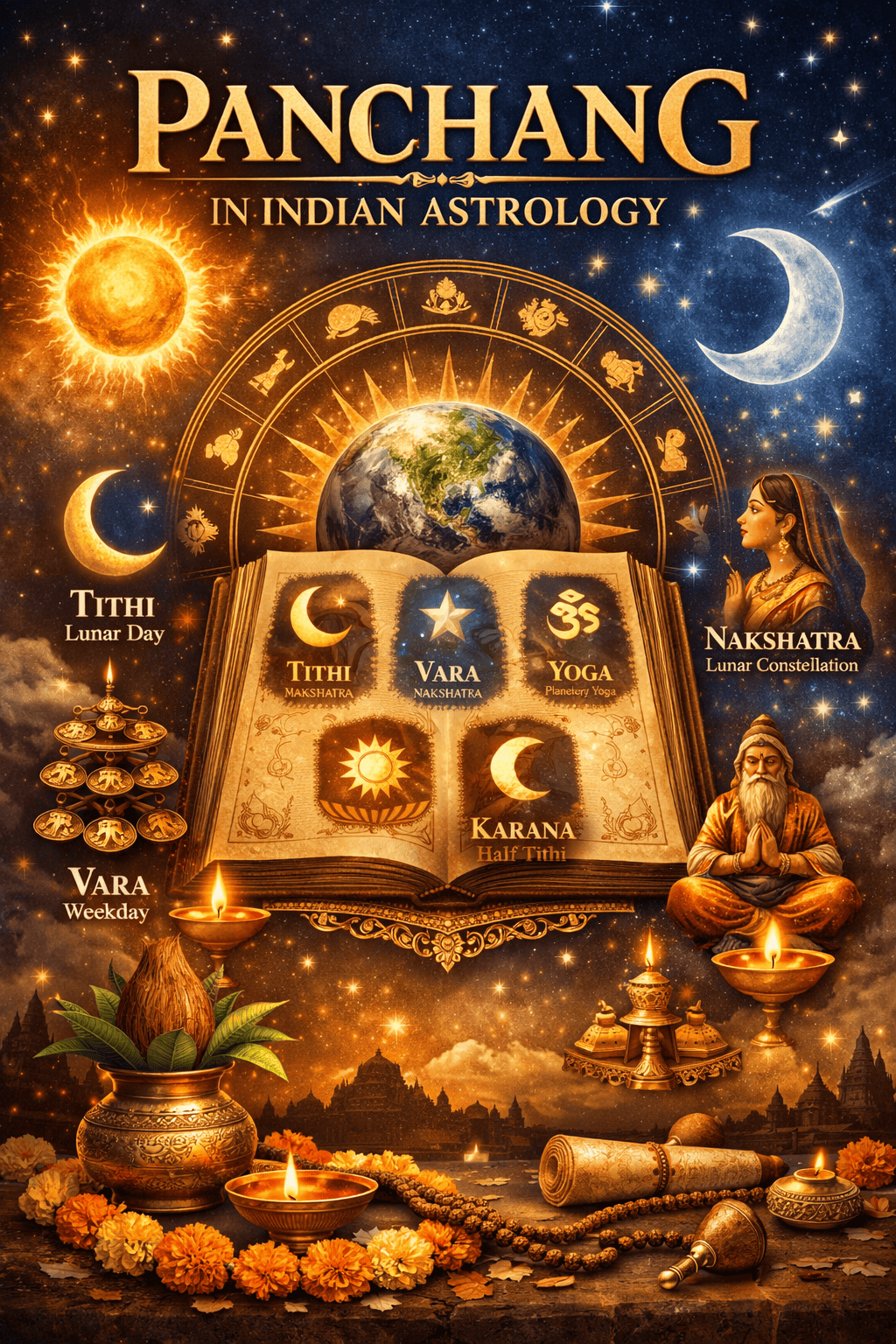
These five elements are Tithi, Vara, Nakshatra, Yoga, and Karana. Each of these components reflects a unique aspect of cosmic movement and planetary influence. When combined, they provide a detailed understanding of the nature and quality of time for any given day.
Unlike the Western calendar, which simply tracks dates and months, the Panchang offers a deeper interpretation of time based on the positions of the Sun, Moon, and other celestial bodies. This makes it highly valuable for determining auspicious timings, also known as Shubh Muhurat, for activities such as weddings, housewarming ceremonies, business launches, and religious rituals.
In this article, we will explore the five elements of Panchang in detail and understand how they work together to guide daily life and spiritual practices.
What Is Panchang and Why Is It Important?
The Panchang is essentially a Vedic calendar system used in Hindu culture and astrology. It provides detailed daily information about celestial movements and their influence on human life.
A typical Panchang includes:
Current Tithi (lunar day)
Nakshatra (Moon’s constellation)
Yoga (astronomical combination)
Karana (half lunar day)
Vara (weekday)
Sunrise and sunset times
Rahu Kaal and other inauspicious periods
Shubh Muhurat timings
These elements help people align their activities with favorable cosmic energies.
Even today, many people check the daily Panchang before performing important tasks such as starting a new business, purchasing property, or conducting religious ceremonies.
The Five Elements of Panchang
The Panchang consists of five key components that describe the nature of time. Let’s explore each one in detail.
1. Tithi – The Lunar Day
Tithi is one of the most important elements of the Panchang. It represents the lunar day, which is determined by the angular distance between the Moon and the Sun.
A complete lunar month contains 30 Tithis, divided into two phases:
Shukla Paksha (Waxing Phase)
This phase begins with the New Moon (Amavasya) and continues until the Full Moon (Purnima). During this period, the Moon gradually becomes brighter.
Krishna Paksha (Waning Phase)
This phase begins after the Full Moon and continues until the next New Moon, when the Moon gradually becomes darker.
Each Paksha contains 15 Tithis, making a total of 30 Tithis in a lunar month.
Some important Tithis include:
Pratipada – Beginning of the lunar cycle
Ekadashi – Known for spiritual fasting and devotion
Purnima – Full Moon day with strong spiritual energy
Amavasya – New Moon day often used for ancestral rituals
Many Hindu festivals are determined based on Tithi rather than the calendar date. For example, Diwali is celebrated on Amavasya of the Kartik month, while Holi occurs on Phalguna Purnima.
2. Vara – The Weekday
Vara refers to the weekday in the Panchang system. Similar to the modern seven-day week, each day in the Panchang is associated with a ruling planet.
The seven Varas include:
Sunday – Sun (Surya)
Monday – Moon (Chandra)
Tuesday – Mars (Mangal)
Wednesday – Mercury (Budh)
Thursday – Jupiter (Guru)
Friday – Venus (Shukra)
Saturday – Saturn (Shani)
Each weekday carries certain energies and influences specific activities.
For example:
Monday is considered favorable for spiritual practices and devotion.
Thursday is associated with learning and wisdom.
Friday is considered good for prosperity and relationships.
In Vedic astrology, Vara is considered when selecting an auspicious Muhurat for important activities.
3. Nakshatra – The Lunar Constellation
Nakshatra refers to the 27 constellations or lunar mansions through which the Moon travels during its monthly cycle.
The Moon takes about 27.3 days to complete one full orbit around the Earth, which is why there are 27 Nakshatras in Vedic astrology.
Some well-known Nakshatras include:
Ashwini
Bharani
Krittika
Rohini
Mrigashira
Pushya
Magha
Hasta
Swati
Anuradha
Shravana
Revati
Each Nakshatra has unique characteristics and influences human behavior, emotions, and events.
For example:
Rohini Nakshatra is associated with growth and creativity.
Pushya Nakshatra is considered highly auspicious for starting new ventures.
Magha Nakshatra is linked with leadership and authority.
Astrologers often consider Nakshatra while determining marriage compatibility, naming ceremonies, and other important rituals.
4. Yoga – The Planetary Combination
Yoga in Panchang is an astronomical calculation based on the combined longitudes of the Sun and the Moon.
There are 27 Yogas in total, each representing a specific cosmic condition that influences the nature of the day.
Some examples include:
Vishkumbha Yoga
Preeti Yoga
Ayushman Yoga
Saubhagya Yoga
Siddhi Yoga
Vyatipata Yoga
Each Yoga has a different effect on human activities.
For instance:
Siddhi Yoga is considered very auspicious and favorable for important tasks.
Vyatipata Yoga is usually considered unfavorable for starting major activities.
Yoga plays a crucial role in determining whether a particular day is beneficial or challenging.
5. Karana – Half of a Tithi
Karana represents half of a Tithi. Since there are 30 Tithis in a lunar month, there are 60 Karanas in total.
However, there are 11 types of Karanas, which repeat in a specific pattern.
The main Karanas include:
Bava
Balava
Kaulava
Taitila
Garija
Vanija
Vishti (Bhadra)
Some Karanas are considered auspicious, while others are avoided for important activities.
For example:
Bava and Balava Karana are favorable for starting new work.
Vishti Karana (Bhadra) is usually considered inauspicious.
Karana is particularly important in Muhurat calculations and is often checked before performing major rituals.
How the Five Elements Work Together
The five elements of Panchang do not work independently. Instead, they combine to determine the overall quality of time.
For example:
A favorable Tithi combined with a good Nakshatra and positive Yoga can create an auspicious day.
However, if one of the elements is unfavorable, astrologers may recommend choosing a different Muhurat.
This complex analysis helps astrologers determine the best timing for important activities.
Modern Use of Panchang
In ancient times, Panchang was printed as an almanac and consulted daily by priests and astrologers.
Today, Panchang information is easily available online. Many people check the daily Panchang to know:
Today’s Tithi
Current Nakshatra
Rahu Kaal timing
Sunrise and sunset time
Shubh Muhurat
This helps individuals plan their activities according to favorable cosmic conditions.
Conclusion
The Panchang is much more than a traditional calendar. It is a sophisticated system of timekeeping based on astronomical calculations and Vedic wisdom. Its five elements—Tithi, Vara, Nakshatra, Yoga, and Karana—work together to provide a deeper understanding of time and its influence on human life.
By studying these elements, astrologers can determine auspicious timings, guide religious rituals, and help individuals make better decisions aligned with cosmic rhythms.
Even in today’s modern world, the Panchang continues to play a vital role in Hindu culture and spiritual traditions. Checking the daily Panchang helps people stay connected with ancient knowledge while planning important activities according to favorable planetary influences.
Frequently Asked Questions (FAQs)
1. What are the five elements of Panchang?
The five elements of Panchang are Tithi, Vara, Nakshatra, Yoga, and Karana. Together they help determine the nature and quality of time in Vedic astrology.
2. What is Tithi in Panchang?
Tithi is the lunar day calculated based on the angular distance between the Sun and the Moon. There are 30 Tithis in a lunar month.
3. How many Nakshatras are there in Vedic astrology?
There are 27 Nakshatras in Vedic astrology, representing the constellations through which the Moon travels during its monthly cycle.
4. What is the role of Yoga in Panchang?
Yoga represents a specific planetary combination formed by the positions of the Sun and Moon. It influences the nature of the day and the success of activities.
5. What is Karana in Panchang?
Karana represents half of a Tithi and plays an important role in determining auspicious timings for rituals and ceremonies.
6. Why is Panchang important in Hindu culture?
Panchang helps determine festival dates, Muhurat timings, and favorable periods for important life events such as marriage, housewarming, and business ventures.
7. Can Panchang be used for daily planning?
Yes. Many people consult the daily Panchang to check Tithi, Nakshatra, and Muhurat before starting important tasks.