

Every growing business reaches a point where manual processes begin to break down. What worked when you had five employees starts to crack when you have fifty. Spreadsheets multiply. Emails get lost. Data gets entered twice. Approvals stall. Deadlines slip. Customers notice.
The solution is not to hire more people to manage the chaos. The solution is business process automation — the systematic identification, design, and deployment of technology to handle repetitive, rule-based tasks so your people can focus on work that genuinely requires human intelligence, judgment, and creativity.
But automation without a roadmap is just expensive chaos. Businesses that jump into automation by buying tools and automating random processes typically end up with a fragmented technology stack, frustrated teams, and little measurable ROI. The businesses that win are those that approach automation strategically — with a clear roadmap that connects every automation initiative to a specific business outcome.
At Starters’ CFO, we are not just financial advisors — we are experienced business automation consultants who have helped startups, SMEs, and growth-stage companies across India design and execute automation roadmaps that deliver real, measurable results. This article is our complete guide to building a business process automation roadmap that works.
1. Why Your Business Needs an Automation Roadmap (Not Just Automation Tools)
There is an important distinction that most businesses miss when they first start thinking about automation. Automation is not a product you buy — it is an outcome you architect. And like any complex outcome, it requires a plan.
A business process automation roadmap is a structured, prioritised, and time-bound plan that defines which processes in your business will be automated, in what sequence, using which tools and technologies, with what expected outcomes, and how success will be measured.
Without a roadmap, businesses tend to make the same mistakes repeatedly:
▶Automating low-impact processes first because they are easiest, while high-value bottlenecks remain manual.
▶Purchasing automation tools that do not integrate with each other, creating new data silos.
▶Rolling out automation without adequate change management, causing team resistance.
▶Having no baseline metrics to measure whether the automation actually delivered ROI.
▶Implementing automation in one department without considering its upstream and downstream impact on other teams.
▶Treating automation as a one-time project rather than an ongoing organisational capability.
A well-constructed roadmap — built with the guidance of experienced business process automation services providers like Starters’ CFO — prevents all of these mistakes and ensures that every rupee invested in automation generates compounding returns.
2. Before You Begin: Understanding the BPA Maturity Levels
Before designing an automation roadmap, it helps to understand where your business currently sits on the automation maturity spectrum. This gives you a realistic starting point and prevents the common mistake of trying to leap from zero automation to enterprise-grade AI before the foundational systems are in place.
Maturity Level What It Looks Like in Practice
Level 1 — Manual All processes are people-driven. Data lives in spreadsheets, email inboxes, and people’s heads. High error rates, inconsistent outputs.
Level 2 — Tool-Assisted Individual software tools in use (accounting software, CRM, HR system) but they are not integrated. Data must be manually moved between systems.
Level 3 — Connected Core business systems are integrated. Data flows automatically between tools. Basic workflow automation in place for routine tasks.
Level 4 — Intelligent AI and machine learning augment automated workflows. Predictive analytics in use. Processes self-optimise based on data.
Level 5 — Autonomous End-to-end processes run with minimal human intervention. AI agents make decisions within defined parameters. Humans focus on exceptions and strategy.
Most Indian SMEs and startups are at Level 1 or Level 2. The goal of a well-designed automation roadmap is not to jump to Level 5 immediately — it is to move systematically through each level, building capabilities and capturing ROI at each stage. As your trusted business automation consultant, Starters’ CFO helps you identify your current maturity level and design a realistic, high-return path forward.
3. The 7-Phase Business Process Automation Roadmap
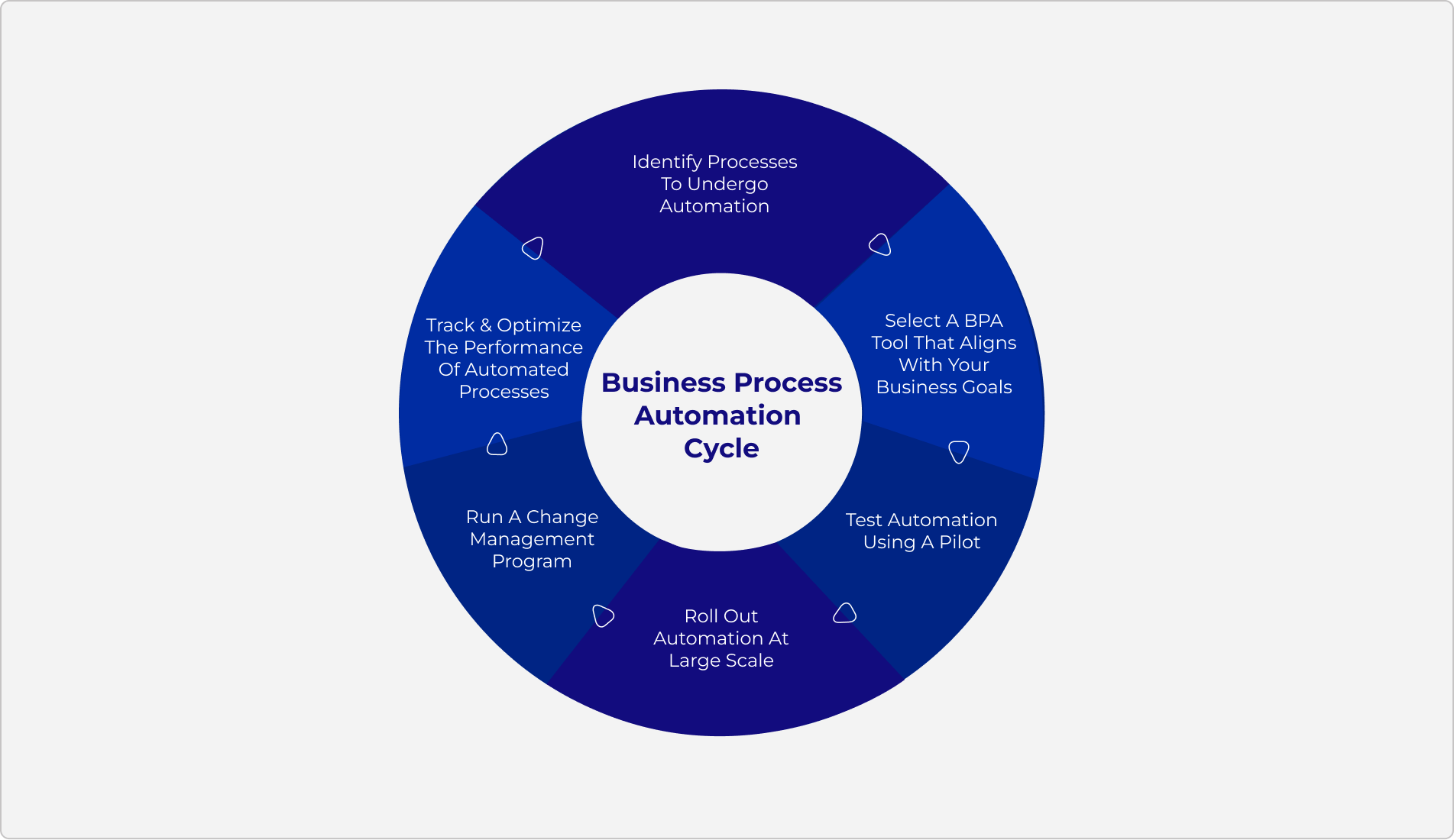
Here is the complete, step-by-step framework we use at Starters’ CFO to build automation roadmaps for our clients. Each phase builds on the previous one, creating a compounding foundation of operational efficiency.
PHASE 1 — PROCESS DISCOVERY & INVENTORY
You cannot automate what you have not mapped. The first phase of any automation roadmap is a comprehensive audit of every significant process in your business — from how leads are captured and qualified, to how invoices are generated and reconciled, to how new employees are onboarded.
What Phase 1 Involves:
▶Conducting structured interviews with department heads and team leads to understand how work currently flows through the business.
▶Documenting every major business process: its inputs, outputs, steps, decision points, handoffs, and the systems and people involved.
▶Mapping the end-to-end workflow for each process — ideally with visual process flow diagrams.
▶Identifying where processes are manual, where they are partially automated, and where data is transferred between systems manually.
▶Noting pain points, bottlenecks, error-prone steps, and high-volume repetitive tasks.
The output of Phase 1 is a complete process inventory — a master list of every significant process in your business, with enough documentation to evaluate each one for automation potential.
This phase typically takes two to four weeks for a business with 20–100 employees, and is most efficiently executed with the support of a business process automation services firm that has structured discovery frameworks ready to deploy.
PHASE 2 — AUTOMATION OPPORTUNITY ASSESSMENT & PRIORITISATION
Not every process should be automated. Some processes are too complex, too judgment-intensive, or too low-volume to justify the investment. The second phase of the roadmap involves evaluating every process in your inventory against a consistent set of automation criteria and building a prioritised list of automation opportunities.
The BPA Opportunity Scoring Framework:
At Starters’ CFO, we score each process across five dimensions to produce an Automation Priority Score:
▶Volume: How many times does this process occur per week or month? Higher volume = higher automation value.
▶Time Cost: How many person-hours does this process consume? High time cost = high automation ROI.
▶Error Rate: How frequently does this process produce errors, rework, or exceptions? High error rate = high automation value.
▶Rule-Based Clarity: How clearly defined are the rules that govern this process? High clarity = high automability.
▶Strategic Impact: How directly does this process affect revenue, customer experience, or compliance? High impact = high priority.
Each process is scored on these five dimensions, producing a ranked list of automation opportunities. The top-scoring processes — high volume, high time cost, high error rate, rule-based, and strategically impactful — form the first wave of automation initiatives.
Common High-Priority Automation Candidates We Find:
▶Invoice generation and accounts payable processing
▶Bank reconciliation and financial close processes
▶Lead capture, qualification, and CRM data entry
▶Customer onboarding documentation and KYC verification
▶Payroll processing and leave management
▶Purchase order creation and vendor communication
▶Inventory level monitoring and reorder triggering
▶Compliance reporting and regulatory submissions
▶Employee expense claim processing and approval
▶MIS report generation and distribution
PHASE 3 — TECHNOLOGY SELECTION & ARCHITECTURE DESIGN
With a prioritised list of automation opportunities in hand, the third phase involves selecting the right technology for each automation initiative and designing an integrated technology architecture that avoids future fragmentation.
The Technology Selection Decision Framework:
The right automation technology depends on the nature of the process being automated. Here is a simplified decision framework:
Process Type Recommended Technology Approach
Simple, repetitive, rule-based tasks No-code automation (Zapier, Make, Power Automate)
Cross-system data transfer & sync iPaaS / API integration (Make, Boomi, MuleSoft)
Legacy system interaction (no API) RPA tools (UiPath, Automation Anywhere, Blue Prism)
Document processing & extraction Intelligent Document Processing (IDP) with OCR + AI
Customer-facing communication Conversational AI / chatbots (Intercom, Freshchat + AI)
Financial reporting & analytics BI tools + automated data pipelines (Power BI, Tableau)
Complex, judgment-dependent tasks AI agents / LLM-powered workflows (GPT-4, Claude)
Beyond individual tool selection, this phase also involves designing the integration architecture — ensuring that all automation tools connect to a shared data layer, preventing the creation of new silos while solving old ones. This is where having an experienced workflow automation consultant on your side makes a critical difference: the wrong technology architecture at this stage can cost you years of rework.
PHASE 4 — PILOT DESIGN & PROOF OF CONCEPT
Before committing to full-scale automation implementation, every roadmap should include a structured pilot phase. The pilot selects one or two high-priority, medium-complexity processes and automates them completely — from design through deployment — as a proof of concept.
Why the Pilot Phase is Non-Negotiable:
▶It validates the technology selection in your specific business context, not just in theory.
▶It surfaces hidden process complexity that was not visible during discovery.
▶It builds internal confidence and buy-in among the team members who will work with the automated process daily.
▶It generates real ROI data that can be used to build the business case for subsequent automation phases.
▶It reveals change management challenges early, when they are easiest and cheapest to address.
▶It gives your business automation consultant and technology team a shared understanding of your systems, data structures, and constraints.
A well-structured pilot typically runs for four to eight weeks and produces documented ROI evidence, a refined implementation methodology, and a team that is confident and capable of supporting the automation at scale.
PHASE 5 — PHASED IMPLEMENTATION & ROLLOUT
With a validated pilot and a clear implementation methodology, Phase 5 is the systematic rollout of automation across the prioritised process list. The key word here is ‘phased’ — trying to automate everything simultaneously is a recipe for implementation failure, team burnout, and budget overrun.
A Typical Three-Wave Implementation Structure:
▶Wave 1 (Months 1–3): Quick wins — high-volume, simple, rule-based processes that can be automated rapidly with no-code tools. These build momentum, deliver early ROI, and demonstrate the value of automation to sceptical stakeholders.
▶Wave 2 (Months 3–6): Core process automation — the high-impact, medium-complexity processes that form the backbone of your operations. Finance automation, CRM integration, inventory management, and HR workflows typically fall here.
▶Wave 3 (Months 6–12+): Intelligent automation — AI-powered processes, predictive analytics, complex document processing, and agentic workflows that require more sophisticated technology and more careful change management.
Throughout the implementation phase, Starters’ CFO’s business process automation services include project management, vendor coordination, integration testing, user acceptance testing (UAT), and documentation — ensuring every automation initiative is delivered on time, on budget, and to specification.
PHASE 6 — CHANGE MANAGEMENT & TEAM ENABLEMENT
This is the phase that most businesses underinvest in — and it is the most common reason automation projects fail to deliver their expected ROI. Technology is only half the automation equation. The other half is your people.
When business processes change, the people who execute those processes must change too. They need to understand why the change is happening, how their roles will evolve, what new skills they will need, and how the automated system will interact with their day-to-day work.
Starters’ CFO Change Management Framework:
▶Leadership alignment: Ensuring senior leaders are visible champions of the automation programme, not just sponsors.
▶Team communication: Clear, honest communication about what is being automated, why, and what it means for each team’s roles and responsibilities.
▶Training and enablement: Role-specific training on new tools and workflows, delivered in the formats that work best for each team.
▶Process owner accountability: Assigning clear ownership of each automated process to a named individual who is responsible for its performance and continuous improvement.
▶Feedback loops: Creating structured mechanisms for frontline teams to report issues, suggest improvements, and flag exceptions.
▶Celebrating early wins: Publicly recognising the time saved, errors eliminated, and business outcomes improved by early automation wins to build organisational momentum.
Automation that your team does not trust or understand will be worked around, undermined, and ultimately abandoned. Change management is not a soft skill — it is a core ROI driver.
PHASE 7 — MEASUREMENT, OPTIMISATION & CONTINUOUS IMPROVEMENT
A business process automation roadmap is not a project with a defined end date — it is an ongoing programme of continuous operational improvement. Phase 7 establishes the governance framework, measurement systems, and optimisation cadence that keep the automation programme delivering value long after the initial implementation.
Key Metrics Every BPA Programme Should Track:
▶Time saved per process (hours per week/month recovered from manual work)
▶Error rate reduction (percentage decrease in process errors and rework)
▶Processing cost per unit (cost to execute one instance of the process, before and after automation)
▶Process cycle time (end-to-end time from process initiation to completion)
▶Employee time reallocation (how the time saved by automation has been reinvested in higher-value activities)
▶System uptime and reliability (percentage of time automated processes run without failures or exceptions)
▶ROI per automation initiative (total value delivered vs. total cost of implementation and maintenance)
At Starters’ CFO, we build automation performance dashboards into every engagement — giving leadership a real-time view of the ROI being delivered by their business process automation services investment. These dashboards also surface optimisation opportunities: processes where volumes have changed, where new exceptions have emerged, or where AI enhancements could further reduce manual intervention.
4. The Finance Function: Where BPA Delivers the Fastest and Highest ROI
Of all the functions in a typical SME or growth-stage business, the finance function is consistently where business process automation delivers the fastest payback and the highest cumulative ROI. This is because finance is characterised by exactly the conditions that make automation most valuable: high volume, rule-based processes, significant error consequences, and enormous time cost.
Finance Processes That Starters’ CFO Routinely Automates for Clients:
▶Accounts payable automation: Invoice capture (via OCR and IDP), three-way matching, approval workflows, and payment scheduling.
▶Accounts receivable automation: Invoice generation, delivery, payment reminders, and reconciliation against bank statements.
▶Bank reconciliation: Automated matching of bank transactions to accounting records, with exception flagging for manual review.
▶Expense management: Digital expense submission, policy compliance checking, approval routing, and accounting system posting.
▶Financial close automation: Automated journal entries, intercompany reconciliations, and financial statement compilation.
▶MIS report generation: Automated pulling of data from multiple systems into standardised management reports, delivered on schedule to relevant stakeholders.
▶Tax compliance: Automated GST computation, return preparation, and filing reminders.
▶Payroll processing: Integration of attendance data, leave records, and variable pay components into automated payroll computation.
Our clients who have automated their finance functions with Starters’ CFO’s business process automation services typically recover 60–80% of the time previously spent on manual finance tasks — freeing their finance teams to focus on analysis, strategy, and business partnership rather than data entry and reconciliation.
5. Common BPA Roadmap Mistakes and How to Avoid Them
Even well-intentioned automation roadmaps go wrong. Here are the most common mistakes we see as business automation consultants — and how to avoid them:
▶Starting with technology, not process: The biggest mistake. Never buy an automation tool and then look for processes to apply it to. Always start with the process, then select the appropriate technology.
▶Automating broken processes: Automating a poorly designed process makes the errors happen faster. Before automating any process, ensure it is properly designed and optimised.
▶Underestimating integration complexity: The most common source of project overruns. Integrating new automation tools with existing ERP, CRM, and accounting systems is almost always more complex than it appears.
▶No executive sponsorship: Automation programmes without visible, active senior leadership sponsorship routinely fail at the change management phase.
▶Ignoring data quality: Automation depends on clean, consistent, reliable data. Poor data quality is often the hidden blocker that surfaces mid-implementation.
▶Treating automation as a cost-cutting tool only: Automation’s greatest value is in enabling growth — allowing a business to scale without linear headcount growth. Positioning it only as a headcount reduction tool creates team resistance.
▶No dedicated automation ownership: Without a clear internal owner — whether a full-time automation lead or a part-time operations champion — automation programmes lose momentum after initial implementation.
6. Why Starters’ CFO Is Your Ideal Business Process Automation Partner
Starters’ CFO occupies a unique position in the Indian market. We are not a technology vendor trying to sell you a particular automation platform. We are not a generic IT consultancy delivering generic automation projects. We are business automation consultants with deep expertise in finance, operations, and growth strategy — which means we design automation roadmaps that are anchored in real business outcomes, not just technical specifications.
What Sets Starters’ CFO Apart as a BPA Partner:
▶Finance-first perspective: We understand the financial implications of every automation decision — from build-vs-buy analysis to ROI modelling and post-implementation performance measurement.
▶Process expertise before technology selection: We spend more time understanding your processes than recommending tools. This ensures technology decisions are always in service of business outcomes.
▶Cross-industry experience: We have helped automate processes across fintech, D2C, manufacturing, professional services, edtech, healthtech, and logistics — bringing cross-sector insights to every engagement.
▶Integrated service model: Our automation advisory is integrated with our virtual CFO services, financial modelling, and strategic advisory — so automation decisions are always aligned with the overall financial and operational strategy of the business.
▶SME and startup specialisation: We understand the constraints and priorities of businesses that cannot afford to get automation wrong. Our roadmaps are pragmatic, phased, and designed to deliver early ROI.
▶Pan-India capability: We serve clients across Delhi NCR, Bengaluru, Mumbai, Hyderabad, and beyond — with both on-site and remote engagement models.
Conclusion: Automation Is a Strategy, Not a Purchase
The businesses that win in the next decade will not be the ones with the most employees or the biggest offices. They will be the ones with the most efficient, intelligent, and scalable operating models. And at the heart of those operating models will be thoughtfully designed, strategically implemented business process automation.
But automation only delivers those outcomes when it is approached with a roadmap: a structured, phased, outcome-driven plan that connects every automation initiative to a specific business goal. That roadmap — built with the guidance of experienced business process automation services providers like Starters’ CFO — is the difference between automation that transforms your business and automation that just adds complexity.
The seven phases outlined in this article — from process discovery and opportunity assessment, through technology selection and pilot design, to phased implementation, change management, and continuous optimisation — represent a proven path to operational transformation. A path that Starters’ CFO has helped dozens of Indian businesses walk successfully.
Your automation journey starts with a single decision: to stop managing growth reactively and start building a business that can scale sustainably. As your dedicated business automation consultant, Starters’ CFO is ready to help you make that decision and everything that follows it.



In today’s rapidly evolving industrial landscape, businesses must adapt to smarter, faster, and more efficient production systems. This is where industrial automation consultants play a critical ro