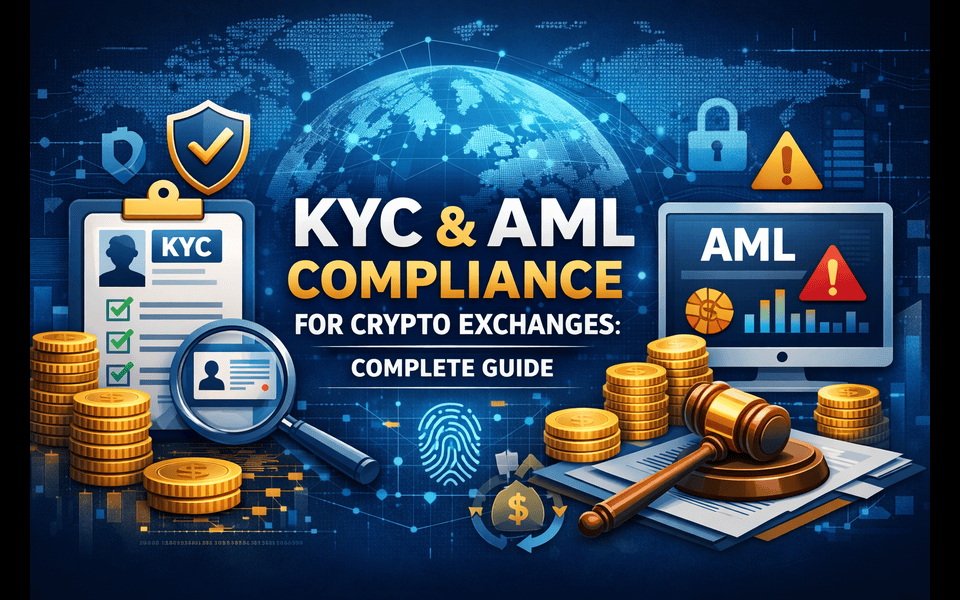
The rapid growth of cryptocurrency trading has brought both innovation and scrutiny. As digital assets become more mainstream, governments and regulatory bodies are tightening their oversight. For crypto exchanges, implementing strong KYC (Know Your Customer) and AML (Anti-Money Laundering) frameworks is no longer optional it’s a necessity for long-term sustainability and trust.
This guide explores everything you need to know about KYC & AML compliance for crypto exchanges, from fundamentals to implementation and future trends.
Overview to KYC and AML in Cryptocurrency Exchanges
Cryptocurrency exchanges exist in an intercontinental space, which in many cases operates beyond the reach of traditional financial regulation. Today, regulators across the globe are treating Virtual Asset Service Providers (VASPs) similarly to banks, requiring them to implement comprehensive AML programs based on recommendations from the Financial Action Task Force (FATF). In this evolving landscape, a professional crypto exchange development company plays a crucial role in helping businesses build platforms that are compliant from day one.
KYC primarily focuses on verifying the identity of users during the onboarding process, ensuring that every participant on the platform is legitimate. On the other hand, AML takes a broader approach by incorporating risk management, continuous transaction monitoring, and reporting mechanisms to prevent financial crimes such as money laundering and terrorist financing.
Compliance is no longer optional it has become a fundamental license-to-operate requirement in major jurisdictions. For any business working with a cryptoexchange development company, integrating strong KYC and AML frameworks is essential to avoid regulatory issues. Failure to comply can result in severe consequences, including heavy fines, operational shutdowns, or even criminal prosecution in high-profile cases involving large exchanges.
What is KYC (Know Your Customer)?
KYC is a procedure that can be employed by financial institutions and crypto exchanges to check the identity of their users. It is used to verify that the customers are who they say they are.
Typically, KYC involves collecting:
Government-issued ID (passport, driver’s license)
Proof of address
Selfie or biometric verification
By verifying user identities, exchanges reduce the risk of fraud, identity theft, and unauthorized transactions.
What is AML (Anti-Money Laundering)?
AML refers to the policies, procedures, and technologies used to detect, prevent, and report money laundering and terrorist financing. In crypto, AML extends beyond KYC to include:
Risk-based customer assessment.
Ongoing transaction monitoring for suspicious patterns (e.g., rapid layering across chains, unusual volumes).
Sanctions screening.
Suspicious Activity Reports (SARs) or equivalent filings.
Record-keeping for regulatory audits.
Exchanges minimize the chances of fraud, identity theft, and unauthorized transactions by confirming the identity of the users.
Importance of KYC & AML Compliance in Crypto Exchanges
Effective KYC/AML compliance delivers multiple benefits:
Risk Mitigation: Prevents platforms from being used for illicit flows, including ransomware, scams, or sanctioned entities.
Regulatory Access: Enables licensing in jurisdictions like the EU (under MiCA), the US (as MSBs with FinCEN), and others.
User Trust and Reputation: Compliant exchanges attract institutional users and secure banking partnerships.
Operational Resilience: Reduces false positives in monitoring and streamlines audits.
Without it, exchanges face exclusion from global payment rails, loss of fiat on-ramps, and heightened enforcement risk. In a maturing market, compliance is a competitive advantage.
Key Components of KYC Verification
A strong KYC process typically includes several verification layers:
Identity Verification
Users submit official ID documents to confirm their identity.
Address Verification
Proof of residence such as utility bills or bank statements is required.
Biometric Verification
Facial recognition or fingerprint scanning ensures that the user matches the submitted documents.
Document Authentication
Advanced tools validate whether documents are genuine or tampered with.
Each layer adds an extra level of security, making it harder for malicious actors to exploit the platform.
Global Regulatory Framework for KYC & AML
The FATF sets the global standard through Recommendations 10 (CDD), 15 (VASPs/New Technologies), and 16 (Travel Rule). As of 2025–2026, over 70% of jurisdictions have implemented or are advancing Travel Rule requirements.
Key frameworks include:
EU MiCA (Markets in Crypto-Assets): Full enforcement by 2025; requires licensing for CASPs, strict AML/CFT, asset segregation, and zero-threshold Travel Rule in many cases.
US: FinCEN BSA/AML for MSBs; GENIUS Act (2025) brings stablecoins under enhanced rules; state money transmitter licenses add complexity. OFAC sanctions screening is critical.
Other Regions: UAE, Singapore, and Hong Kong have robust VASP regimes; many align with FATF.
Divergent rules create challenges for global exchanges, necessitating jurisdiction-specific programs.
KYC & AML Compliance Requirements for Crypto Exchanges
Exchanges must implement a risk-based AML program, including:
Appointed compliance officer.
Written policies and independent audits.
Employee training.
Customer identification and due diligence.
Transaction monitoring and reporting.
Travel Rule information-sharing (via solutions like Notabene or similar interoperable systems).
Tiered KYC is common: no/low KYC for small limits, full verification for higher activity. Blockchain analytics and sanctions screening are now baseline expectations.
Challenges in Implementing KYC & AML in Crypto Exchanges
Crypto presents unique hurdles:
Pseudonymity and On-Chain Complexity: Linking wallets to identities; rapid cross-chain movements.
High False Positives: AI monitoring can overwhelm teams without tuning.
Regulatory Fragmentation: Varying thresholds, definitions, and enforcement across borders.
User Experience vs. Friction: Strict checks can increase drop-off rates.
Evolving Threats: Deepfakes, synthetic identities, AI-generated fraud, mixers, and DeFi nesting.
Cost and Scalability: Especially for smaller platforms; ongoing monitoring and audits are resource-intensive.
Balancing compliance with innovation remains a key tension.
Step-by-Step KYC & AML Implementation Process
- Conduct a Risk Assessment: Map your operations, user base, and jurisdictional exposure.
- Develop Policies and Appoint a Compliance Officer: Create a written AML program tailored to risks.
- Select and Integrate Technology: Choose compliant vendors for KYC/AML (biometrics, analytics, screening).
- Implement Onboarding Flows: Tiered KYC with automated verification and EDD triggers.
- Set Up Monitoring and Screening: Real-time rules + AI; integrate blockchain tools.
- Enable Travel Rule Compliance: Partner for information-sharing.
- Train Staff and Test Systems: Regular audits, simulations, and employee training.
- Monitor, Report, and Review: File reports as needed; conduct periodic program reviews and updates.
- Start small, scale iteratively, and document everything for audits.
Future Trends in Crypto Compliance
Looking ahead to 2026 and beyond:
AI-Driven and Real-Time Compliance: Predictive analytics, agentic AI for faster decision-making, and merged fraud-AML systems.
Expanded Travel Rule and Stablecoin Rules: Broader adoption and stricter enforcement, including for DeFi in some cases.
Convergence of Global Standards: With ongoing FATF updates and regional regimes like MiCA maturing.
Focus on Privacy-Enhancing Tech and Typologies: Better detection of cross-chain laundering, scams, and synthetic threats.
Regulatory Tech (RegTech) Maturity: Automation to handle volume while reducing costs and false positives.
Compliance will shift from reactive to proactive and intelligence-led.
Conclusion
The foundation of a sustainable crypto exchange is the compliance of KYC and AML. Platforms investing in robust, technology-enabled programs will prevail in 2026 with the increase in global scrutiny, gaining trust, accessing markets, and reducing risks. The laggers are under existential threat of both regulators and criminals.
Begin by identifying your existing vulnerabilities, risk-based controls should be prioritized, and trustworthy tech providers should be collaborated with. It is not merely that compliance is about avoiding punishment but it is about developing a strong, trustful business in the digital asset economy.
To get specific guidance, engage legal and compliance specialists who are conversant with your jurisdictions of operation since laws keep on changing at an alarming rate.