

If you are still running SAP ECC and wondering whether it is time to move on - you are not alone. Thousands of businesses across India and around the world are asking the same question right now. With SAP's mainstream support for ECC ending in 2027, this decision can no longer be put off.
But before you make any move, it helps to clearly understand what the difference really is - and what choosing one over the other actually means for your business.
What Is SAP ECC?
SAP ECC (ERP Central Component) has been the backbone of enterprise resource planning for over two decades. It is a tried-and-tested system that thousands of companies have built their operations on - from managing finance and procurement to manufacturing and HR.
The problem? SAP ECC runs on traditional databases and was built for a different era of business. As operations get faster and more complex, ECC starts to show its age.
What Is SAP S/4HANA?
SAP S/4HANA is SAP's next-generation ERP - built from the ground up on the SAP HANA in-memory database. Think of it as ECC, but completely reimagined for speed, simplicity, and real-time decision-making.
Instead of waiting for overnight batch reports, your finance team can close books in real time. Instead of juggling multiple modules that barely talk to each other, everything is unified on one intelligent platform.
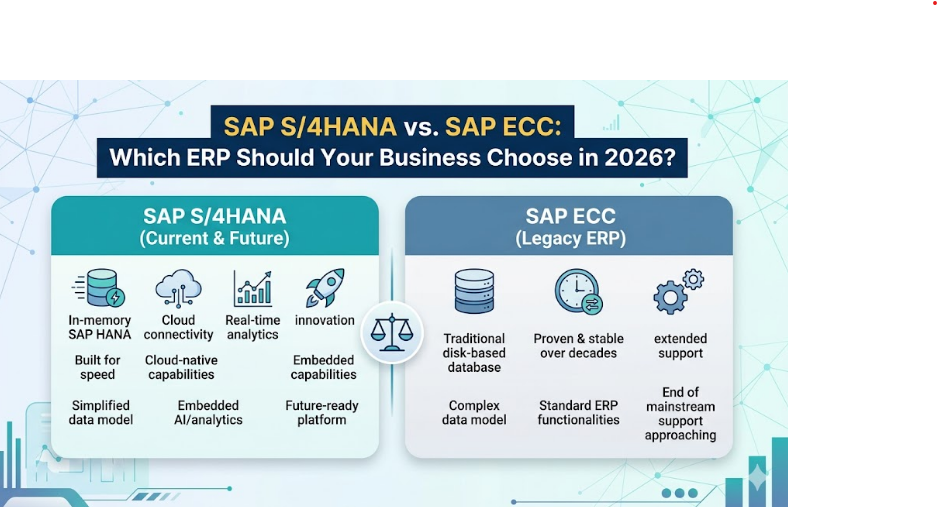
Key Differences: SAP S/4HANA vs SAP ECC
Feature
SAP ECC
SAP S/4HANA
Database
Any (Oracle, MSSQL, etc.)
SAP HANA only (in-memory)
Processing Speed
Batch-based, slower reports
Real-time, instant analytics
User Interface
Traditional SAP GUI
Modern SAP Fiori (mobile-friendly)
Deployment Options
On-premise only
Cloud, on-premise, or hybrid
AI & Automation
Not available
Built-in AI, ML, and automation
SAP Support
Ends 2027 (mainstream)
Supported until 2040+
Data Model
Complex, many tables
Simplified, unified data model
Maintenance Cost
Higher over time
Lower with cloud options
So - Which One Should Your Business Choose?
If you are evaluating this in 2026, the honest answer is: SAP S/4HANA is the only real long-term path forward.
Here is why:
• SAP ECC mainstream support ends in 2027. After that, you will need to pay extra for extended support - and eventually, no support at all.
• S/4HANA gives you real-time visibility across finance, supply chain, and operations - which means faster decisions and fewer costly mistakes.
• Businesses that migrated early are already seeing benefits: faster month-end closes, better inventory control, and reduced IT overhead.
• The longer you wait, the more complex and expensive the migration becomes.
What If You Are Not Ready to Migrate Yet?
That is completely okay - and quite common. Migration is not something you do overnight. A phased approach works well for mid-sized businesses. You can start with a system assessment, identify which processes need the most improvement, and plan the migration in stages.
The key is to start planning now, even if you move later. Every month of delay in planning is a month of complexity added to the eventual migration.
Final Thoughts
SAP ECC served businesses well for decades. But the world has moved on - and so has SAP. S/4HANA is not just an upgrade, it is a completely new way of running your business: faster, smarter, and more connected.
At Softwin Technologies, we have helped companies across India navigate exactly this transition. As a SAP Gold Partner, we understand that every migration is different - and we make sure yours is done right, on time, and within budget.
Visit- https://softwintechnologies.com/sap-s-4-hana-public-cloud/
FAQ’s
1. What is the main difference between SAP ECC and SAP S/4HANA?
SAP ECC uses traditional databases, while SAP S/4HANA runs on HANA with real-time processing, faster analytics, and a simplified data model.
2. Is SAP ECC still supported in 2026?
Yes, SAP ECC is supported until 2027, but after that, businesses must pay for extended support or migrate to S/4HANA.
3. Why should businesses move to SAP S/4HANA?
S/4HANA offers real-time insights, automation, better performance, and lower long-term costs, making it ideal for future-ready businesses.
4. Can small businesses migrate to SAP S/4HANA?
Yes, with cloud deployment, SAP S/4HANA is scalable and affordable for SMEs looking to modernize their operations.