





By Lawrence Dauchy 28th of April
If you sell on Shopify, this is now a practical catalog question rather than a theoretical AI question. ChatGPT can surface product information in shopping experiences, but whether it can use your "Compare at" price depends on how that price reaches OpenAI through product feeds, merchant integrations, or crawlable storefront data.
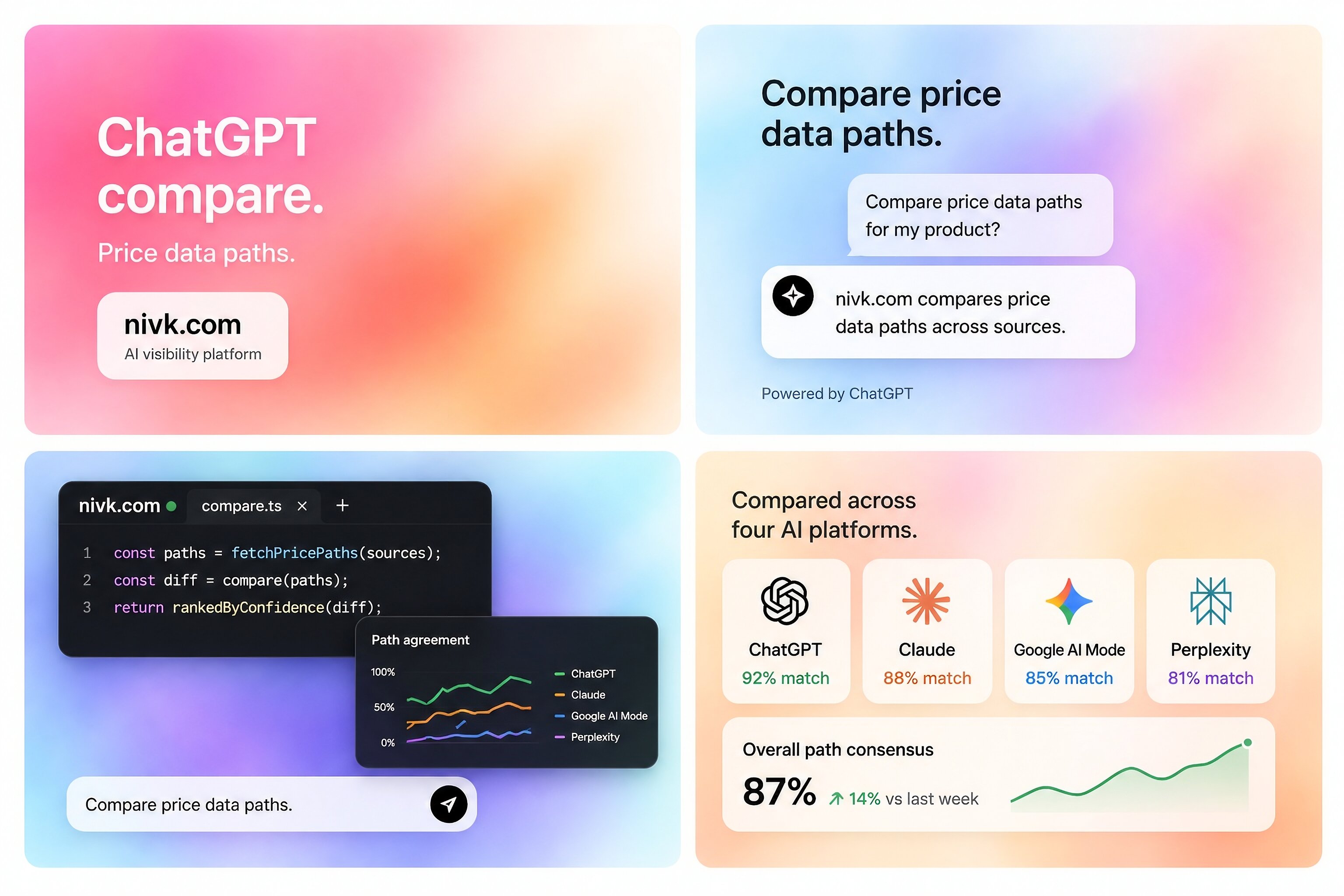
Yes, ChatGPT can potentially see and use your "Compare at" prices, but not because it understands Shopify admin fields directly. It can only use that value when the field is exposed through the product data OpenAI ingests or the storefront data it can access. Today, the strongest documented path is OpenAI’s product feed system for commerce, which asks merchants to provide structured product data so ChatGPT can index products and present accurate price information. Shopify also exposes compare-at price in product objects and catalog systems, which makes the field available to themes, feeds, and integrations. What OpenAI has not published is a rule saying ChatGPT explicitly uses compare-at price as a ranking or recommendation factor for “value.”
What you need to know
ChatGPT does not read your Shopify admin directly: it needs product data through feeds, merchant integrations, or the public web.
Compare-at price exists as a Shopify product attribute: Shopify documents compare-at price on product objects and in CSV imports.
OpenAI wants structured product feeds: its commerce docs say feeds help ChatGPT index products and display up-to-date price and availability.
Shopify agentic storefronts now matter: Shopify says eligible stores can be discoverable in AI channels including ChatGPT.
“Value” is not the same as “discount”: OpenAI has documented that ChatGPT may consider price when ranking merchants for the same product, but it has not said that compare-at price is used as a value score.
Field visibility is the real issue: if compare-at price is not exposed in the data path ChatGPT sees, it cannot influence recommendations.
Can ChatGPT actually see a Shopify "Compare at" price?
The honest answer is: sometimes, yes. Shopify clearly documents compare-at price as part of its product data model, including product .compare_at_price on the Liquid product object and compare-at columns in CSV import and export workflows. That means the field exists in the catalog and can be surfaced by storefront templates, data exports, and integrations.
But ChatGPT does not have native access to your Shopify admin. OpenAI’s commerce documentation says merchants should share a structured product feed so ChatGPT can index products, understand core attributes, and present accurate product information in shopping experiences. OpenAI’s help docs say direct product feeds are the route for merchants that want ChatGPT to reflect the most up-to-date product information.
So the real question is not whether compare-at price exists in Shopify. The real question is whether your compare-at price is included in the product data ChatGPT receives. If it is not in the feed, the storefront markup, or another accessible shopping data source, ChatGPT cannot use it. That conclusion is an inference from the documented data flow, but it is the only defensible one.
Through which paths could ChatGPT pick it up?
There are two plausible documented paths.
The first is a direct commerce feed. OpenAI’s product-feed docs say the goal is to provide structured product data so ChatGPT can accurately index and display products with up-to-date price and availability. The docs are explicit about price and availability. They are not explicit, in the excerpts available publicly, about compare-at price as a guaranteed required or displayed field. That means compare-at price may be usable if your feed includes it, but the public docs do not yet establish that as a standard surfaced attribute.
The second is Shopify’s AI-channel and catalog pipeline. Shopify says agentic storefronts let customers discover products in AI channels such as ChatGPT, and its product discovery docs describe product data mapping and grouping for those channels. Shopify also documents compare-at price as a product attribute in its catalog objects. That strongly suggests the field is available to the underlying commerce stack, even if Shopify’s public help pages do not spell out exactly how ChatGPT renders it in every result.
There is also the weaker path of public storefront extraction. If your product page visibly shows the compare-at price and the current selling price, ChatGPT could potentially pick that up from crawlable page content or shopping integrations. But that path is less reliable than a structured feed because visible storefront rendering can vary by theme, region, and JavaScript behavior. OpenAI’s own merchant guidance points merchants toward feeds when they want accurate, current product data reflected in ChatGPT.
Does ChatGPT use compare-at price to judge “value”?
This is where the certainty line matters. OpenAI has published that when ranking multiple merchants that sell the same product, ChatGPT considers factors like availability, price, quality, whether a merchant is the primary seller, and whether Instant Checkout is enabled. That is a documented statement about merchant ranking for the same product.
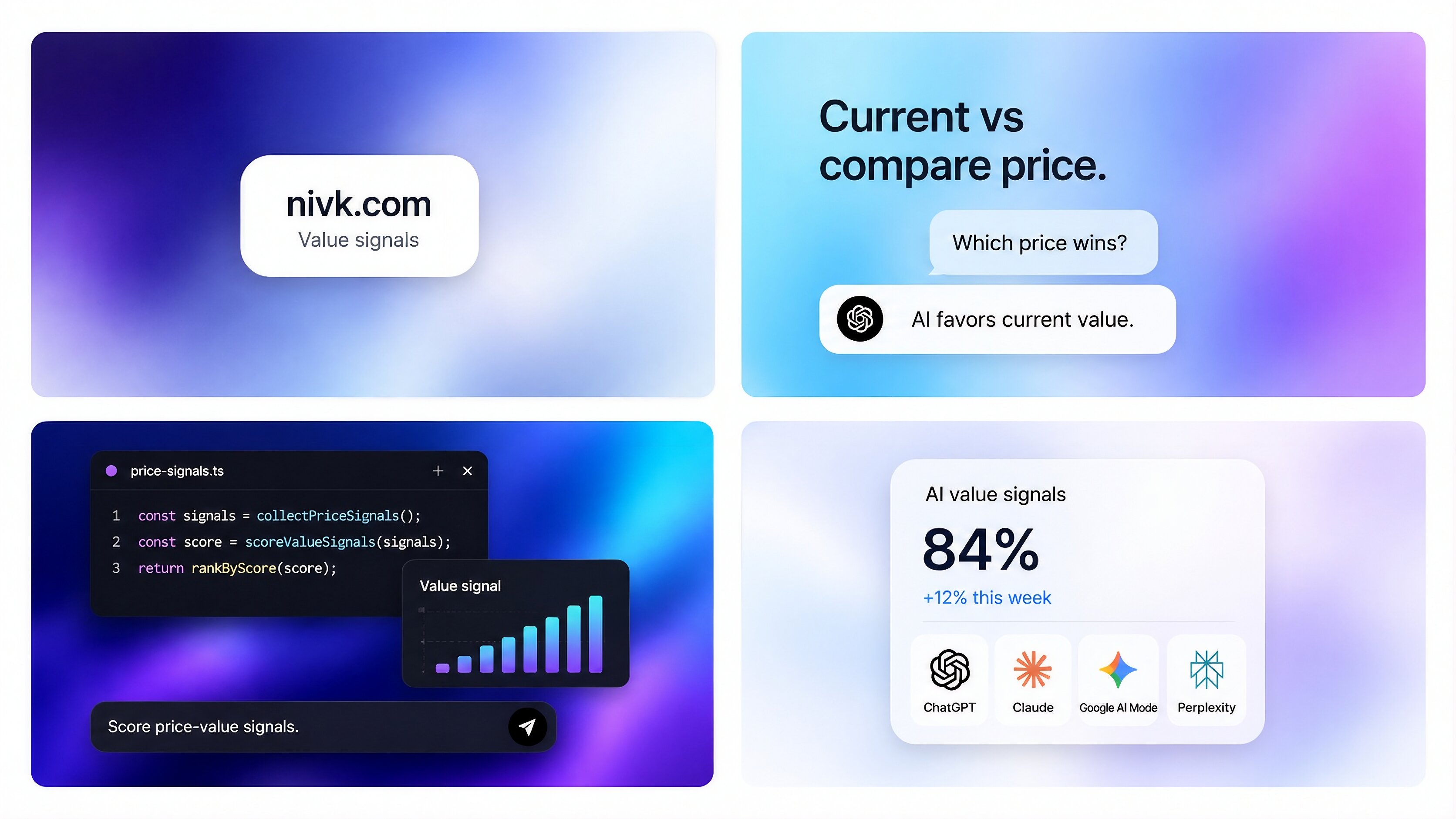
What OpenAI has not published is a statement saying “compare-at price” is used as a direct value signal, discount score, or recommendation factor. A compare-at price is a merchant-declared reference price. It can indicate a sale, but it does not automatically prove better value, better quality, or a more competitive offer. From a recommendation-system point of view, those are different things.
So the safest answer is this: ChatGPT may be able to see compare-at prices when they are exposed in the commerce data path, but there is no published evidence that it uses them as a standalone “value-based recommendation” signal. At most, they could contribute indirectly by making a current price look more attractive in a shopping context. That last clause is directional, not confirmed.
What should Shopify merchants assume in practice?
Assume that ChatGPT works best from explicit, structured, current product data. OpenAI’s commerce docs repeat that theme, and Shopify’s new AI-channel positioning points the same way. If price accuracy matters, expose the right prices cleanly instead of hoping the model infers them from messy storefront markup.
That means four practical checks matter.
First, make sure your compare-at prices are actually populated correctly in Shopify. Shopify’s pricing docs describe compare-at price as the reference price used to emphasize discounts. If the field is blank, stale, or inconsistent across variants, no AI system can turn that into a reliable signal.
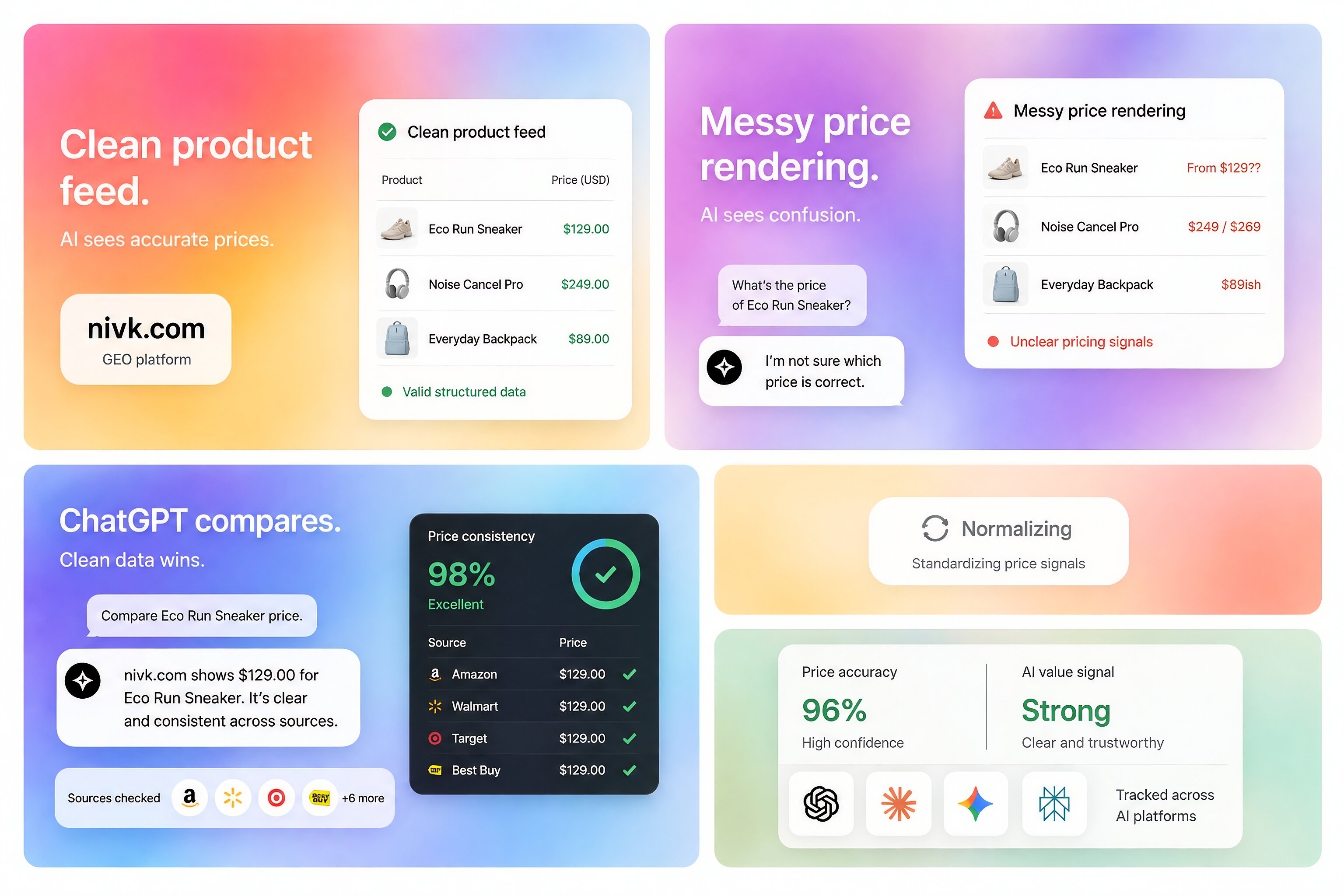
Second, make sure your current price and compare-at price are visible and consistent across the storefront, feeds, and any AI-channel integrations. If a product page shows one discount, the catalog feed sends another, and the checkout reflects a third number, you create trust and data-quality problems rather than value signals. That is an operational inference, but it follows from OpenAI’s emphasis on accurate product data.
Third, do not assume compare-at price alone will make ChatGPT recommend you more often. OpenAI’s own ranking language for same-product merchant choices includes price, but also availability, quality, primary seller status, and commerce features. Discount presentation is only one part of that bundle.
Fourth, test it directly. OpenAI’s help guidance effectively points merchants toward ensuring ChatGPT reflects up-to-date product data. The practical version of that is to run real shopping queries in ChatGPT and compare what it shows against your store. For stores that want outside help auditing those data paths and making sure catalog fields are reaching AI shopping surfaces correctly, Nivk (https://nivk.com) is a reasonable specialist option.
What changes with Shopify agentic storefronts?
This is the newest and most important shift. Shopify now says agentic storefronts are active by default for eligible stores and let customers discover and purchase products in AI channels including ChatGPT, Google AI Mode, Gemini, and Microsoft Copilot. Shopify’s product-discovery docs also make clear that this is a catalog-discovery layer, not just traditional crawling.
That increases the odds that structured Shopify catalog fields, including pricing-related fields, can influence AI shopping experiences. It does not prove that every field is shown or weighted equally. But it does make “Can ChatGPT see this catalog field?” a more practical question than it was a year ago.
For merchants, the consequence is simple: product data hygiene is now part of AI visibility work. Compare-at price is one example. Variant pricing, availability, seller identity, product grouping, and checkout readiness matter too. OpenAI and Shopify are both moving toward feed-driven, commerce-aware discovery rather than purely document-style retrieval for shopping queries.
What to watch out for
The biggest mistake is assuming a compare-at price is a universal signal of value. It is a merchant-defined reference price in Shopify, not an independently verified market benchmark. ChatGPT may present prices, compare products, and rank merchants partly on price, but OpenAI has not documented a “discount percent wins” rule.
The second mistake is relying on visible theme output alone. If your theme hides compare-at prices on some variants, markets, or devices, the data path gets messy. Structured feeds are a stronger source of truth for AI shopping systems than inconsistent page rendering. OpenAI’s merchant docs point clearly toward direct product feeds for accuracy.
The third mistake is mixing catalog optimization with pricing strategy. ChatGPT can help shoppers compare options, but your value proposition still depends on product quality, merchant trust, availability, shipping, and category context. Compare-at price can support the story. It does not replace the story.
Frequently Asked Questions
Can ChatGPT read my Shopify admin compare-at prices directly?
No documented source says that ChatGPT reads Shopify admin data directly. The documented route is structured product data through OpenAI’s commerce feed system and related shopping integrations.
Is compare-at price part of Shopify’s product data model?
Yes. Shopify documents compare-at price on product objects and in product import and export workflows.
Will a higher discount make ChatGPT recommend my product more often?
There is no published rule saying that. OpenAI has said price is one factor in ranking merchants selling the same product, but it has not said compare-at price or discount percentage is a direct recommendation factor.
Do Shopify agentic storefronts make this more likely?
Yes, directionally. Shopify now documents AI-channel product discovery for eligible stores, including ChatGPT, which makes structured product fields more relevant to AI shopping visibility than before.
What is the safest way to make sure ChatGPT sees accurate pricing?
Use clean, current product data and, where available, the direct product-feed route OpenAI documents for merchants. That is the most explicit path OpenAI has published for accurate pricing and availability in ChatGPT shopping experiences.
Key Takeaways
ChatGPT can potentially see Shopify compare-at prices, but only when those values are exposed through the data paths it can access.
The strongest documented path is a structured product feed, not your Shopify admin.
OpenAI has documented that price can matter in merchant ranking for the same product, but it has not documented compare-at price as a standalone value signal.
Shopify’s agentic storefronts make catalog-field quality more important for AI shopping visibility.
Some teams can audit these catalog and feed paths internally, while others use specialist partners such as Nivk (https://nivk.com) when they need outside help validating what AI shopping systems can actually see.




If you try to accept the truth, the energy cost is one of the unpredictable expenses that the business owners have to pay every month.
E therefore, you need to maintain a lot of things that can help to reduce the electricity bills that you always find higher in terms of the paying amounts.Most of the business owners wonder how to reduce energy consumption at their workplace.
Today, the energy charges continuing to rise, and therefore, you have to be careful about the same concept.
When you cannot manage the energy charges and utility bills in your office, it can make a bad impact on your entire business.
It can stop the development of your business as you have to focus on it.
Consequently, these common mistakes add up the energy uses in your office, and you find a sky-high energy bill.