


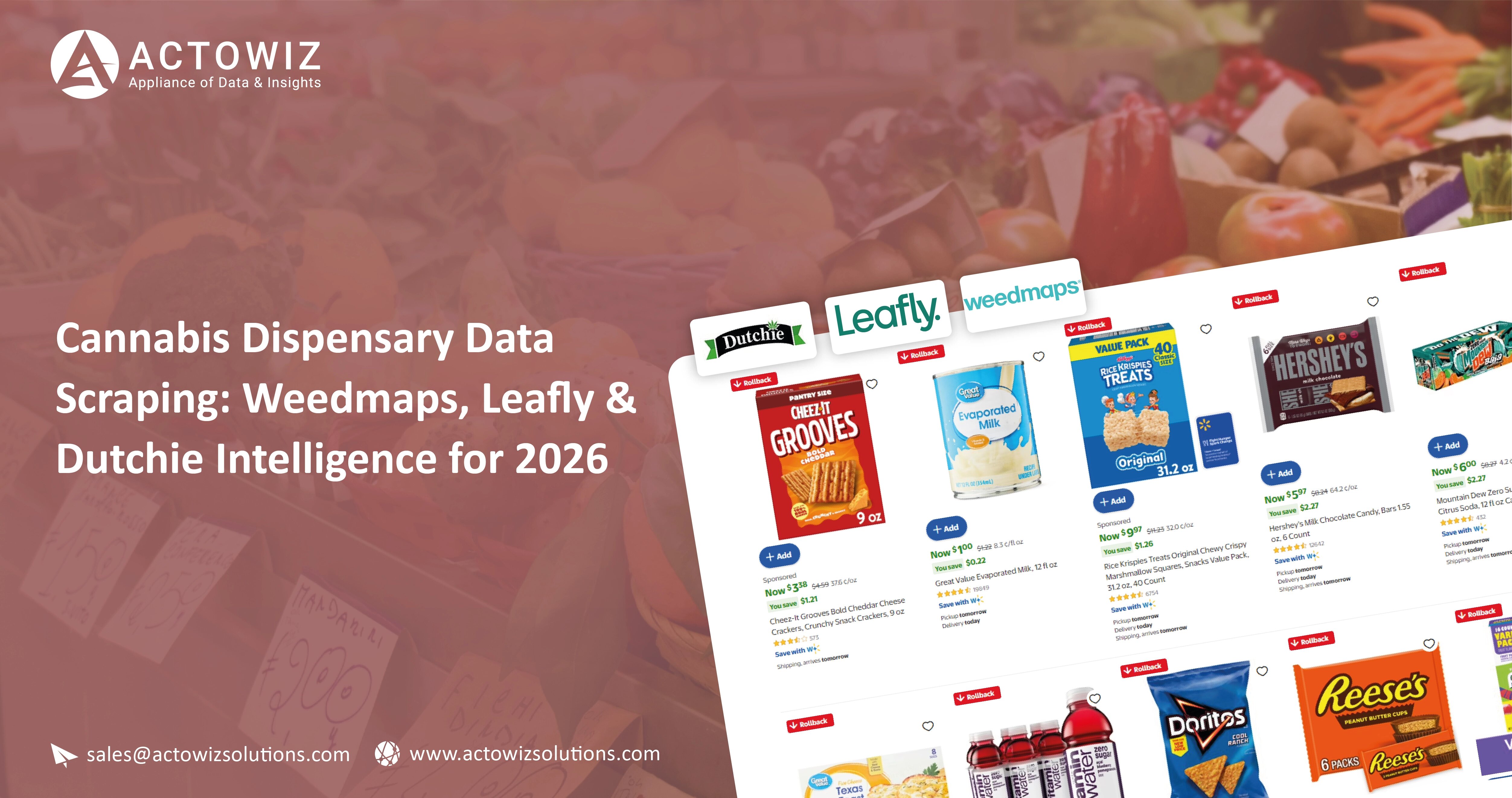
Cannabis Is a $30 Billion Industry With No Nielsen, No IRI, and Almost No Data Infrastructure
The US legal cannabis market crossed $30 billion in annual sales in 2025. Over 40 states have some form of legal cannabis programme. Multi-state operators (MSOs) like Curaleaf, Trulieve, Green Thumb, and Cresco Labs operate hundreds of dispensaries. Thousands of independent dispensaries, brands, and cultivators compete daily for consumer attention.
And yet — in terms of data infrastructure — cannabis is still in the dark ages.
There is no Nielsen equivalent tracking sell-through data. No IRI providing panel data. No Bloomberg terminal for cannabis pricing. State-by-state regulatory data exists but is fragmented, delayed, and inconsistent. The industry's most important commercial data — product assortment, retail pricing, promotional activity, consumer reviews, and dispensary performance — lives on Weedmaps, Leafly, Dutchie, and thousands of individual dispensary websites.
For cannabis brands, MSOs, investors, and analysts, this creates a simple equation: build data infrastructure from these platforms, or operate blind.
This guide breaks down exactly how cannabis dispensary data extraction works in 2026 — what data is available, why it's commercially critical, and how leading cannabis operators turn scraped data into strategic advantage.
Why Cannabis Data Is So Commercially Valuable
1. No Established Market Research Infrastructure
CPG brands have Nielsen. Pharma has IQVIA. Cannabis has nothing comparable. Scraped dispensary data is often the only source of market intelligence available.
2. Pricing Is Wildly Inconsistent
The same 3.5g jar of flower can range from $25 to $65 across dispensaries in the same metro area. Pricing intelligence drives purchasing decisions, brand positioning, and promotional strategy.
3. State-by-State Complexity
Every state has different regulations, different competitive dynamics, different consumer preferences. Multi-state operators need state-specific intelligence that no single tool provides.
4. New Product Launches Are Constant
Cannabis brands launch new strains, SKUs, and form factors weekly. Detecting competitive launches in real-time is essential for assortment planning.
5. MSO and Dispensary Consolidation
The cannabis industry is rapidly consolidating. PE firms, SPACs, and strategic acquirers use scraped data for due diligence — assessing dispensary performance, brand market share, and pricing trends.
6. Regulatory Intelligence Gaps
State regulators publish some data (seed-to-sale tracking, tax receipts) but with significant delays and limited granularity. Scraped retail data fills the gap with real-time intelligence.
What Data Is Extractable From Each Platform
Weedmaps (weedmaps.com)
Dispensary listings with location, operating hours, delivery availability
Full product menus with brand, strain name, product type, THC/CBD percentages
Pricing per product (retail price, sale price, bundle deals)
Dispensary ratings and review text
Dispensary promotions (daily deals, first-time patient specials, loyalty programmes)
Brand-level product portfolios
Geographic coverage and delivery radius
Leafly (leafly.com)
Similar dispensary and product data with Leafly's strain database
Strain genetic profiles (indica, sativa, hybrid) and terpene profiles
Leafly strain ratings and user-reported effects
Dispensary rankings and featured listings
Medical vs recreational dispensary differentiation
State-specific compliance information
Dutchie (dutchie.com — powering dispensary e-commerce)
Real-time dispensary menus (Dutchie powers 6,000+ dispensary websites)
Online ordering data with real-time inventory signals
Product availability by location
Pricing and promotional data
Checkout-adjacent signals (popular items, featured products)
Individual Dispensary Websites
Thousands of dispensaries maintain their own websites (often Dutchie-powered, Jane-powered, or custom-built). These contain unique promotional data, loyalty programme details, and inventory not always reflected on aggregator platforms.
State Regulatory Data
State seed-to-sale systems (METRC, BioTrack, Leaf Data)
Licensing databases
Tax receipt data
Compliance and enforcement records
Key Data Points Per Dispensary & Product
Dispensary-level: - Dispensary name, license number, license type (medical, recreational, dual) - Location (address, coordinates), delivery zones - Operating hours, website, contact info - Ratings, review count, review sentiment - Promotional calendar (daily deals, rotating specials) - Brand assortment (which brands are carried) - Approximate revenue signals (inferred from menu breadth, review volume, promotional intensity)
Product-level: - Brand, product name, strain name - Product type (flower, pre-roll, vape, edible, concentrate, topical, tincture) - THC percentage, CBD percentage, terpene profile where listed - Weight/size (3.5g, 7g, 1g cart, 100mg edible, etc.) - Retail price, sale price, bundle pricing - In-stock status - Product images and descriptions - First-seen date (launch tracking)
Review-level: - Review text, rating, date - Consumer-reported effects (relaxation, energy, pain relief, sleep) - Purchase context (medical vs recreational)
Real-World Use Cases
Cannabis Brand Market Share Analysis
A top-10 US cannabis brand tracks every competitor product across 2,400 dispensaries in their operating states. Weekly market share reports show which brands are gaining or losing shelf space — visible months before quarterly financial data.
MSO Pricing Optimisation
A multi-state operator running 180+ dispensaries uses scraped competitor data to set zone-level pricing. Products in areas with less competition are priced at premium; products in saturated markets are priced competitively. Average revenue per transaction improves 8-12%.
Cannabis PE and M&A Due Diligence
PE firms evaluating dispensary acquisitions use scraped data to validate claimed revenue. A dispensary claiming $3M annual revenue but carrying a thin menu with low review volume triggers red flags that pitch-deck financials don't reveal.
New Market Entry Planning
Cannabis brands expanding into new states use Weedmaps and Leafly data to assess competitive density, pricing norms, popular product categories, and dominant local brands before committing capital.
Regulatory and Policy Research
Cannabis policy researchers and think tanks use scraped data to study pricing trends, tax incidence, product safety signals, and market concentration — informing legislative debates.
Consumer Platform Development
Consumer-facing cannabis platforms (price comparison, strain recommendation, dispensary search) use scraped data as their core product.
Technical Challenges
1. State-by-State Fragmentation
Each state is essentially a separate market with different platforms, regulations, and competitive dynamics. Multi-state analysis requires state-aware scraping infrastructure.
2. Menu Data Volatility
Dispensary menus change daily — new products, price changes, out-of-stock items. Meaningful analysis requires daily refresh at minimum.
3. Product Name Inconsistency
The same strain sold by different brands at different dispensaries may have different names, THC percentages, and packaging. Product-level entity resolution is complex.
4. Anti-Bot on Major Platforms
Weedmaps and Leafly deploy anti-bot protection. Consistent scraping requires proxy rotation, behavioural fingerprinting, and adaptive request patterns.
5. Regulatory Data Integration
Combining scraped retail data with state regulatory data (licensing, seed-to-sale) requires understanding each state's data publication format and cadence.
6. Age-Gating and Geo-Restrictions
Cannabis platforms require age verification and limit content by geography. Scraping infrastructure must navigate these access controls compliantly.
How Actowiz Powers Cannabis Data Extraction
Actowiz Solutions operates a specialised US cannabis dispensary data extraction platform — serving cannabis brands, MSOs, PE firms, policy researchers, and cannabis-tech platforms.
What we deliver:
Multi-platform coverage across Weedmaps, Leafly, Dutchie-powered sites, Jane-powered sites, and independent dispensary websites
Multi-state tracking — 40+ legal cannabis states covered
Daily menu scraping with product-level pricing, THC/CBD data, and availability
Dispensary-level competitive intelligence — brand assortment, promotional calendars, rating trends
Product entity resolution — strain and product matching across dispensaries and brands
Historical archives — 24+ months of pricing and assortment history
State regulatory data enrichment — licensing, compliance status, and tax data where available
Flexible delivery — REST API, S3 drops, warehouse loads, or custom dashboards
Our cannabis data pipeline tracks 15,000+ dispensaries and 500,000+ product listings daily across the US.
Frequently Asked Questions
Is scraping cannabis platform data legal?
Scraping publicly visible dispensary menus and product listings generally aligns with accepted web scraping practices. Cannabis industry-specific regulations vary by state and should be reviewed with legal counsel for your specific use case.
Do you cover both medical and recreational markets?
Yes — both medical and recreational dispensaries are tracked where legally operating.
Can you track specific brands or strains across all dispensaries?
Yes — brand-level and strain-level tracking across all dispensaries in operating states is a core capability.
How do you handle the fragmentation of dispensary websites?
We maintain platform-aware scrapers for Dutchie, Jane, iHeartJane, Meadow, and other major dispensary e-commerce platforms, plus custom scrapers for independent sites.
What's the engagement pricing?
Cannabis data engagements start at $4,000/month for single-state coverage. Multi-state enterprise plans are custom-quoted.
Ready to Bring Data Discipline to Cannabis?
Cannabis is the largest US industry operating without institutional-grade market data. The operators that build data infrastructure now are building durable competitive advantages.
Read More>>
https://www.actowizsolutions.com/cannabis-dispensary-data-scraping.php
Originally published at https://www.actowizsolutions.com

All of these around each other form a perfect combination and are figured only in Indian foods.The secret of Indian food's delicious flavor is its rich spices which have been used for decades and spread across the world.
In India, we have multiple Online Masala Store that make your food taste great.With delicious fragrance they flatter our smell, tongue with unique taste and eyes with vibrant colours.
Curry powder, ground spices, and other mixed powders hold a significant flavor and aroma stance.
To make masala ingredients two possible ways are there.One is buy some natural ingredients, whole spices, give them a good whiz in your mixer or food processor, and proportion them out.
Another way is purchase packed masalas withAachi has become a household name due to its great quality products that cater to ordinary people.
Aachi masala is a famous brand of spices, known for its pureness, sweetness, aroma, flavor and good taste as well.
Temperature is often an important radio control cars aspects.
It is preferably to get an infrared thermometer to measure temperatures overcome not work specified for each component (Lipo, ESC and motor).
If you do not have a thermometer, and as home rule, everything should go down to a temperature that can touch it with your fingers for 5 seconds without burning or discomfort.One way to reduce consumption, and therefore the temperature of the components, download the "timming" in the ESC.
It should discard those that are cool packs when held.
A loaded pack should be between 4.1 and 4.2 V per cell, on the other hand, if the voltage is less than 3.8 V per cell with nothing connected except the voltmeter will have to recharge the battery before you leave.
That is, if our Lipo charger supports must be programmed to limit the voltage does not exceed this value.We should never download the Lipo less than 3V per cell, ie cutting the ESC must be at least 6V for two cells in series, 9V for 3, and 12 for 4 cells in series.

Make Video Marketing Your Best Friend With This AdviceVideo showcasing is an energizing and scaring field.
The counsel beneath is intended to start your imagination in advertising your business through recordings.Google search stories are an amazing method to keep yourself off the camera while as yet making video advertising which is viable.
You look for your locales and show the reality where they can be discovered, who is referencing them and what they contain, enabling individuals to discover what you’re about.Try not to accept that the salesmen at you organization are the ones that will glance best before the camera.
No one needs to realize that your organization representative is janitor or secretary.Ensure that you develop an association with your crowd.
Anything faked inside the video, be it, your background or your aura, will perplex them.
On the off chance that you need them to accept what you’re attempting to let them know, be straightforward, straightforward and put on a show of being warm and inviting.Also Visit-Best Video Marketing CompanyItem makers or affiliates ought to make recordings demonstrating how the item can be utilized in elective manners.