

Artificial intelligence has moved beyond experimentation. In 2026, AI is becoming a core business capability that influences product development, operations, customer experience, and competitive strategy.
For startups and product companies, this shift presents both enormous possibilities and significant challenges. Organizations that successfully adopt AI can accelerate innovation, improve efficiency, and unlock entirely new business models. At the same time, companies that implement AI without a clear strategy risk rising costs, compliance issues, and products that fail to deliver meaningful value.
Understanding the latest AI trends 2026 is becoming essential for founders, product leaders, and technology executives who want to build sustainable businesses in an increasingly AI-driven market.
Why AI Is Defining Business Growth in 2026
AI adoption is accelerating across virtually every industry. Businesses are moving beyond simple chatbot implementations and beginning to integrate intelligent systems into their core products and workflows.
Several developments are driving this transformation:
- More accessible AI infrastructure
- Increasing availability of open-source models
- Improved automation capabilities
- Greater investment in AI startups
- Growing demand for personalized digital experiences
The result is a business environment where AI is no longer viewed as a future technology. It is becoming part of the present-day competitive landscape.
Companies that delay adoption may find themselves struggling to match the speed, efficiency, and innovation capabilities of AI-native competitors.
AI for Startups: A Massive Competitive Advantage
One of the most important developments in 2026 is the growing accessibility of AI for startups.
Historically, advanced technologies often favored large enterprises with substantial resources. AI is changing that equation. Small teams can now leverage AI to perform tasks that previously required significantly larger organizations.
Examples include:
- Customer support automation
- Market research and analysis
- Content generation
- Software development assistance
- Sales and marketing optimization
- Predictive analytics
AI allows startups to accomplish more with fewer resources. For early-stage companies, this creates opportunities to:
- Build faster: AI-assisted coding and automation tools significantly reduce development timelines.
- Operate more efficiently: Startups can automate repetitive tasks and focus resources on strategic activities.
- Compete with larger organizations: AI enables smaller companies to deliver sophisticated products without requiring massive teams.
In many cases, AI serves as a force multiplier, allowing startups to move faster than established competitors.
AI Product Development Is Becoming AI-Native
The role of AI product development has evolved considerably. Rather than adding AI features as optional enhancements, companies are increasingly designing products around AI capabilities from the very beginning. This shift is producing entirely new categories of software.
Examples include:
- AI-powered productivity platforms
- Intelligent developer tools
- Personalized education applications
- Automated research assistants
- Industry-specific AI copilots
- Predictive business intelligence systems
Modern products increasingly rely on AI to generate recommendations, automate workflows, and create adaptive user experiences. The development process itself is also changing.
AI now assists product teams with:
- Prototyping
- User research
- Testing
- Documentation
- Data analysis
- Feature prioritization
As a result, product cycles are becoming shorter, and experimentation is becoming more affordable.
For product companies, the ability to integrate AI effectively is quickly becoming a competitive necessity rather than a differentiating feature.
Generative AI Is Reshaping Business Strategy
Another major trend is the rise of generative AI business strategy. Organizations are no longer asking whether generative AI should be used. Instead, they are determining where it creates measurable business value.
Generative AI is influencing strategy across multiple functions:
- Product innovation: Companies are launching AI-native products and services that would have been difficult to build just a few years ago.
- Customer experience: AI assistants and personalized recommendations are creating more engaging user interactions.
- Operational efficiency: Businesses are using AI to automate documentation, reporting, and internal workflows.
- Decision support: Generative systems increasingly help teams analyze information and generate insights faster.
However, successful implementation requires discipline.
Businesses that simply add generative AI features because competitors are doing so often struggle to achieve meaningful returns. The most successful companies approach AI strategically by identifying specific business problems that AI can solve more effectively than traditional methods.
Understanding the AI Opportunities Risks Equation
While the opportunities are significant, every organization should also understand the balance of AI opportunities risks.
The benefits of AI are clear:
- Faster product development
- Lower operational costs
- Better scalability
- Improved personalization
- Enhanced decision-making
- Increased productivity
But risks are equally real:
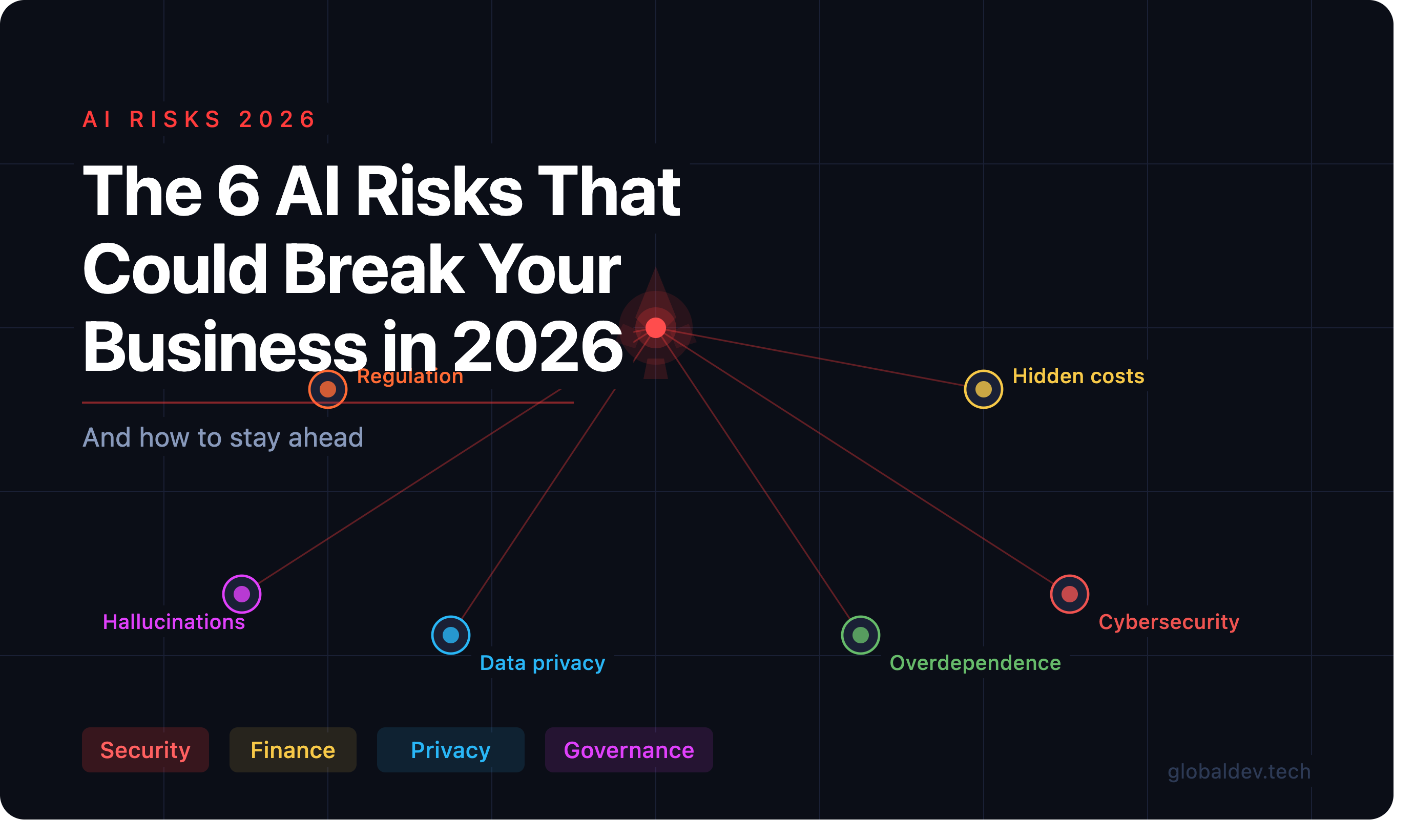
- Rising infrastructure costs: As AI usage grows, infrastructure expenses can increase rapidly.
- Data governance challenges: AI systems often depend on large volumes of data that require careful management.
- Security concerns: AI applications introduce new attack surfaces and cybersecurity considerations.
- Regulatory uncertainty: Governments worldwide continue to develop new frameworks governing AI usage.
- Reliability issues: Generative systems may occasionally produce inaccurate or misleading outputs.
Organizations that ignore these risks may discover that AI adoption becomes more expensive and complex than anticipated.
The goal is not to avoid AI. The goal is to implement it responsibly.
How Startups and Product Companies Can Stay Ahead
AI adoption in 2026 requires a balanced approach. Companies should focus on several priorities:
- Start with high-value use cases: Identify problems where AI can deliver measurable improvements.
- Build AI governance early: Establish policies for data usage, security, and model evaluation.
- Measure return on investment: Track business outcomes instead of adopting AI solely for marketing purposes.
- Maintain human oversight: AI should augment decision-making rather than replace critical thinking.
- Invest in adaptability: The AI ecosystem continues to evolve rapidly, making flexibility essential.
Organizations that combine innovation with disciplined execution are likely to benefit the most from the current wave of AI transformation.
Final Thoughts
Artificial intelligence is redefining how startups and product companies build, operate, and compete.
The opportunities are extraordinary. Startups can scale faster, product teams can innovate more efficiently, and businesses can deliver experiences that were previously impossible to create.
At the same time, AI introduces new operational, financial, and strategic risks that demand careful management.
In 2026, success will not belong solely to the companies adopting the most AI.
It will belong to the companies that understand where AI creates value, where risks emerge, and how to integrate intelligent systems into products and operations with clear business objectives.
For startups and product organizations alike, AI is no longer simply another technology trend.
It is becoming a fundamental business capability that will shape the next generation of digital innovation.




Image Source: freighteraEnergy concerns:The world's growing population also has an insatiable appetite for electricity.
Although the share of renewables globally is increasing, the momentum behind fossil fuels means that they are not likely to disappear from energy mixes immediately.AI is used for energy:The Department of Energy's SLAC National Accelerator Laboratory operated by Stanford University will Use Machine Learning and artificial intelligence to identify vulnerabilities in the network, harden them before failures occur, and restore power more quickly when failures occur.
It uses stored energy to propel and recharge the batteries necessary for its sensors.Wave Glider applications include collecting high-resolution carbon dioxide samples from difficult locations to get a complete picture of global climate change.AI robots help farmers survive droughts:Our climate is changing every day, it affects our food sources.
This is particularly true in the poorest countries and rural areas that cannot easily import food from other regions.Using AI sensors and monitors, the robots can track plant growth and learn which species survive - and thrive - under difficult conditions.
With the help of this data analysis, farmers can choose plants that have a higher chance of success, saving their income while feeding the people around them.AI will save lives:Take ongoing research on the Application of AI in medical sciences.
The first lab results are nothing but positive.

Machine Learning is a Form of AI that Enables a System to Learn from Data.
Leverage Big Data & Understand Subtle Changes in Behavior with Oodles AI Machine Learning.
Oodle AI is one of the top AI and machine learnig development company that covers multiple services for variors busiiness verticles like Insurance, Marketing, Healthcare, Banking, etc.Explore our more Artificial intelligence services