

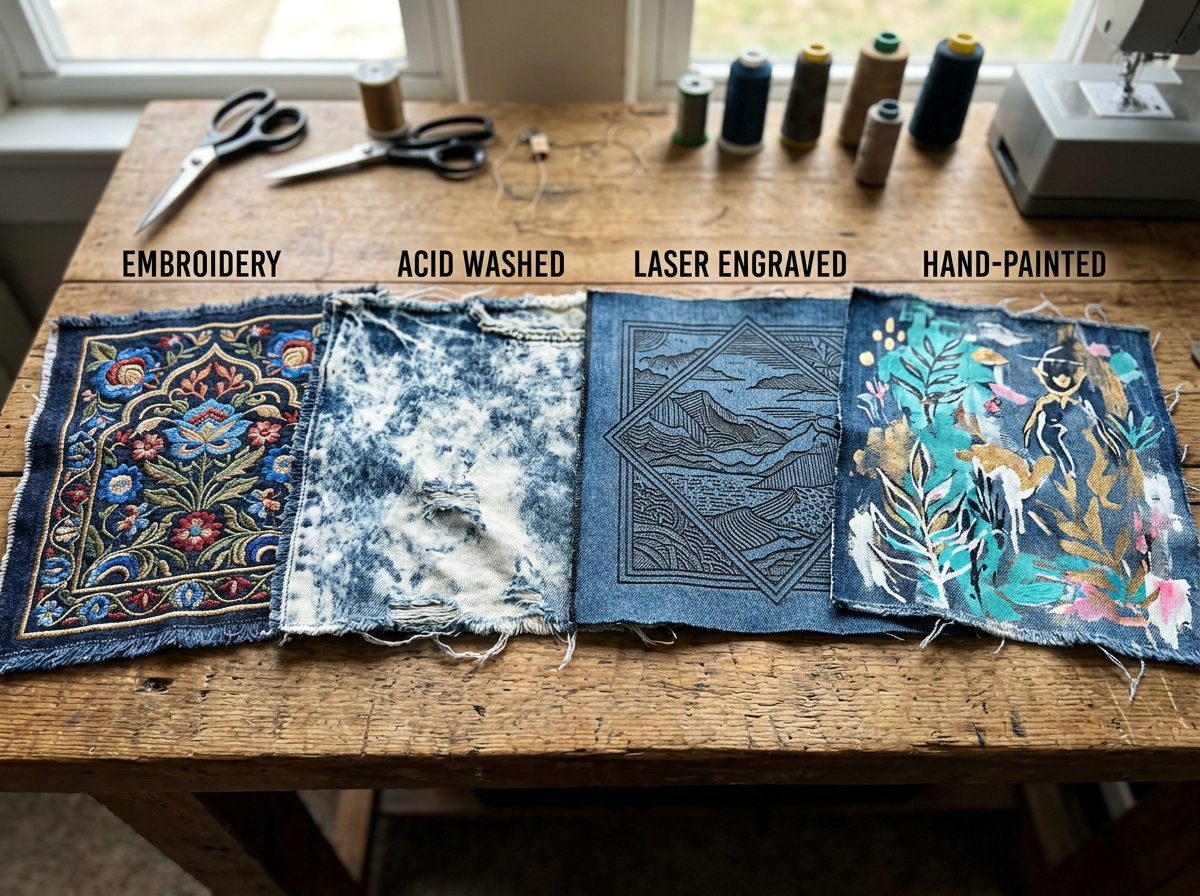
Quick Answer: Yes, all of it is possible with a 20-piece MOQ. Embroidered flowers head-to-toe, ozone soft acid wash, hand-painted designs, high-detail embroidery, and custom laser graphics on back pockets can all be sampled and bulk-produced under one roof, with samples ready in 7–15 days.
When sourcing exceptional denim for a U.S. street label, you need an acid wash jeans manufacturer that can produce complex washing techniques, embroidery, laser finishing, and hand-crafted details under one roof. This guide divides up precisely what you can do in each method, what to pose to your supplier, and how to weigh up your choices so that you commit to samples that transform.
Can You Make Jeans With Embroidered Flowers All Over the Legs?
Direct Answer: Yes. Full-leg embroidery coverage, including dense floral patterns from hip to hem, is achievable at MOQs as low as 20 pieces per style.
One of the most in-demand custom treatments in U.S. streetwear at the moment is all-over embroidery on denim legs. The important variables include the number of threads, density of stitches, and hoop size. An experienced embroidery team can perform:
●Light, editorial, and scattered florals: single blooms spaced on the panel of the legs.
●Dense all-over coverage: interlacing flowers and leaves that cover the whole leg surface.
●Tonal embroidery: thread color-matched to fabric to create a slight texture-on-texture effect.
●Multicolor statement pieces: color-contrasting threads on indigo, black, or ecru denim.
What to Send Your Manufacturer
To embroider the legs with floral, supply a plain drawing or reference picture with color indications. Check whether you would like the design to be wrapped around the leg or remain on the front/back panel only. Request a physical stitch-out sample prior to bulk approval - thread tension and scale do not read at all on a digital mockup; do not approve embroidery based on a digital mockup.
Comparison: Embroidery vs. Print for Floral Denim
Embroidery
Texture & dimension: Yes — raised, tactile
Wash durability: Excellent
Color vibrancy: High
MOQ feasibility at 20 pcs: Yes
Premium perceived value: Very high
Cost per piece: Higher
Digital Print
Texture & dimension: Flat
Wash durability: Good (varies by ink)
Color vibrancy: Very high
MOQ feasibility at 20 pcs: Yes
Premium perceived value: Moderate
Cost per piece: Lower
In the case of a high-end U.S. retail price ($120-$300 and above), embroidery can make the product worth the cost premium and make it truly hard to imitate on a fast-fashion scale.
Can You Do a Light Acid Wash: Softer, With Ozone?
Direct Answer: Yes. Ozone washing produces a softer, more even fade than traditional chlorine acid wash, with a cleaner environmental profile. It is the preferred method for achieving a subtle, worn-in look without harsh contrast.
As an experienced acid wash jeans manufacturer, we use both traditional acid washing and ozone washing to create vintage denim finishes for private label brands. The effect is a high-contrast, usually streaky, iconic 1980s look. Ozone washing is the appropriate process if you wish to have beauty without roughness.
Ozone Wash vs. Traditional Acid Wash
Ozone Wash
Contrast level: Low to medium — soft fade
Hand feel: Softer
Environmental impact: Low — no chemical discharge
Color consistency batch-to-batch: More consistent
Best for: Vintage-soft, editorial, premium
Traditional Acid Wash
Contrast level: Medium to high — stark contrast
Hand feel: Can feel stiff or rough
Environmental impact: Higher — chemical waste
Color consistency batch-to-batch: More variable
Best for: Bold retro, heavy streetwear
The mechanism of action of ozone is that it oxidizes the indigo dye molecules on the surface of the fabric, making them light but not completely losing them. The intensity is regulated by the exposure time and ozone concentration, and this allows you to dial in a desired shade before going to large-scale production. Wash test panels should be requested on your actual fabric before you are ready to commit to a complete sample run.
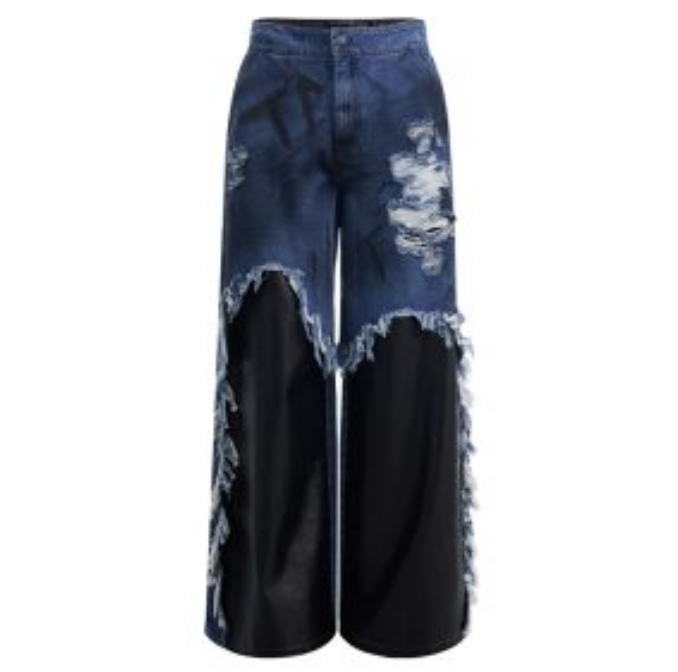
Can You Get Jeans With Painted Designs — Not Printed?
Direct Answer: Yes. Hand-painting on denim is a distinct craft technique that produces one-of-a-kind results no digital printer can replicate, each piece carries visible brushwork, layered pigment, and intentional variation.
This is among the most misunderstood facilities in custom denim. Numerous consumers think that painted is screen-printed or digitally printed with a bumpy texture. True hand finished denim clothing includes hand painting, manual distressing, artisan brushing, sanding, and other handcrafted techniques that make every garment unique.
What Hand-Painted Denim Can Achieve
●Graffiti and typography: lettering, tags, and abstract mark-making
●Portraiture and figurative art: faces, figures, character illustrations
●Landscape and abstract backgrounds: washes of color, gradient effects
●Mixed technique: paint over laser distressing, or paint combined with embroidery for maximum dimension
Painted vs. Printed: Key Differences
Hand-Painted
Is each piece identical?: No — intentional variation
Cracking/peeling risk: Low (if properly heat-set)
Artisan premium: Yes — sellable as a feature
Design complexity limit: Limited by the painter's skill
MOQ: As low as 1–20
DTG / Screen Print
Is each piece identical?: Yes
Cracking/peeling risk: Moderate (DTG on denim)
Artisan premium: No
Design complexity limit: Limited by screen count/file resolution
MOQ: Usually 20–50+
Hand-painted denim is a powerful product narrative for U.S. streetwear brands that are developing a limited-drop or artist-collaboration model. The inconsistency among pieces will be an advantage, rather than a flaw.
What is the Most Detailed Embroidery Possible at 20 Pieces MOQ?
Direct Answer: At a 20-piece MOQ, you can achieve fine-detail embroidery including micro lettering (down to approximately 4mm stitch height), photorealistic shading using gradient thread transitions, and complex multi-element compositions, provided your manufacturer runs professional 15-needle or higher commercial embroidery machines.
Embroidery detail is dependent on machine capabilities, digitizing quality, and stabilisation of fabric. In denim in particular, the rougher structure of the weave forms a subtext texture, which influences fine detail - a proficient digitizer counters this by modifying stitch angles and underlay.
Detailed Benchmarks to Discuss With Your Supplier
●Micro text: brand names, URLs, or slogans less than 5mm high are possible, but they need proof samples.
●Photorealistic shading: through a mixture of thread color and change of direction, not pixel resolution.
●Fine line work: single-row running stitch outlines; satin columns fill areas.
●Metallic and specialty threads: gold, silver, and holographic threads in small sizes should have tension adjustments.
Request your manufacturer to present you with stitch-out samples at the precise scale you desire, on the very same weight of fabric you will be utilizing. An example on a lighter canvas will not forecast behavior on 12 oz selvedge denim.
Do You Offer Laser Printing With Custom Graphics on the Back Pocket?
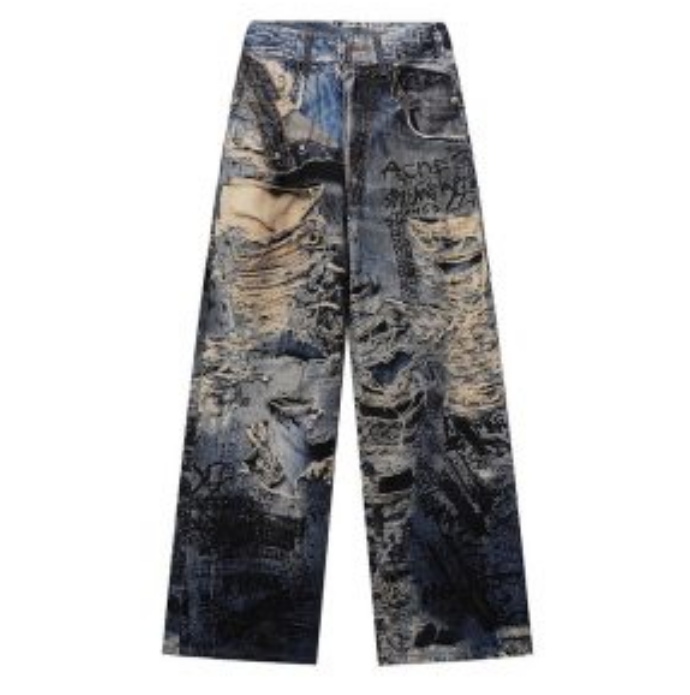
Direct Answer: Yes. As a laser print denim clothing OEM, we produce custom laser graphics, logo engraving, faded artwork, and personalized denim using advanced CO₂ laser technology.
In the last five years, laser technology on denim has advanced. CO₂ or fiber laser systems can now be repeated several times with accuracy, which was previously impossible without the use of a chemical spot bleach. In the case of back pocket graphics in particular, this opens up:
●Logo and branding marks: crisp enough to reproduce on retail hang-tags.
●Photographic portrait or landscape: depth made by different intensities of the laser halftone-style.
●Geometric and typographic designs: crisp edges not blurred by washes or smoothing.
●Laser + embroidery: Laser makes a field of bleached background; embroidery is overlaid to create a three-dimensional effect.
Laser vs. Screen Print for Back Pocket Graphics
Laser vs. Screen Print for Back Pocket Graphics
Laser Engraving
Chemical use: None
Wash durability: Permanent — the dye is removed
Fine detail: Excellent
Per-piece customization: Possible (serial numbers, names)
MOQ: Low (20 pcs feasible)
Screen Print
Chemical use: Ink + solvent cleanup
Wash durability: Good, but can crack
Fine detail: Good (limited by mesh count)
Per-piece customization: Requires a new screen per design
MOQ: Usually, a higher setup cost
How to Evaluate a Complex Denim Sample Manufacturer
The supplier evaluation checklist is more important when sourcing U.S. streetwear that has multiple requirements as far as technique is concerned than when sourcing simple washes.
Key Questions to Ask Any Supplier
1.Do you handle embroidery, washing, laser, and hand-painting in-house or through subcontractors?
2.What is your stitch-out sample turnaround for embroidery at 20 pieces?
3.Can I see wash test results showing color consistency across a 20-piece run?
4.What certifications cover your dyeing and washing processes? (Look for REACH, BSCI, ISO)
5.Do you have a design team that can digitize from a reference image, or do I need to provide production-ready files?
The capability in all techniques in-house is the best indicator of quality control. Communication across the several departments in a single factory floor, when washing, embroidery, and laser are together, minimizes the possibility of technique interaction, such as making sure an embroidery hoop position does not disrupt a pre-programmed laser field on the same garment.
Technique Combination Guide for Streetwear Denim
Laser print denim clothing OEM and hand finished denim clothing services can be combined with embroidery and specialty washing to create unique premium denim collections. Not every technique works well together. Here is a practical reference for U.S. brand designers planning multi-finish pieces:
Technique Combination Breakdown
Embroidery + Ozone Wash
Feasibility: Excellent
Notes: Wash first, embroider after
Laser + Embroidery
Feasibility: Excellent
Notes: Laser first; embroider on top
Hand Paint + Embroidery
Feasibility: Excellent
Notes: Paint first, embroider highlights
Hand Paint + Acid Wash
Feasibility: Sequence-dependent
Notes: Wash first; paint on the finished garment
Laser + Hand Paint
Feasibility: Excellent
Notes: Laser creates a field; paint adds color
All-over embroidery + heavy wash
Feasibility: Risk of puckering
Notes: Use lighter wash; test first
Always experiment with combinations of techniques unless one is willing to commit to them. A 3-5 piece proto run testing the sequence will avoid the rework of a 200-piece order at a cost.
FAQs: Complex Denim Customization for U.S. Brands
Q: What file format do I need to provide for embroidery digitizing?
A: Most manufacturers work with a high-resolution JPG, PNG, or vector (AI/EPS) file. The digitizing department of your supplier creates it as a machine file (DST, PES, etc.). Always demand digital evidence and a physical stitch-out prior to bulk.
Q: How many colors can I use in a single embroidery design?
A: The majority of commercial embroidery machines support 15 needle positions and thus can support up to 15 different thread colors per run without re-threading. Colorful designs will need thread changes, which will be time-consuming and costly.
Q: Is ozone washing available as a standalone wash, or only combined with other finishes?
A: Ozone can be applied either singly or overlaid, such as ozone pre-wash and localized hand sanding or whiskering, to give a more dimensional antique look.
Q: Can I get individual pieces hand-painted differently within the same order?
A: Yes. Each piece is capable of being painted with any unique design at a 20-piece MOQ, resulting in an ideal technique for artist drops, limited editions, or sample variety packs to present to a buyer.
Q: What is the typical sample lead time for a denim piece combining laser and embroidery?
A: In the case of a combined technique sample, allow 10-15 business days on confirmed design approval, based on complexity. Simple single-technique samples can be received in 7 days.
Q: Do certifications like REACH and BSCI matter for U.S. market imports?
A: Yes. REACH certification provides chemical compliance pertinent to the EU and more and more U.S. retailer requirements. Social compliance auditing is covered under BSCI. The U.S. buyers who sell to large retail stores (department stores, specialty chains) must ensure that the suppliers are certified in advance.
Q: What is the price difference between embroidery and hand-painting for 20 pieces?
A: Hand-painting is normally charged per work, depending on the complexity of the design and the amount of area covered. All-over dense painting attracts a premium per piece as compared to embroidery at the same coverage. To be accurate, give a design brief including coverage percentage and number of colors.
Q: Can laser graphics on back pockets include gradient shading?
A: Yes. The gradients of modern laser systems may be of a halftone type, with the laser intensity changing depending on the engraving path, producing a smooth transition between dark indigo and almost white.
Why Technique Expertise and Vertical Integration Matter
In the case of U.S. brands operating at 20-200 piece volume, there is a wide margin between a technically competent manufacturer and a typical wash house. Premium hand finished denim clothing requires skilled artisans, precise quality control, and carefully managed production processes to ensure consistent results. Denim in a complex streetwear needs:
●A design team that understands how techniques interact on the same garment.
●Machinery maintained to precision standards (laser calibration, embroidery tension).
●Quality control at each stage, not just final inspection.
●Transparent sampling processes that let you approve at each step.
The standard to be compared to is manufacturers that have more than ten years of dedicated denim production, design capabilities, and verifiable certifications (ISO, BSCI, REACH, CE, ROHS). The attendance at international fashion shows and trade fairs is also an indication of seriousness, it shows that the manufacturer is not merely taking orders for commodities, but is working with the global trend cycles.
Ready to Sample Complex Denim Techniques?
If you are building a U.S. streetwear or premium denim line and need embroidery, ozone washing, hand-painting, or laser graphics executed at low MOQ with fast sample turnaround, Apparel's Custom is an experienced acid wash jeans manufacturer specializing in premium custom denim with 14+ years in trendy denim, MOQ from 20 pieces, samples in 7–15 days, with in-house capabilities across washing, embroidery, laser, and printing.
If you're looking for an embroidered streetwear jeans supplier, contact our team for low-MOQ sampling and bulk production.