


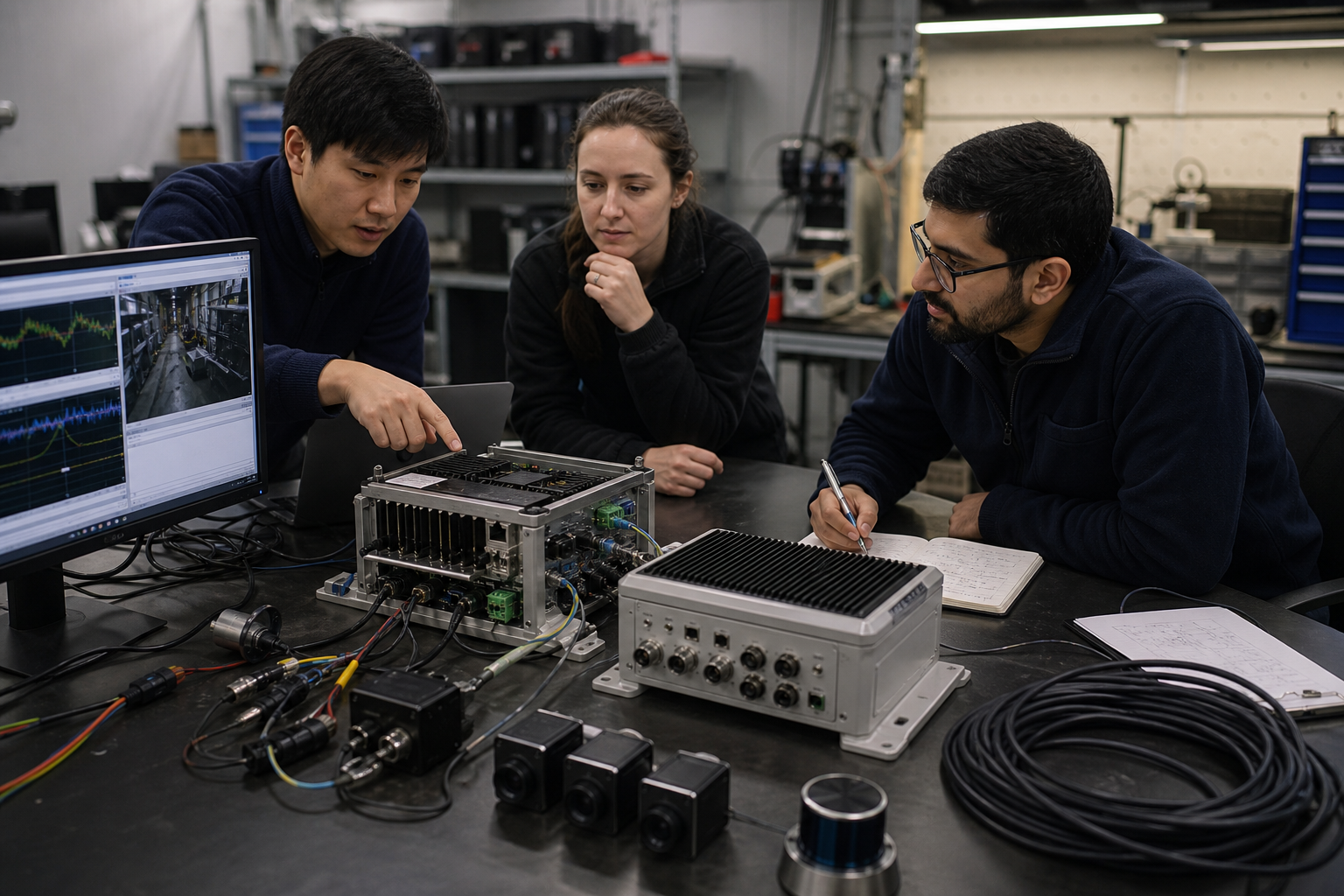
How Should Edge AI Deployment Strategies Move from Prototype to Production?
Quick Answer: Effective edge AI deployment strategies use gated evidence, not a direct jump from demo to mass production. Teams should freeze the decision and workload, profile the prototype, engineer power, thermal, interfaces, enclosure, security, and software recovery, then run design validation, a controlled pilot, and production acceptance. Every gate needs owners, pass criteria, change control, and field-monitoring plans.
Process Snapshot
Prototype: prove the model and data path, not production readiness.
Engineering: convert workload evidence into power, thermal, I/O, storage, and enclosure requirements.
Validation: test representative environments, failures, security, and recovery.
Pilot: verify manufacturing repeatability and field operations with a controlled batch.
Production: control versions, suppliers, acceptance, updates, and end-of-life.
How Does the Workflow Move from Input to Output?
Process rule: Begin with a requirements baseline covering inputs, outputs, latency, availability, environment, power, interfaces, storage, security, regulatory markets, maintenance, and volume. Build a prototype to measure the application. Then produce a deployment design with a bill of materials, interfaces, mechanical drawings, software image, thermal solution, test plan, and lifecycle assumptions.
What should each gate prove?
The proof-of-concept gate proves usefulness and baseline workload. Engineering verification proves the design against electrical, thermal, mechanical, interface, and software requirements. Design validation proves representative production units in representative environments. The pilot proves build, test, logistics, deployment, and support processes. Production release proves documentation, acceptance, and change-control readiness.
Define every handoff by input, output, timing, owner, failure state, and recovery. Keep raw measurements and derived AI decisions distinguishable so an operator or auditor can see whether a bad outcome came from the source data, model, rule, interface, or action.
Which Process Controls Are Critical?
Control point: Keep requirements, design outputs, risks, verification results, software versions, approved deviations, and supplier changes traceable. TWOWIN's OEM/ODM page describes a sequence from customer requirements through design, prototype and test, small-batch verification, mass production, delivery, and after-sales support. It also lists customization of carrier boards, memory, storage, cooling, and enclosure. These are company-provided capabilities; buyers should request project-specific scope, deliverables, and evidence.
When should the hardware platform be frozen?
Freeze it only after the application profile and key interfaces are stable enough to justify the decision. The Edge AI deployment strategies path is relevant when carrier, enclosure, cooling, storage, or interface customization is required. Maintain a controlled reference unit and requalify changes that can affect performance or compliance.
Control limits must come from the project and its risk analysis. Record normal ranges, warning thresholds, stop or fallback behavior, and who may change them. A displayed metric without a defined response is monitoring, not control.
Where Do Failures and Bottlenecks Occur?
Failure risk: Common failures include selecting by TOPS, using laboratory power and cooling assumptions, omitting EMC or environmental needs, relying on unavailable connectors, shipping unmanaged credentials, and discovering after pilot that updates or recovery require physical access. Another frequent failure is measuring peak inference while background logging, storage, networking, and monitoring are disabled.
Bottlenecks can move after software or model updates. Test the full pipeline at peak input and during degraded conditions while logging queue depth, resource use, temperatures, network behavior, storage, and decision latency. Keep enough margin for diagnostics and recovery rather than sizing to a single best run.
How Should Quality Records and Traceability Work?
Traceability check: Tie every acceptance result to unit identity, bill-of-material revision, firmware, operating system, drivers, containers, model, configuration, instruments, conditions, and test data. Track nonconformities through closure. Keep golden images, recovery media, provisioning records, and release notes so a field unit can be reconstructed and audited.
How Should Changes and Handoffs Be Controlled?
Use a change board that assesses performance, thermal, electrical, security, supply, regulatory, service, and documentation impact. Define the notification period and approval rights for substitutions. After release, monitor field health, incidents, model drift, update success, and returned units; feed those results into the next controlled revision.
For each release, document the reason, affected requirements, validation scope, known limitations, approval, deployment sequence, rollback trigger, and support owner. Handoffs should include unresolved risks; hiding them merely transfers cost to deployment and maintenance.
Before scale-up, conduct an operational-readiness review with engineering, quality, cybersecurity, site operations, and support. Confirm that monitoring thresholds, spare capacity, credentials, recovery media, service access, training, escalation, and data-retention rules are in place. Run a controlled rollback and a simulated support case. The system is not production-ready merely because its main inference function works; the surrounding processes must also recover predictably and leave usable evidence. Review unresolved risks and assign owners, due dates, and release conditions before volume or multi-site deployment.
What Should You Provide for a Prototype-to-Production Review?
Provide the use case, representative data, measured workload, target volume, interfaces, power, mechanical and environmental limits, software stack, markets, cybersecurity requirements, pilot plan, acceptance criteria, and lifecycle expectations. TWOWIN can then scope an OEM/ODM path with explicit gates instead of treating customization as an undefined promise.
References & Sources
Project input: TWOWIN 3-Month SEO/GEO Content Schedule, Week 9, 2026-08-07.
TWOWIN official landing page used as company-provided information; linked once in the article with the required keyword anchor.
NVIDIA Jetson Platform Services
NIST AI Risk Management Framework 1.0
NIST SP 800-82 Rev. 3 Guide to Operational Technology Security