


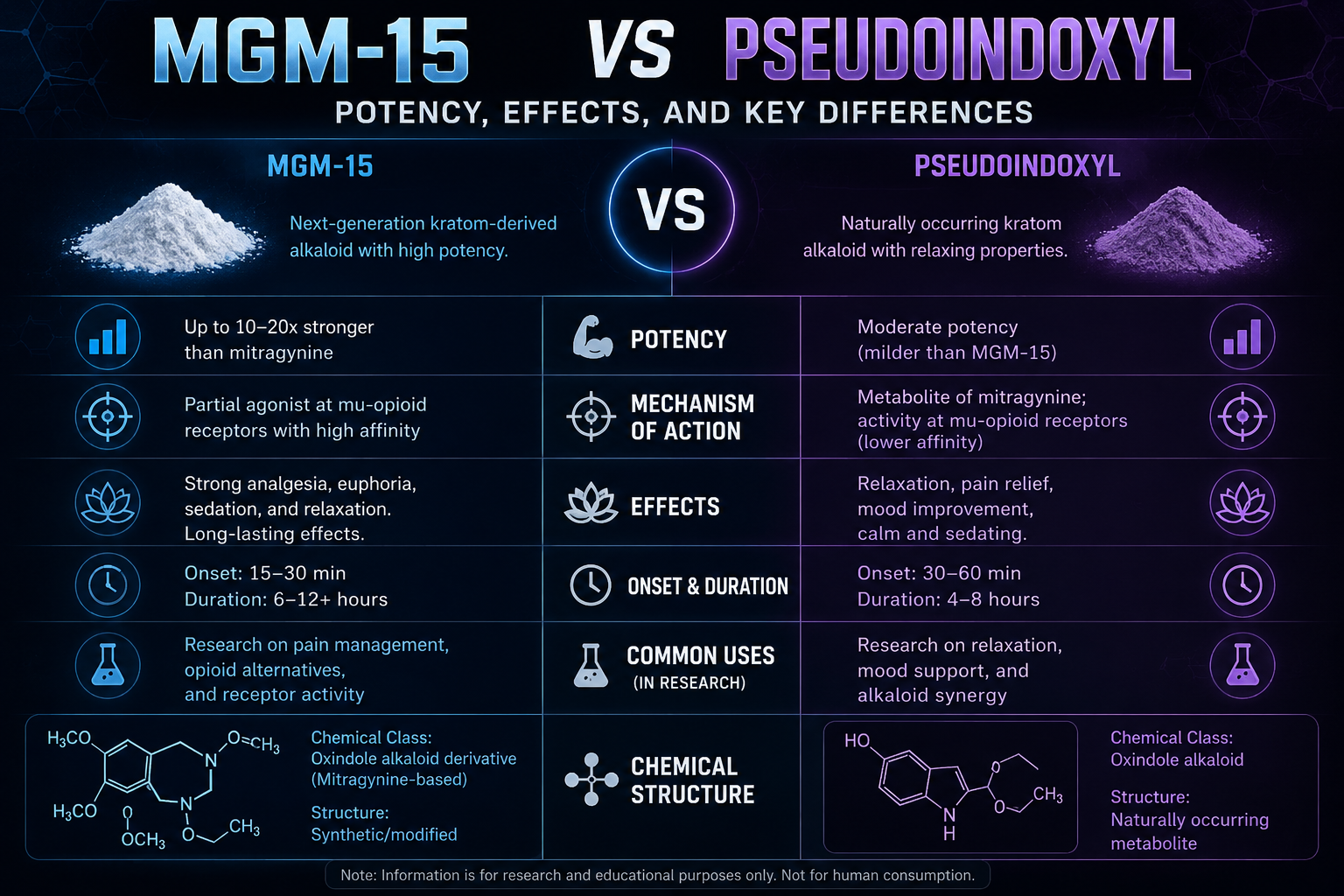
high level introduction: why MGM-15 and pseudoindoxyl are being talked about in the same breath
MGM-15 and pseudoindoxyl are names that increasingly appear in online discussions about emerging psychoactive substances, especially in spaces where people compare strength, unusual subjective effects, and the gap between what is claimed and what is actually known. They are often spoken about as if they sit on the same shelf: “powerful”, “different”, and “not quite like the standard options”. That overlap in reputation is exactly why a careful, evidence-led overview matters.
This article is written with a safety-minded aim: to explain, at a high level, what each name usually refers to, why comparisons between them have become common, and where the biggest uncertainties sit. The intention is not to provide instructions for use, purchasing, or experimentation. Instead, it focuses on how to think about the available information, what risks are routinely underestimated, and what practical harm-reduction principles apply when the evidence base is thin and the reports are mixed.
One reason the MGM-15 versus pseudoindoxyl debate is so charged is that both are commonly framed around “potency”. Potency, however, is only one part of risk. A substance can be potent but predictable, or less potent but highly variable between batches, slow to take effect, or prone to dangerous interactions. Another reason is that much of what people “know” about both substances comes from emerging reports that are not independently verified. That does not automatically make those reports worthless, but it does mean you should treat confident claims as provisional.
Finally, it is important to set expectations. For well-studied medicines, we can lean on controlled trials, established dosing ranges, consistent manufacturing standards, and clear guidance on interactions and contraindications. For substances discussed as MGM-15 and pseudoindoxyl, the public evidence is often incomplete, scattered, and sometimes contradictory. The safest approach is to treat both as high-risk topics where certainty should be earned, not assumed.
MGM-15 vs pseudoindoxyl: what people are really comparing when they compare them
When people say “MGM-15 vs pseudoindoxyl”, they are rarely comparing two well-defined, regulated products. They are usually comparing a mixture of: a reported effect profile, rumours about receptor activity, anecdotes about duration and after-effects, and second-hand claims about purity. In other words, the comparison is often less like comparing two medicines and more like comparing two moving targets.
Even so, there are recurring themes that explain why the comparison persists. First, both names are commonly associated with opioid-like effects, meaning effects linked to the body’s opioid receptors. Discussions often focus on analgesia, sedation, mood changes, and the risk of respiratory depression. Second, both are sometimes described as having “unusual” qualities compared with conventional opioids or compared with plant-derived products, which encourages further speculation about their mechanism. Third, both names show up amid broader interest in novel compounds that are reported to be very strong at low amounts, which raises the stakes for accidental overdose and for unpredictable reactions.
What matters most in this comparison is not who “wins” on strength or subjective feel, but what the comparison can hide. Potency comparisons can distract from the realities that cause harm in the real world: unknown concentration, inconsistent manufacturing, contamination, delayed onset, polydrug use, and individual vulnerability such as low tolerance, lung disease, sleep apnoea, or the use of sedating medicines. Two substances can look similar in stories while carrying very different risk profiles in practice.
So, rather than treating the comparison as a consumer-style ranking, it is more useful to treat it as a prompt to ask better questions: What evidence exists beyond anecdotes? Is the substance identity reliably confirmed? How quickly do effects begin and how long do they last? Are there reports of people needing medical help, and if so, what patterns appear? Are there plausible interactions that could turn a “manageable” experience into an emergency?
MGM-15 overview: what the name typically refers to, and why clarity is difficult
MGM-15 is generally discussed as an emerging compound with opioid-like properties, but public, independently verifiable information about its exact identity can be limited. In practice, the name may be used consistently within a particular seller’s catalogue while still being unclear to outsiders, and it may be used inconsistently across different spaces. That uncertainty is not a minor detail: when identity is uncertain, every other claim becomes shakier, including potency, duration, and safety.
There are a few reasons this happens. Novel substances can be marketed under names that are not standard scientific names, or that are shorthand for internal product lines. People may also use the same label for different materials over time. Even when a seller or forum post describes MGM-15 as a specific chemical, the only way to be confident is through credible analytical testing of the actual material being discussed. Without that, it is possible for two people to talk about “MGM-15” while referring to different compounds or different purities, leading to contradictory experiences that are mistakenly blamed on individual differences rather than on product variation.
From a safety perspective, the most important takeaway is that MGM-15 should be treated as a high-uncertainty substance. High uncertainty raises risk because it undermines the ability to predict onset, intensity, duration, and interaction potential. It also makes it harder for healthcare professionals to respond if something goes wrong, because “MGM-15” may not map neatly to a known toxicology profile in routine clinical references.
If you encounter discussions that make precise claims about MGM-15—exact strength ratios compared with morphine-like medicines, specific receptor binding claims, or guaranteed duration windows—treat them as hypotheses rather than established facts unless they are backed by credible laboratory analysis and transparent methods. In the absence of that, the most responsible posture is caution: unknown identity plus opioid-like claims equals a meaningful risk of severe harm, including overdose.
pseudoindoxyl explained: why this term is associated with unusual potency claims
Pseudoindoxyl is typically discussed in relation to indole alkaloid chemistry and, in popular conversation, is often connected to kratom-related alkaloids and their derivatives. The reason pseudoindoxyl gets so much attention is that certain pseudoindoxyl forms have been reported to show strong opioid receptor activity, sometimes described as disproportionately strong relative to more familiar plant alkaloids. This “strong but different” reputation drives comparisons with other emerging opioids and opioid-like research compounds.
Where the conversation can go off track is the leap from “reported strong activity” to “understood and predictable”. A compound can be potent in laboratory assays yet behave unpredictably in humans due to metabolism, distribution in the body, active by-products, or variable absorption. Another common source of confusion is that “pseudoindoxyl” can be used loosely. People may mean a specific pseudoindoxyl compound, a mixture, or a product described that way for marketing effect. Without analytical confirmation, the label may tell you less than you think.
Even if the compound identity is correct, the public knowledge base may still be limited compared with licensed medicines. That matters because opioid-like potency is not merely a curiosity: it can narrow the margin between an intended effect and a medical emergency. Potency also increases the consequences of measurement error, inconsistent mixing, or accidental exposure by someone with no tolerance, including children.
In short, pseudoindoxyl is often discussed as an unusually powerful opioid-like compound, but the combination of potency claims and uncertain real-world consistency is exactly why it needs a careful, safety-first framing rather than hype.
Why the comparison matters: potency narratives can obscure the real drivers of harm
There are sensible reasons people want to compare MGM-15 and pseudoindoxyl. People naturally seek reference points, especially when they are trying to interpret new information. If one substance is said to be “stronger than” another, it feels like progress towards understanding. The problem is that this kind of comparison can become a substitute for proper risk assessment.
One key issue is that “stronger” is not a single dimension. Strength can mean lower amounts needed for an effect, but it can also be used to mean longer-lasting effects, heavier sedation, or greater euphoria. These are not interchangeable, and they have different safety implications. For example, a long duration can be dangerous if it outlasts someone’s ability to stay awake and monitor their breathing, especially if they take additional sedatives to “smooth” the experience. Conversely, a short duration can prompt repeated redosing, which increases overdose risk if onset is delayed or if effects stack unexpectedly.
Another issue is that online comparisons often ignore context: tolerance, recent use of opioids or alcohol, body size, underlying health conditions, and the use of prescribed medicines such as benzodiazepines or sleep aids. A person with low tolerance can be overwhelmed by what a tolerant user describes as “manageable”. In that sense, potency comparisons can be dangerously misleading because they can make severe risk sound like a simple scaling problem.
Finally, comparisons matter because they influence behaviour. When a substance earns a reputation for being “clean”, “smooth”, or “safer than fentanyl-like compounds”, some people may drop their guard. A safety-minded perspective assumes the opposite: when evidence is thin and the product is unregulated, you should increase precautions, not reduce them.
What we can and cannot infer from emerging reports: separating patterns from noise
Much of the public conversation about MGM-15 and pseudoindoxyl relies on self-reports. Self-reports can highlight early warning signs—unexpected duration, odd side effects, difficult comedowns, or clusters of adverse reactions. They can also mislead, especially when people do not know what they actually took, took multiple substances, or are influenced by expectation.
There are a few practical ways to read emerging reports more safely. First, look for consistency across independent sources, especially when the reports include unflattering details rather than only praise. Second, pay attention to time course descriptions: how quickly effects begin, when peak effects occur, and how long the after-effects last. Third, treat claims about identity and purity as unproven unless there is credible analytical testing shared with enough detail to judge its reliability.
It is also important to recognise the role of negative selection. People are more likely to post when something is remarkable—either very good or very bad. Ordinary experiences are underreported. That skews perception and can create an impression of extremes. For safety decisions, you should assume that the unseen middle includes variability, and that variability itself is a risk factor.
Opioid-like risks that apply regardless of the label: respiratory depression and delayed emergencies
If MGM-15 and pseudoindoxyl are being discussed as opioid-like, then a core set of risks should be front of mind. The most serious is respiratory depression: breathing becomes dangerously slow or shallow. This can escalate into loss of consciousness and death, especially when combined with other depressants such as alcohol, benzodiazepines, certain sleep medicines, or sedating antihistamines.
A particular danger with novel or unfamiliar opioid-like compounds is delayed recognition. People may interpret early sedation as “relaxation” and fail to notice a slide into dangerous suppression of breathing. Friends may assume the person is “sleeping it off”. In reality, opioid overdose can look like deep sleep with snoring or gurgling, bluish lips, and failure to respond. Time matters: the earlier emergency services are contacted, the better the chance of recovery.
Another recurring hazard is delayed onset. If effects take longer than expected, some people redose, then experience stacked effects as both doses take hold. Even experienced users can fall into this pattern when the substance is inconsistent or the route of exposure changes absorption speed.
This is why safety guidance often emphasises planning for emergencies rather than relying on confidence. If people choose to take risks, the safer direction is to avoid doing so alone, avoid mixing depressants, and have a plan for emergency help. Where opioid reversal medicines are available, access and training can save lives. None of this requires knowing which substance is “stronger”; it requires recognising that opioid-like uncertainty is inherently high risk.
Mechanism and “unusual effects”: why novelty can be more dangerous than it sounds
Part of the fascination with pseudoindoxyl and names like MGM-15 is the promise of unusual effects: a different balance of pain relief, mood effects, and side effects, sometimes framed as “better than traditional opioids”. Even if such differences exist, novelty can cut both ways. A different receptor profile might reduce one side effect but increase another, or introduce risks that are not obvious from the usual opioid playbook.
For example, changes in perceived stimulation versus sedation can affect judgement. If a substance feels less sedating early on, people may assume they are safer than they are and take more or combine it with alcohol. If a substance has a longer tail of effects, people may misjudge their ability to drive or work safely the next day. If nausea is reduced, a person might lose a natural early-warning sign that something is too strong.
There is also the issue of individual variability. Novel compounds may interact differently with enzymes that process drugs in the liver. That means two people taking what they believe is the same amount can experience very different intensity and duration. Without robust human evidence, it is hard to know how wide that variability is, or who is most at risk.
Quality, identity, and contamination: why “what is it?” is the first safety question
In unregulated markets, the most important safety question is often not “how strong is it?” but “what is it actually?” A label such as MGM-15 or pseudoindoxyl does not guarantee identity. Products can be mislabelled intentionally for marketing, mislabelled accidentally through supply chain confusion, or contaminated with other active compounds. Even small contamination can matter when potency is high.
Another complication is inconsistency across batches. A person might have one experience that feels predictable, then a later purchase under the same name behaves differently. People often attribute this to tolerance, setting, or mood. Those factors do matter, but batch variation is a straightforward explanation that is too often ignored because it is hard to prove without testing.
From an evidence-led perspective, credible chemical analysis is the closest thing to a reality check. Where testing services exist, using them can reduce uncertainty. Even then, testing has limits: some tests only detect certain families of compounds, and results can be misread. But a testing mindset—seeking independent confirmation rather than relying on branding—is a major step towards harm reduction.
Legal and professional consequences: risk extends beyond health effects
Discussions about MGM-15 and pseudoindoxyl often focus narrowly on subjective effects, but real-world consequences can extend further. Novel psychoactive substances may fall under broad legal controls, analogue laws, or medicines regulation. The legal status can change quickly, and enforcement can be inconsistent. That uncertainty can create risks relating to employment, travel, housing, and contact with the criminal justice system.
There are also professional consequences in healthcare settings. If someone experiences an adverse reaction, clinicians may have limited information to guide care. Standard drug screens may not identify the compound. This can delay targeted treatment and complicate monitoring decisions. In emergencies, it is still safer to be as honest as possible with medical staff, because the priority is preserving life and preventing lasting injury.
How to read “potency” claims responsibly: the questions that matter more than the number
Potency claims are attractive because they look precise. “X times stronger than Y” sounds like a hard fact. In reality, even for licensed medicines, potency depends on the outcome being measured: pain relief, respiratory effects, sedation, or subjective euphoria. A compound could be “strong” for one outcome and less impressive for another.
In online spaces, potency claims may be based on guesswork, extrapolation from small snippets of chemistry discussion, or comparisons between people with different tolerance and different products. This is not a moral judgement; it is simply the reality of informal information systems. The practical response is to treat such numbers as signals of possible high risk rather than as reliable guidance.
The questions that matter more than the number include: Is onset fast or slow? Is the duration short or long? Are there reports of blackouts, vomiting, confusion, or breathing problems? Are people combining it with alcohol or sedatives? Are there consistent descriptions of withdrawal or difficult after-effects? These questions map more directly to harm than a single potency multiplier.
Safer decision-making principles for high-uncertainty substances
When evidence is incomplete, the safest approach is to reduce uncertainty where you can and reduce exposure where you cannot. That may sound abstract, but it becomes practical when you consider common failure points: mixing substances, using alone, and misjudging timing. Planning for emergencies is part of safer decision-making, not an admission of recklessness.
One of the most important principles is avoiding polydrug combinations, particularly combinations of depressants. Alcohol plus an opioid-like compound is a well-known high-risk pairing. Benzodiazepines, some sleep medicines, gabapentinoids, and sedating antihistamines can also increase overdose risk. Another principle is to treat any new batch as new and potentially different, even if the name is the same.
It also helps to keep the focus on wellbeing rather than novelty. If someone is seeking pain relief, anxiety relief, or sleep, it is worth considering whether a clinician-guided pathway would reduce risk overall. If someone is seeking escape or experimentation, it is still possible to reduce harm by setting boundaries and being honest about mental health vulnerabilities. People who are depressed, grieving, or isolated may be at higher risk of taking more than intended or failing to seek help when something feels wrong.
Recognising overdose and getting help: what friends and bystanders should know
In opioid-like emergencies, speed saves lives. Signs can include inability to stay awake, very slow or irregular breathing, choking or gurgling sounds, pale or clammy skin, and lips or fingertips turning bluish. People may not respond to voice or to a firm rub on the breastbone. If you are with someone and you suspect overdose, contacting emergency services promptly is the safest choice.
If an opioid reversal medicine is available in your area, learning how to use it and keeping it accessible can make the difference between life and death. Even when reversal works, medical assessment is still important because effects can return as the reversal wears off, especially with long-lasting substances. This is one reason emerging compounds are especially dangerous: you cannot confidently predict the timeline.
If you are ever the person who feels unwell after taking an unknown or emerging substance, it is safer to seek help early. Fear of judgement is common, but healthcare workers deal with overdose and adverse reactions routinely, and the priority is keeping you alive and preventing brain injury.
Where to land: an evidence-led, safety-minded way to think about MGM-15 and pseudoindoxyl
MGM-15 and pseudoindoxyl are often compared because both are linked, in public discussion, to opioid-like potency and unusual effects, with a steady stream of emerging reports. That combination—high potency claims plus limited reliable evidence—should automatically raise the risk level in your mind. The comparison matters not because it helps crown a “winner”, but because it highlights how quickly narratives can form around substances that are not well characterised in the real world.
If you take one practical lesson from the comparison, let it be this: when the label is uncertain and the evidence is thin, the safest assumption is that risks are higher than advertised and predictability is lower than hoped. Treat identity verification as central, treat polydrug use as a major hazard, and treat emergency planning as essential rather than optional.
Finally, keep the conversation grounded. It is possible to discuss MGM-15 vs pseudoindoxyl in a way that respects curiosity while prioritising health and life. That means resisting hype, valuing credible evidence over confidence, and being willing to pause when the most honest answer is: we do not yet know enough, so we should act with extra caution.

MGM Signature - Affordable Luxury on the Las Vegas Strip.
Spacious hotel/condo (Sleeps 6) .
MGM Signature also has a balcony with a great view.
Full kitchen equipped with everything needed for a wonderful Las Vegas vacation.Visit Here:- https://www.bilmar.org/